

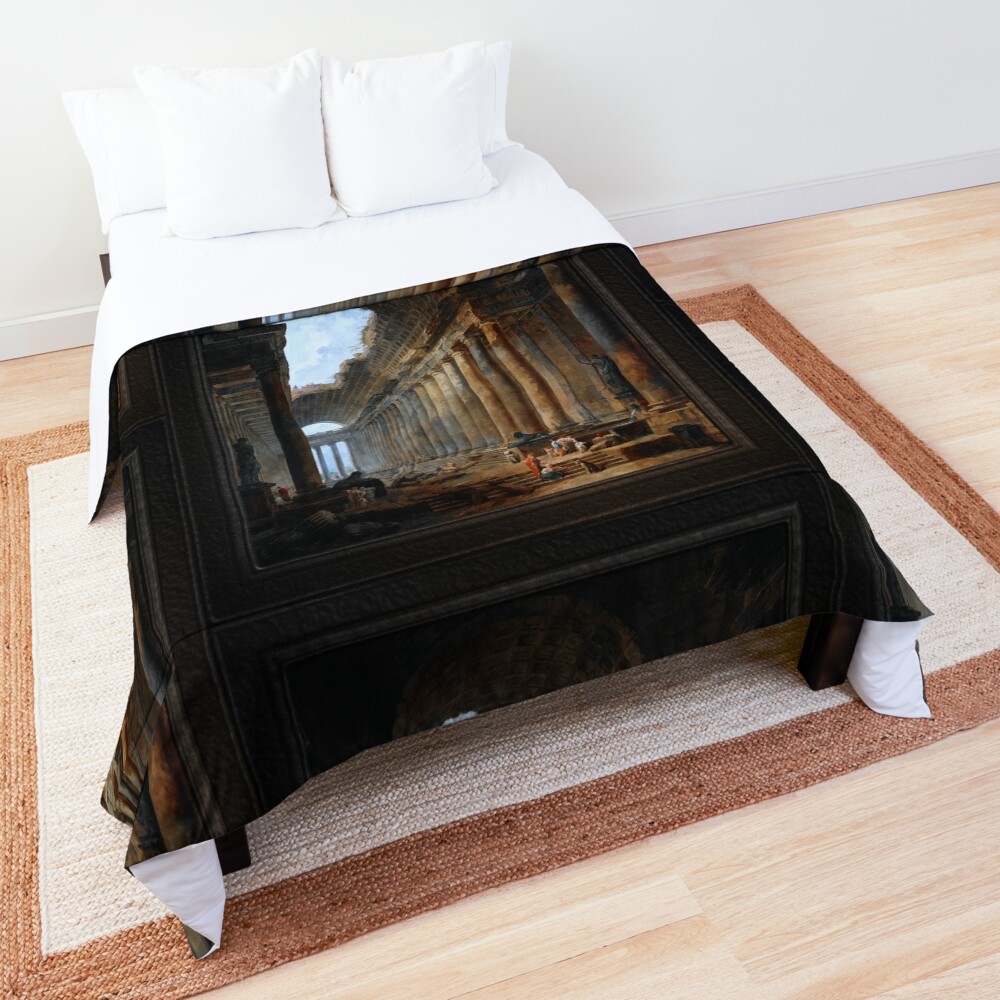
The Old Temple c1788
Hubert Robert'na peantadh The Old Temple, air a chruthachadh timcheall 1788, captures a striking representation of ancient ruins, masterfully blending history with the passage of time. Rugadh e a-steach 1733 agus a 'dol seachad air a-steach 1808, Robert was a prominent French painter of the Rococo and early Neoclassical periods, known for his romanticized depictions of ruins and imaginary landscapes.
Ann an The Old Temple, the artist explores the theme of decay and the eternal passage of time, a subject that was central to the intellectual and artistic movements of the late 18th century. The work reflects the fascination of the era with classical antiquity and the sublime, which was often juxtaposed with the concept of destruction and the fragility of human creation.

Clàr-innse
Cuspair agus sgrìobhadh
The central focus of the painting is a vast ruin of an ancient temple, its once grandiose architecture now weathered and eroded by centuries of neglect. The temple’s towering columns rise majestically, despite their crumbling state. An ailtireachd, though in ruins, retains the classical order of the past, with tall, fluted Corinthian columns and an arching ceiling that hints at the grandeur of a lost civilization.
The viewer’s eye is drawn through the temple’s vast interior, where shafts of light pierce through the dilapidated roof, illuminating the remains of the stone floor. The scene is not devoid of life, ge-tà; human figures occupy the foreground, some appearing to study the ruins, others engaging in idle conversation, perhaps contemplating the history of the structure they stand within.
The structure’s vastness is amplified by the carefully constructed perspective of the artist, who utilizes the length of the temple’s columns to guide the viewer’s gaze toward the light-filled arch at the far end of the composition. The architectural forms are exaggerated in their scale, evoking a sense of awe and reverence.
The deliberate use of light and shadow also adds to the dramatic mood of the painting, where the natural elements interact with the built environment to create a melancholic yet beautiful effect. The rubble scattered on the ground further emphasizes the ruinous state of the temple, with stone fragments and collapsed structures evoking the passage of time and the inevitable decay of all things.
An Cruth-tìre agus an Talamh
Beyond the temple’s grand interior, the landscape opens up into a wide vista. A faint blue sky, dotted with clouds, serves as a backdrop to the crumbled columns and statues. The contrast between the bright sky and the shadowed ruins highlights the passing of time, as nature continues its cycle, indifferent to the fall of civilizations. Some sparse vegetation, possibly moss or ivy, has begun to grow in the cracks of the stone, suggesting that nature is reclaiming its dominion over the human-made structure. The terrain is rocky and uneven, further suggesting the erosion caused by years of exposure to the elements.
The scene’s open expanse also gives a sense of isolation and abandonment. The figures are placed within the ruins, not as part of a vibrant society, but as passive observers of something long past its prime. Their small scale in relation to the monumental ruins evokes the transient nature of human life compared to the timelessness of the world itself. Tro seo, Robert poignantly suggests that while human creations may fall, the land and the forces of nature endure.
Stuthan agus dhòighean
Hubert Robert’s meticulous use of oil paints is evident in the fine details and textures within the scene. The artist’s masterful handling of light and shadow enhances the three-dimensionality of the columns and figures, creating depth and a sense of realism. The surface of the stone columns is textured, with visible cracks and worn surfaces that add to the sense of decay. Cluich an t-solais, particularly as it filters through the broken roof, is rendered with such skill that it appears almost ethereal, casting delicate shadows and highlighting the fine details of the architecture and rubble.
An obair bhruis, while intricate in the foreground, becomes looser and more fluid as it recedes into the background, particularly in the rendering of the sky. This technique allows the viewer to focus on the foreground while gently leading the eye toward the horizon. The subtle transitions between light and shadow, combined with the precise depiction of architectural elements, showcase Robert’s ability to balance both the human and natural aspects of the scene, blending them into a harmonious whole.
Stoidhle, Cuspair, agus Mood
A thaobh stoidhle, Robert’s The Old Temple reflects the late 18th-century interest in Romanticism and the Sublime, which often dealt with themes of decay, ruin, and the ephemeral nature of human achievement. This movement emphasized the power of nature and the insignificance of mankind in the face of its vastness. The juxtaposition of human figures within the monumental ruins serves as a reminder of this contrast. While the figures seem to occupy the space, they are overwhelmed by the sheer size and decay of the temple, suggesting that even the greatest human endeavors are transient in the grand scope of history.
The mood of the painting is one of reflection and melancholy. The ruinous state of the temple and the solitary, almost contemplative poses of the figures invoke a sense of nostalgia for a bygone era. Aig an aon àm, there is a beauty in the decay, as the natural world begins to reclaim the space, illustrating the cyclical nature of life and death. The peacefulness of the scene, despite the temple’s destruction, suggests a sense of acceptance, as though the passage of time is a natural and inevitable process.
The Old Temple is a retouched digital art old masters reproduction of a public domain image that you can by as a clò-bhualadh canabhas rollaichte.
Neach-ealain Bio
Fiosrachadh gu h-ìosal bho Wikipedia.org
Rugadh Hubert Robert ann am Paris ann an 1733. Athair, Nicolas robert, bha e ann an seirbheis François-Joseph de Choiseul, marquis de Stainville prìomh thagraiche à Lorraine. Chrìochnaich Raibeart òg a chuid ionnsachaidh leis na h-Ìosaichean aig an Collège de Navarre ann an 1751 agus a-steach do chlàr-ithe an snaigheadair Michel-Ange Slodtz a theagaisg dealbhadh agus sealladh dha ach a bhrosnaich e gu bhith a ’tionndadh gu peantadh. Ann an 1754 dh'fhalbh e dhan Ròimh ann an trèana Étienne-François de Choiseul, mac fastaiche athar, a chaidh ainmeachadh mar thosgaire na Frainge agus a bhiodh na Rùnaire Stàite airson Cùisean Cèin gu Louis XV ann an 1758.
Chuir e seachad aon bliadhna deug anns an Ròimh, ùine iongantach; às deidh do dhachaigh oifigeil an neach-ealain òg aig Acadamaidh na Frainge san Ròimh ruith a-mach, thug e taic dha fhèin le obraichean a rinn e airson tadhal air connoisseurs mar an abbé de Saint-Non, a thug Raibeart gu Napoli sa Ghiblean 1760 gus tadhal air tobhtaichean Pompeii. Am marcas de Marigny, bha stiùiriche nam Bâtiments du Roi a ’cumail suas ris an leasachadh aige ann an litrichean le Natoire, stiùiriche Acadamaidh na Frainge, a chuir ìmpidh air na peinnseanairean sgeidse a-muigh, bho nàdar: Cha robh feum aig Raibeart air ìmpidh sam bith; tha dealbhan bho na leabhraichean sgeidse aige a ’clàradh a shiubhal: Villa bliadhnaEste, Caprarola.
Bha an eadar-dhealachadh eadar tobhta na seann Ròimhe agus beatha na h-ùine aige a ’togail ùidh mhòr. Bha e ag obair airson ùine ann an stiùidio Pannini, chithear a bhuaidh ann an Sealladh Ìomhaigh Gailearaidh Ruined Louvre (dealbh). Chuir Raibeart seachad a chuid ùine ann an companaidh luchd-ealain òga ann an cearcall Piranesi, aig an robh capricci de thobhtaichean romansach a thug buaidh cho mòr air gun d ’fhuair e am far-ainm Robert des ruines.[2] Thug na clàran de dhealbhan agus dhealbhan a chruinnich e san Ròimh motifan dha a dh ’obraich e a-steach do dhealbhan rè a bheatha.