

Cruth-tìre le staidhre agus obelisg
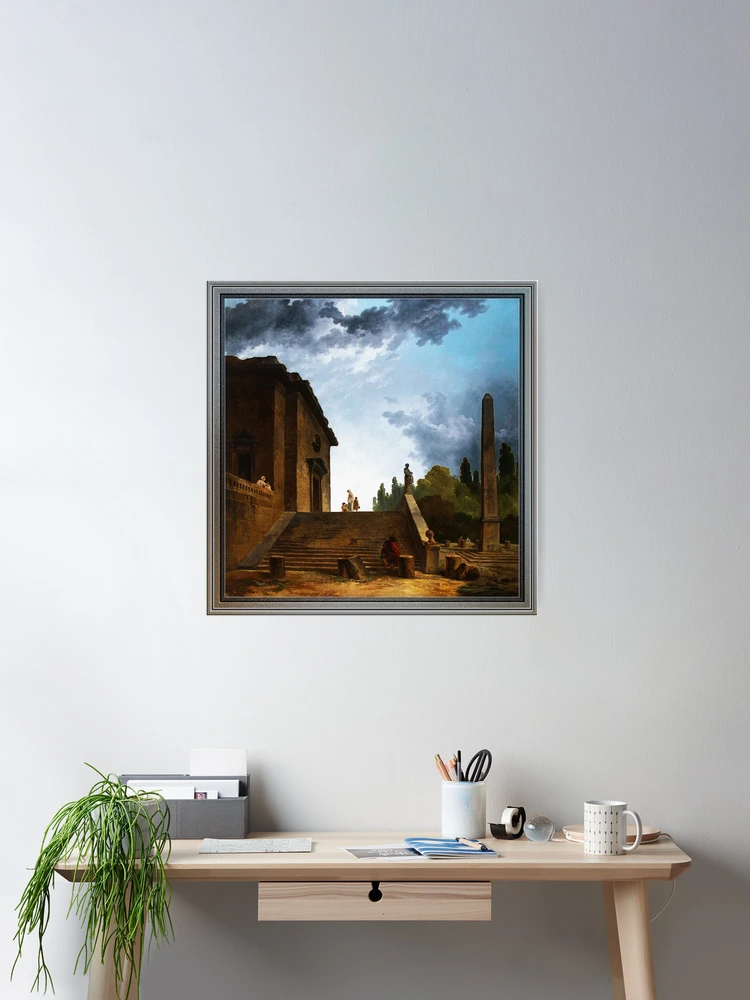
“Cruth-tìre le staidhre agus obelisg” na eisimpleir iongantach de pheantadh cruth-tìre Frangach bhon 18mh linn, air a chruthachadh le Hubert Robert timcheall 1770-1780. Tha e ainmeil airson a ùidh ann an tobhtaichean clasaigeach agus suidheachaidhean ailtireil mòra, Raibeart (1733 – 1808) a’ glacadh sealladh a tha a’ nochdadh bòidhchead romansach na h-ùine. Tha an obair aige a’ measgachadh eileamaidean nàdarra agus dèanta le duine, a’ nochdadh co-sheasmhachd co-sheirm eadar na structaran dèanta le daoine agus an fhìor mhòr, cruth-tìre gun ùine. Tha am pìos seo a’ toirt cuireadh do luchd-amhairc iad fhèin a bhogadh ann an saoghal far a bheil eachdraidh, nàdur, agus ailtireachd a’ tighinn còmhla.
Clàr-innse
Prìomh chuspair agus sgrìobhadh
Is e prìomh fhòcas an obair-ealain seo an staidhre mòrail a tha a’ leantainn gu togalach mòr no teampall, còmhla ris an obelisk àrd air a’ chùl. Tha aimsir air an staidhre fhèin agus tha e coltach gu bheil iad dèanta de chloich, an ceuman a' dol suas gu structar cloiche. Tha làthaireachd na staidhre seo a 'nochdadh suidheachadh àrsaidh no uasal, 's dòcha ceangailte ri iomraidhean eachdraidheil no beul-aithris, feart de na dealbhan romansach aig Raibeart de thobhtaichean clasaigeach.
Ri aghaidh na deilbh, tha dithis air an sealltainn - fear na shuidhe agus fear eile na sheasamh air an staidhre. Tha e coltach gu bheil iad neo-chunbhalach do mhòrachd an t-suidheachaidh ach tha pàirt deatamach aca fhathast ann a bhith a’ cur ri làthaireachd daonna a tha eadar-dhealaichte bhon ailtireachd carragh-cuimhne.. Bidh an suidheachadh aca a’ cuideachadh le bhith a’ cothromachadh ìre an t-suidheachaidh, a’ toirt faireachdainn de chuibhreann daonna am measg nan structaran àrda.
An obelisk, an ancient Egyptian monument re-imagined within a classical European setting, stands as another focal point to the right side of the composition. This object symbolizes the ancient world, evoking the sense of a lost civilization while anchoring the piece in the romantic classical themes Robert was known for. The use of the obelisk reinforces the notion of timelessness, a central theme in much of Robert’s work, where classical ruins are idealized to evoke both nostalgia and contemplation of past civilizations.
Rudan agus Cruth-tìre
The terrain surrounding the stairs and obelisk is lush and expansive. The ground appears to be cultivated or at least managed, with well-kept paths leading through the terrain. Air an làimh dheis, we see a few figures in the distance, seated or walking, giving the landscape a dynamic feel while reinforcing the setting’s tranquility. The backdrop of trees, with their expansive reach toward the sky, provides a striking contrast against the harsh lines of the stone architecture. The viewer’s eye is naturally drawn toward the horizon, where the trees begin to thin out, leading to a space dominated by clouds and a slightly darker sky.
The juxtaposition of human-made elements—such as the staircase, the obelisk, and the figures—and nature highlights the tension between civilization and the natural world. Robert’s careful rendering of the foliage, combined with the crisp outlines of the architectural elements, underscores the precision of his technique. This harmony between nature and architecture is a key characteristic of the Rococo and Neoclassical periods, where the human desire for understanding and order is reflected through such meticulously designed structures amid nature’s free-flowing form.
Stoidhle agus innleachd
Robert’s style in this work is distinctly Rococo with elements of Neoclassicism, blending the ornate with the classical. An cleachdadh aige de sholas, sgàil, and texture creates a sense of depth and dimension, inviting the viewer to step into the landscape. The clouds in the sky seem to swirl in dramatic motion, contrasting with the stillness of the stone objects below. This use of light and dark not only adds to the mood but also enhances the sense of timelessness that pervades the entire scene.
The application of light is masterful, with shadows creeping along the stone steps, highlighting the weathered texture of the structure. An obelisk, cuideachd, is illuminated with soft, diffuse light, giving it an almost ethereal quality. Na figearan, small in comparison to the surrounding objects, are subtly shaded, further emphasizing their secondary role within the larger composition.
Robert’s technique, while focused on naturalistic detail, maintains an idealized interpretation of the ruins. The rocks and stone are not simply representations of decay but are infused with a sense of romantic nostalgia for an era gone by. The stones seem to have a timeless quality, making them not just relics of the past, but symbols of enduring beauty.
Mood agus cuspair
Tha faireachdainn an deilbh mar aon de mhothachadh sàmhach. An suidheachadh, with its peaceful yet awe-inspiring structures, invites viewers to reflect on the past, siubhal ùine, and the impermanence of human creations. The natural landscape, in its lushness and vividness, contrasts with the stone architecture, suggesting the ephemeral nature of human achievement against the vast, enduring power of nature.
The classical ruins, while not overtly ancient in this depiction, invoke the grandeur of civilizations long past, evoking a sense of nostalgia and reverence for the lost civilizations of Rome and Egypt. An obelisk, with its Egyptian origins, stands as a reminder of these ancient powers. By choosing to depict such ruins, Robert not only preserves the legacy of these ancient structures but also elevates them, presenting them as objects of beauty rather than mere remnants of past civilizations.
The inclusion of figures adds a human touch to the scene, but their small scale and passive actions suggest that humanity, while significant, is but a fleeting moment in the timeline of history. The vast sky, dotted with dark clouds and illuminated by bursts of light, further amplifies the theme of nature’s dominance over time and human endeavors.
Co-dhùnadh
“Cruth-tìre le staidhre agus obelisg” is a masterful example of Hubert Robert’s ability to merge the beauty of nature with the elegance of classical architecture. The scene captures a moment where the monumental and the natural coexist, creating a serene yet thought-provoking atmosphere. Robert’s meticulous attention to detail, his skillful use of light and shadow, and his celebration of classical ruins all serve to reinforce the timeless theme of nature’s dominance and the fleeting nature of human achievement. This work invites the viewer not only to admire its technical brilliance but to reflect on the deeper themes of history, uair, and memory.
Landscape with a Stairs and Obelisk is a retouched digital art old masters reproduction of a public domain image that is available as a clò-bhualadh canabhas air-loidhne.
Neach-ealain Bio
Gu h-ìosal Fiosrachadh a thàinig bho Wikipedia.org
Rugadh Hubert Robert ann am Paris ann an 1733. Athair, Nicolas robert, bha e ann an seirbheis François-Joseph de Choiseul, marquis de Stainville prìomh thagraiche à Lorraine. Chrìochnaich Raibeart òg a chuid ionnsachaidh leis na h-Ìosaichean aig an Collège de Navarre ann an 1751 agus a-steach do chlàr-ithe an snaigheadair Michel-Ange Slodtz a theagaisg dealbhadh agus sealladh dha ach a bhrosnaich e gu bhith a ’tionndadh gu peantadh. Ann an 1754 dh'fhalbh e dhan Ròimh ann an trèana Étienne-François de Choiseul, mac fastaiche athar, a chaidh ainmeachadh mar thosgaire na Frainge agus a bhiodh na Rùnaire Stàite airson Cùisean Cèin gu Louis XV ann an 1758.
Chuir e seachad aon bliadhna deug anns an Ròimh, ùine iongantach; às deidh do dhachaigh oifigeil an neach-ealain òg aig Acadamaidh na Frainge san Ròimh ruith a-mach, thug e taic dha fhèin le obraichean a rinn e airson tadhal air connoisseurs mar an abbé de Saint-Non, a thug Raibeart gu Napoli sa Ghiblean 1760 gus tadhal air tobhtaichean Pompeii. Am marcas de Marigny, bha stiùiriche nam Bâtiments du Roi a ’cumail suas ris an leasachadh aige ann an litrichean le Natoire, stiùiriche Acadamaidh na Frainge, a chuir ìmpidh air na peinnseanairean sgeidse a-muigh, bho nàdar: Cha robh feum aig Raibeart air ìmpidh sam bith; tha dealbhan bho na leabhraichean sgeidse aige a ’clàradh a shiubhal: Villa bliadhnaEste, Caprarola.
Sealladh de Phort Rippeta san Ròimh, c. 1766, a ’sealltainn an t-Seann Pantheon Ròmanach ri taobh port mac-meanmnach
Bha an eadar-dhealachadh eadar tobhta na seann Ròimhe agus beatha na h-ùine aige a ’togail ùidh mhòr. Bha e ag obair airson ùine ann an stiùidio Pannini, chithear a bhuaidh ann an Sealladh Ìomhaigh Gailearaidh Ruined Louvre (dealbh). Chuir Raibeart seachad a chuid ùine ann an companaidh luchd-ealain òga ann an cearcall Piranesi, thug an t-iomall de thobhtaichean romansach aige buaidh cho mòr air is gun d’ fhuair e am far-ainm Robert des ruines. Thug na clàran de dhealbhan agus dhealbhan a chruinnich e san Ròimh motifan dha a dh ’obraich e a-steach do dhealbhan rè a bheatha.