

The Pen c1899
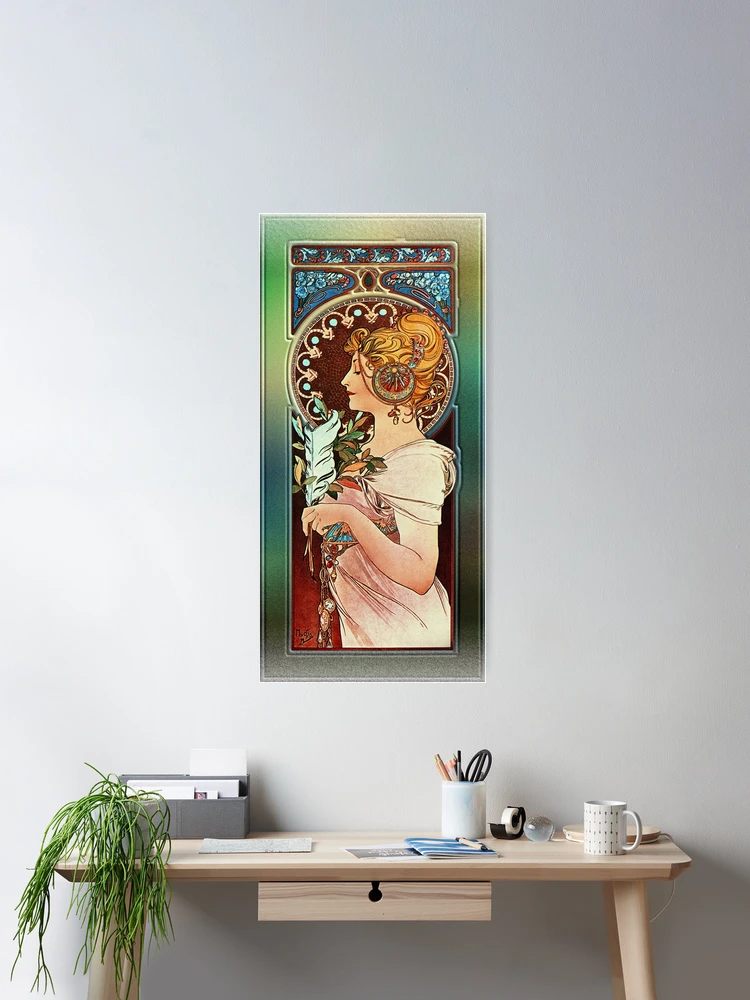
“The Pen” c1899 by Alphonse Mucha (1860 – 1939) is an iconic example of the Art Nouveau style, featuring the signature elements that made Mucha one of the most influential artists of his time. The painting depicts a young woman who is the central subject of the composition. Her graceful, poised figure exemplifies the beauty and elegance of the period, while the intricate patterns and organic shapes in the background draw attention to the artist’s mastery of decorative art. Created at the turn of the 20th century, this work captures the essence of the Art Nouveau movement, where fluid lines, natural forms, and a sense of harmony between the figure and the surroundings were paramount.
Ynhâldsopjefte
Haadûnderwerp en komposysje
The main subject of the artwork is a jonge frou whose profile is elegantly presented in a soft, flowing pose. She holds a quill pen delicately in her right hand, an object that symbolizes both the act of creation and intellect. The pen, an important tool of writing and artistic expression, could also be interpreted as an emblem of feminine creativity and empowerment. Her calm demeanor, combined with the focused gesture of grasping the pen, suggests a sense of thoughtfulness and quiet strength.
Har lang, flowing hair is styled in a loose, luxurious updo that complements her serene expression. The elaborate details of her hair—embellished with floral motifs—suggest a connection to nature, another hallmark of the Art Nouveau style. Her attire is also part of the composition’s elegance, with a flowing white gown that further enhances her ethereal presence. The gown’s soft, flowing lines are echoed in the circular forms of the background, creating a sense of unity and fluidity across the entire piece.
Background and Decorative Elements
The background of the painting is where Mucha’s artistic genius truly shines. It is filled with intricate floral patterns and delicate geometric shapes that wrap around the subject, creating a sense of rhythm and movement. The circular motif in the background, adorned with stylized flowers and symbols, frames the figure in a way that draws the viewer’s eye toward the subject’s face and pen. These elements combine to form a harmonious backdrop that both complements and contrasts with the central figure.
The intricate borders of the piece feature repeating floral and leaf patterns, which seem to emerge from the subject’s hair and clothing, enhancing the natural, almost otherworldly quality of the woman. The geometric lines, coupled with the organic forms, are typical of the Art Nouveau aesthetic, which sought to merge art with the natural world in a decorative, yet meaningful manner.
Styl en technyk
Mucha’s use of line is particularly evident in this piece. The flowing curves that define the woman’s hair, the intricate folds of her gown, and the floral elements all contribute to the piece’s characteristic sensuousness. Mucha’s linear style emphasizes organic shapes, with each curve seeming to flow into the next in a seamless progression. The lines do not simply depict form but also express the mood of the piece, creating a feeling of grace and fluidity.
The color palette used in the painting further contributes to the overall harmony of the composition. Rich reds and oranges in the background contrast with the soft, pastel tones of the woman’s skin and clothing. These colors help establish a sense of depth and dimension, with the warmer tones of the background drawing the viewer’s focus toward the figure. The use of these bold yet soothing colors creates a dynamic tension, ensuring that the viewer’s attention is both captured and guided around the painting.
Moommet en tema
De stimming fan “The Pen” is one of quiet contemplation and dignity. De frou, while positioned in profile, maintains a sense of elegance that suggests both inner strength and an unspoken connection to the world around her. The act of writing or creating with a pen brings forth the theme of intellect and creativity, characteristics often attributed to femininity during the period. Mucha’s portrayal of the subject is both respectful and empowering, portraying her as a figure of grace, wysheid, en autoriteit. The peaceful, almost meditative quality of the painting is reinforced by the smooth flow of the lines and the gentle symmetry of the composition.
This sense of empowerment, combined with the association of the pen with the power of words and art, may also allude to the growing social and cultural influence of women at the time. In a broader sense, the painting embodies the era’s ideals of beauty, intellectualism, and the merging of art with daily life, which were central tenets of the Art Nouveau movement.
Konklúzje
“The Pen” by Alphonse Mucha is a masterpiece of the Art Nouveau movement, embodying its themes of elegance, natuer, and the intersection of art and daily life. De keunstner syn sekuere oandacht foar detail, his use of flowing lines, and his integration of natural motifs into both the figure and the background create a harmonious composition that draws the viewer into its world. The symbolic presence of the pen adds layers of meaning, suggesting both intellectual and creative power. Troch dit wurk, Mucha has created not just a portrait, but a vision of beauty and artistic expression that continues to resonate today.
Artist Bio
Info hjirûnder Fan Wikipedia.org
Alfons Maria Mucha July 24, 1860 – july 14, 1939), waard ynternasjonaal bekend as Alphonse Mucha. Hy wie in foaroansteand Tsjechysk skilder, yllustrator en grafikus, wenne yn Parys yn de Art Nouveau perioade, en is fral bekend om syn dúdlik stilisearre en dekorative teatrale posters, benammen dy fan Sarah Bernhardt.
Hy makke yllustraasjes, advertinsjes, dekorative panielen, en ûntwerpen, dy't ta de bekendste bylden fan 'e perioade waard.
Yn it twadde diel fan syn karriêre, yn de âldens fan 43, hy gie werom nei syn heitelân fan de regio Bohemen-Moravje yn Eastenryk en wijde him ta it skilderjen fan in searje fan tweintich monumintale doeken bekend as The Slav Epic, ôfbyldzjen fan de skiednis fan alle Slavyske folken fan 'e wrâld, dêr't er tusken skildere 1912 en 1926.
Yn 1928, op it 10e jubileum fan de ûnôfhinklikens fan Tsjechoslowakije, hy presintearre de searje oan de Tsjechyske naasje. Hy beskôge it as syn wichtichste wurk. It is no te sjen yn Praach.