

De Petit Savoyard Eet Foar In Yngong By In Hûs
“De Petit Savoyard Eet Foar In Yngong By In Hûs,” skildere yn 1877 troch Frânske keunstner Pascal-Adolphe-Jean Dagnan-Bouveret (1852 – 1929), is in boeiende ferbylding fan in jonge jonge sitten foar in grut gebou yngong, meidwaan oan in stil momint fan iensumens. Dit wurk, ryk oan realisme, vangt in momint fan ûnskuld en kwetsberens yn it libben fan in earm bern út 'e Savoie-regio fan Frankryk, in plak bekend om syn rustike skientme en natuerlike lânskippen. De delikate behanneling fan Dagnan-Bouveret mei ljocht en tekstuer feroaret it beskieden ûnderwerp yn in skerpe útspraak oer de ferskillen tusken de sosjale klassen yn Frankryk fan 'e 19e ieu.
Ynhâldsopjefte
Haadûnderwerp en karakterisearring fan 'e jonge
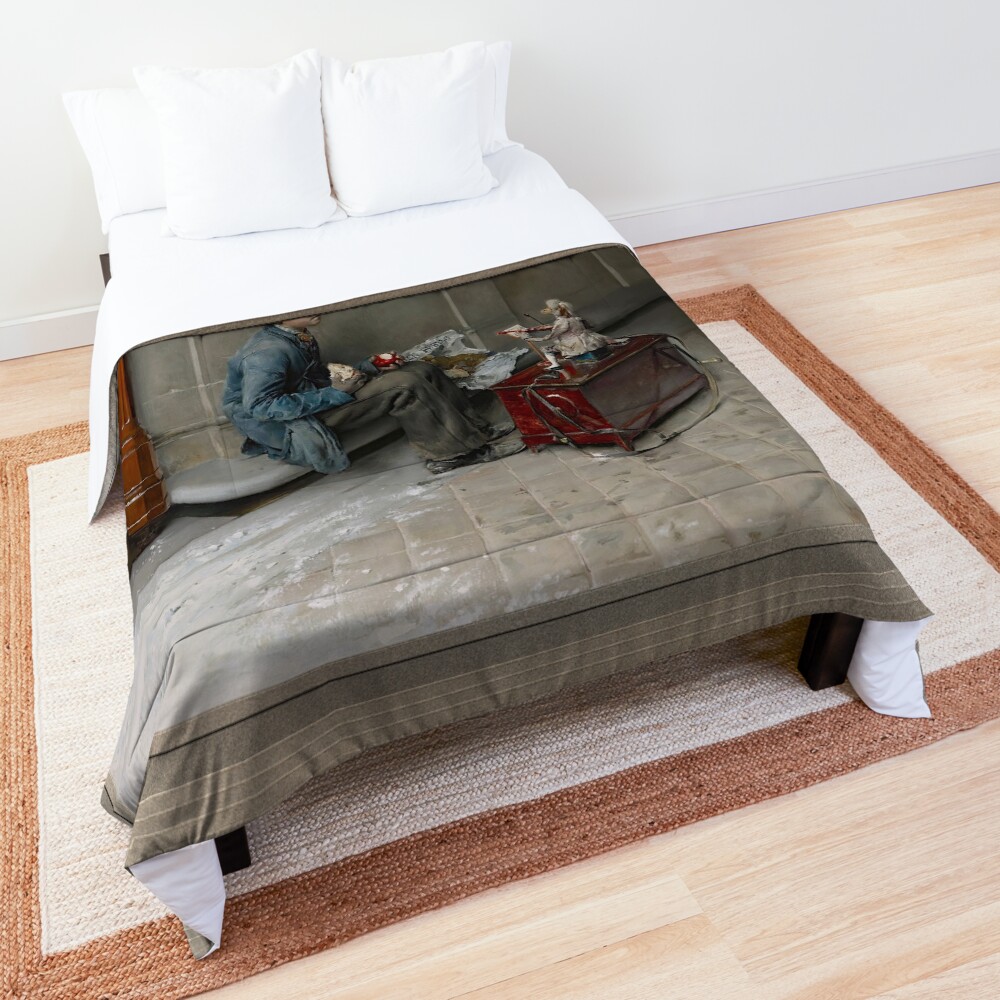
De sintrale figuer yn dizze sjenre skilderij is in jonge jonge, klaaid yn 'e droegen, shabby klean karakteristyk foar in earme bern yn de lette 19e ieu. Syn gesicht, foar in part ôfwiisd fan de sjogger, lit in gefoel fan stille konsintraasje sjen as hy genietet fan syn miel, dy't bestiet út ienfâldige iten. Syn postuer suggerearret wurgens, mar ek in graad fan treast yn dit lytse momint fan rêst. De jonge sit op in stiennen stoep, syn rêch tsjin in grutte, sierlike doar frame, suggerearret dat de lokaasje in begoedige húshâlding wêze kin as in gebou fan betsjutting. Syn eagen, hoewol rjochte op syn miel, lykje ferlern yn gedachten, mooglik wjerspegelje de hurde realiteiten fan syn libben.
De oanpak fan Dagnan-Bouveret foar de ôfbylding fan 'e jonge is foarsichtich en respektfol, it skilderjen fan it bern net as in inkeld symboal fan earmoede, mar as in yndividu mei weardichheid. De keunstner fange de tekstuer fan syn klean mei kunde, de klam op 'e rûchheid en ienfâld fan syn klean, wylst de jonge is rommelich, tousled hier fierder bringt it gebrek oan soarch en middels. Nettsjinsteande syn earme status, der is in gefoel fan stille adel yn syn bywêzen, as hat er leard mominten fan frede te finen yn syn dreech libben.
Objekten en items om de jonge hinne
It beskieden miel fan de jonge en de lytse karre njonken him spylje wichtige rollen yn 'e komposysje. Op 'e grûn by him leit in ôfset stik papier, it tafoegjen fan in touch fan realisme oan it toaniel, klam op de beskieden omstannichheden fan de jonge. Op de karre, in pear ienfâldige boartersguod kin sjoen wurde, ynklusyf in pop. The juxtaposition of the food and the doll gives the viewer an insight into the child’s daily life. The doll may symbolize the fleeting innocence of childhood amidst the harsh conditions of the boy’s life.
The boy’s lack of possessions is evident, and yet, the presence of the cart, though simple, gives him a sense of movement, suggesting that he might have been carrying his belongings as he moved through the city. The artist does not overly romanticize the situation, instead presenting it in a straightforward, almost documentary-like manner, which adds to the emotional weight of the scene.
It terrein en arsjitektoanyske eleminten
The background of the painting provides a sharp contrast to the boy’s humble appearance. The wall of the building behind him is smooth, clean, and imposing, evoking the architectural grandeur of a building meant for wealthier individuals. The decorative details of the door frame suggest that the boy is sitting in front of an area that once belonged to a more affluent person. The contrast between the well-maintained, elegant entrance and the dirty, weathered child seated on the cobblestones speaks volumes about the disparity between the lives of the poor and the rich in 19th-century France.
The cobblestone floor adds a sense of grounding, further emphasizing the boy’s connection to the physical world. The texture of the cobblestones, painted with great care, leads the viewer’s eye into the scene, reinforcing the reality of the boy’s environment. The light that falls across the pavement seems almost as if it were an acknowledgment of the boy’s presence, highlighting him while subtly reinforcing the quiet solitude of the moment.
Styl, Technyk, en Mood of the Artwork
“De Petit Savoyard Eet Foar In Yngong By In Hûs” belongs to the realism genre, a movement that sought to depict everyday life with accuracy and without embellishment. Dagnan-Bouveret, a master of this style, was known for his meticulous attention to detail and his ability to evoke deep emotion through the portrayal of ordinary subjects. The textures, ljocht, and shadows in this work are all rendered with striking realism. The roughness of the boy’s clothing contrasts with the smoothness of the stone pavement and the sleek surface of the building, emphasizing the stark contrast between social classes.
The mood of the painting is melancholic and introspective. The boy’s solitary eating, in front of a building that suggests wealth and status, reinforces the isolation he may feel. Dochs, the scene is not overly dramatic or sorrowful; leaver, it presents the child’s reality in a matter-of-fact way, which makes it all the more powerful. Dagnan-Bouveret’s ability to evoke empathy for the subject without resorting to sentimentalism demonstrates his mastery of realism.
Konklúzje
“De Petit Savoyard Eet Foar In Yngong By In Hûs” is a striking work that captures the quiet dignity of a poor child in the context of a world that often overlooks such individuals. Dagnan-Bouveret’s nuanced rendering of the child’s environment, his clothes, and the architectural backdrop creates a narrative that speaks to themes of class disparity, ûnskuld, en oerlibjen. The boy’s meal, his toys, and his temporary refuge in front of an imposing door frame evoke a sense of loneliness and resilience, creating a poignant and timeless moment in the history of art.
The Petit Savoyard Eating In Front Of An Entrance To A House is a remastered digital art old masters reproduction of a public domain image that is available as a canvas print online.
Artist Bio ôflaat fan Wikipedia.org
Pascal was born in Paris France on January 7, 1852 and was raised by his grandfather, from which he took the name Bouveret after his father emigrated to Brazil.
He started his education in 1869, studying at the École des Beaux-Arts under French Painters Alexandre Cabanel (1823 – 1889) and Jean-Léon Gérôme (1824 – 1904) fan 1869 nei 1875.
Fan 1875 troch 1896 he exhibited at the Paris Salon, first exhibiting there in 1875, where in 1880 he won the first place for the painting “An Accident”; dan yn 1885 he received the medal of honor for his piece “Horses At The Watering Trough”.
During the 1880s Pascal along with French Painter Gustave Courtois (1852 – 1923), maintained a studio in a fashionable part of Paris called Neuilly-sur-Seine; and by this time was a well known and established leading artist known for his peasant scenes, mystical creations and religious compositions.
Yn 1891 Pascal was made an Officer of the Legion of Honour, and nine years later became a member of the Institut de France.