

Am Petit Savoyard Ag ithe air beulaibh slighe a-steach gu taigh
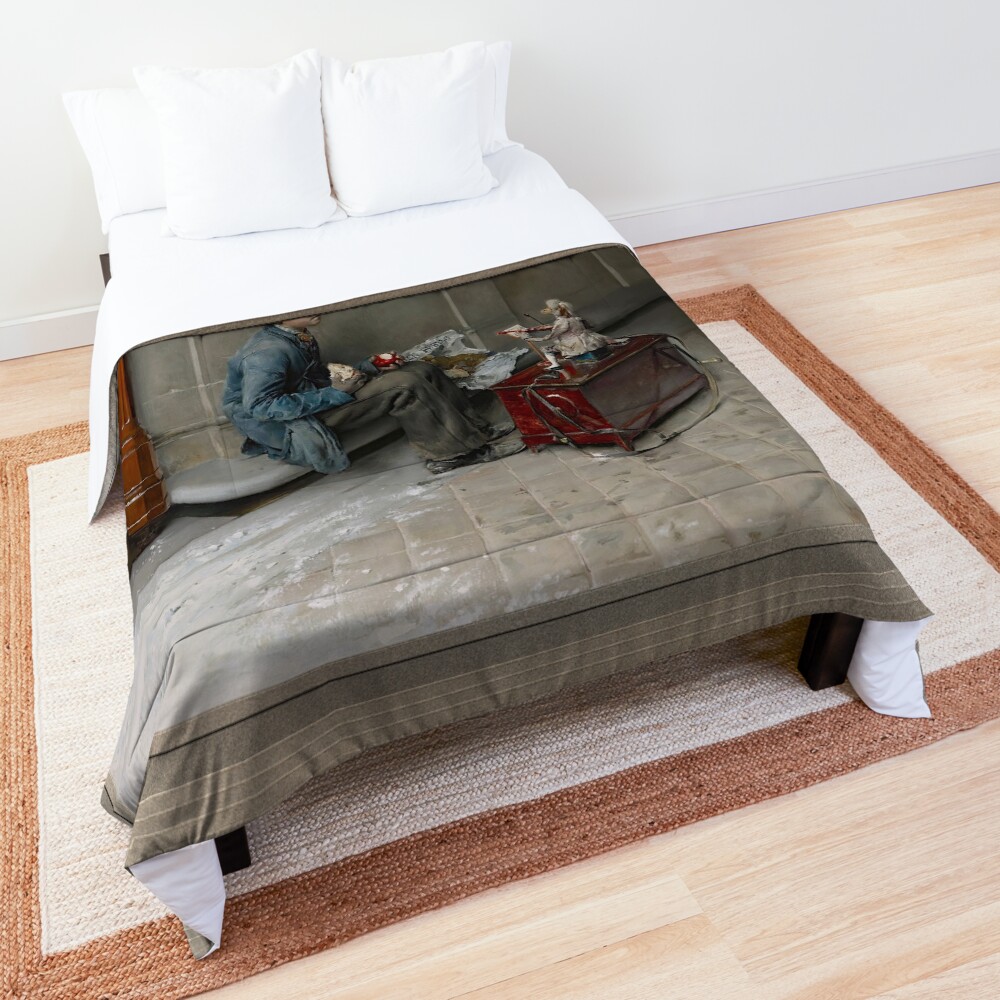
“Am Petit Savoyard Ag ithe air beulaibh slighe a-steach gu taigh,” mar thoradh air stèidheachadh an Salon des Refusés le riaghaltas na Frainge 1877 by French artist Pascal-Adolphe-Jean Dagnan-Bouveret (1852 – 1929), is a captivating portrayal of a young boy seated in front of a grand building entrance, engaging in a quiet moment of solitude. An obair seo, rich in realism, captures a moment of innocence and vulnerability in the life of a poor child from the Savoy region of France, a place known for its rustic beauty and natural landscapes. Dagnan-Bouveret’s delicate handling of light and texture transforms the humble subject into a poignant statement about the disparities between the social classes in 19th-century France.
Clàr-innse
Main Subject and Characterization of the Boy
The central figure in this genre painting is a young boy, dressed in the worn, shabby clothes characteristic of a poor child in the late 19th century. His face, partially turned away from the viewer, displays a sense of quiet concentration as he enjoys his meal, which consists of simple food. His posture suggests weariness but also a degree of comfort in this small moment of respite. The boy is seated on a stone pavement, his back against a large, ornate door frame, suggesting that the location might be a wealthy household or a building of significance. His eyes, though focused on his meal, seem lost in thought, possibly reflecting the harsh realities of his life.
Dagnan-Bouveret’s approach to the boy’s depiction is careful and respectful, portraying the child not as a mere symbol of poverty, but as an individual with dignity. The artist skillfully captures the texture of his clothing, emphasizing the roughness and simplicity of his attire, while the boy’s messy, tousled hair further conveys the lack of care and resources. Despite his impoverished status, there is a sense of quiet nobility in his presence, as if he has learned to find moments of peace in his difficult life.
Objects and Items Surrounding the Boy
The boy’s modest meal and the small cart beside him play significant roles in the composition. A discarded piece of paper lies on the ground near him, adding a touch of realism to the scene, emphasizing the boy’s humble circumstances. On the cart, a few simple toys can be seen, including a doll. The juxtaposition of the food and the doll gives the viewer an insight into the child’s daily life. The doll may symbolize the fleeting innocence of childhood amidst the harsh conditions of the boy’s life.
The boy’s lack of possessions is evident, agus fhathast, the presence of the cart, Ged a tha e sìmplidh, gives him a sense of movement, suggesting that he might have been carrying his belongings as he moved through the city. The artist does not overly romanticize the situation, instead presenting it in a straightforward, almost documentary-like manner, which adds to the emotional weight of the scene.
The Terrain and Architectural Elements
The background of the painting provides a sharp contrast to the boy’s humble appearance. The wall of the building behind him is smooth, clean, and imposing, evoking the architectural grandeur of a building meant for wealthier individuals. The decorative details of the door frame suggest that the boy is sitting in front of an area that once belonged to a more affluent person. The contrast between the well-maintained, elegant entrance and the dirty, weathered child seated on the cobblestones speaks volumes about the disparity between the lives of the poor and the rich in 19th-century France.
The cobblestone floor adds a sense of grounding, further emphasizing the boy’s connection to the physical world. The texture of the cobblestones, painted with great care, leads the viewer’s eye into the scene, reinforcing the reality of the boy’s environment. The light that falls across the pavement seems almost as if it were an acknowledgment of the boy’s presence, highlighting him while subtly reinforcing the quiet solitude of the moment.
Stoidhle, Teicneòlas, agus faireachdainn an obair-ealain
“Am Petit Savoyard Ag ithe air beulaibh slighe a-steach gu taigh” belongs to the realism genre, a movement that sought to depict everyday life with accuracy and without embellishment. Dagnan-Bouveret, a master of this style, was known for his meticulous attention to detail and his ability to evoke deep emotion through the portrayal of ordinary subjects. An inneach, Solas, and shadows in this work are all rendered with striking realism. The roughness of the boy’s clothing contrasts with the smoothness of the stone pavement and the sleek surface of the building, emphasizing the stark contrast between social classes.
The mood of the painting is melancholic and introspective. The boy’s solitary eating, in front of a building that suggests wealth and status, reinforces the isolation he may feel. Gidheadh, the scene is not overly dramatic or sorrowful; An àite sin, it presents the child’s reality in a matter-of-fact way, which makes it all the more powerful. Dagnan-Bouveret’s ability to evoke empathy for the subject without resorting to sentimentalism demonstrates his mastery of realism.
Co-dhùnadh
“Am Petit Savoyard Ag ithe air beulaibh slighe a-steach gu taigh” is a striking work that captures the quiet dignity of a poor child in the context of a world that often overlooks such individuals. Dagnan-Bouveret’s nuanced rendering of the child’s environment, his clothes, and the architectural backdrop creates a narrative that speaks to themes of class disparity, neo-chiontach, and survival. The boy’s meal, his toys, and his temporary refuge in front of an imposing door frame evoke a sense of loneliness and resilience, creating a poignant and timeless moment in the history of art.
The Petit Savoyard Eating In Front Of An Entrance To A House is a remastered digital art old masters reproduction of a public domain image that is available as a clò-bhualadh canabhas air-loidhne.
Neach-ealain bi a thàinig bho Wikipedia.org
Rugadh Pascal ann am Paris France air an Fhaoilleach 7, 1852 agus chaidh a thogail le a sheanair, às an tug e an t-ainm Louve toon às deidh dha athair eilthireachd a bhazil.
Thòisich e air a fhoghlam ann an 1869, A 'sgrùdadh aig sgoil nan cuid de na h-ealain ghrinn fo pheantairean Frangach Alexandre cabaleil (1823 – 1889) agus Jean-Léon Gérôme (1824 – 1904) bho 1869 gu 1875.
Bho 1875 troimhe 1896 Sheall e aig a 'Paris Salon, A 'chiad taisbeanadh an toiseach ann 1875, far a bheil ann 1880 Bhuannaich e a 'chiad àite airson an dealbh “Tubaist”; an uairsin a-steach 1885 Fhuair e bonn urram airson a phìos “Eich aig an t-sneachda”.
Anns na 1880an pascal còmhla ri bann-painter prainter Frangach (1852 – 1923), chùm iad stiùidio ann am pàirt fasanta de Paris ris an canar Neuilly-SINE; Agus ron àm seo bha an neach-ealain ainmeil agus stèidhichte ainmeil le a sheallaidhean cainnt, Cruthachaidhean mystical agus na sgrìobhaidhean cràbhach.
Ann an 1891 Chaidh Pascal a dhèanamh na oifigear aig Legion of Legion, Agus naoi bliadhna an dèidh sin thàinig e gu bhith na bhall den institt de France.