

The Pinup Girl c1947
Alberto Vargasc'est La pin-up, créé dans 1947, stands as a quintessential example of mid-20th-century pinup art. Born in Peru, Vargas (1896 – 1982) became renowned for his distinctive portrayal of sensual women that captured the imagination of the American public during the 1940s and 1950s.
He is celebrated for his ability to blend glamour, élégance, and a sense of playful allure into his works. Dans La pin-up, Vargas presents a model whose pose, expression, and overall aesthetic epitomize the timeless beauty and charm of the pinup genre. This painting is an exquisite reflection of the idealized feminine form, and it remains one of the defining pieces of Vargas’s legacy.
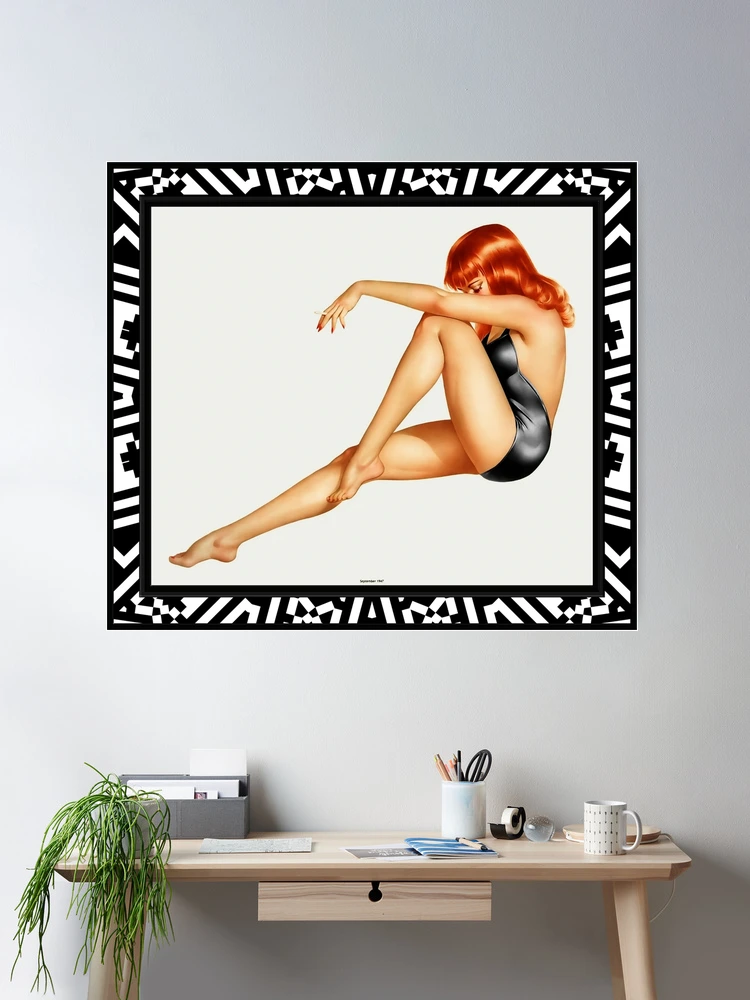
Table des matières
Le sujet principal et pose
Au coeur de La pin-up is the female figure, a captivating model whose body is positioned in a seated pose, gracefully folded into herself. The subject’s figure is sculptural, with every curve emphasized to suggest a heightened sense of femininity. The woman’s posture is delicate yet confident; her legs are drawn up beneath her, with one arm raised to rest gently on her knee, while the other hand rests on her thigh.
Her head is slightly turned downward, with her auburn hair falling in soft waves that frame her face, highlighting her profile. Her facial expression is one of soft contemplation, adding a layer of mystery to her beauty. There is a perfect balance between the sensuality of the pose and the restraint suggested by her serene demeanor.
Costume and Details
The model in La pin-up is dressed in a classic one-piece swimsuit, which clings to her body, accentuating her slender waist and curves. The swimsuit is black, creating a striking contrast against her pale skin, and is designed with a plunging neckline that enhances the sensuality of the composition.
The simplicity of her attire speaks to the sophistication of the era’s fashion, capturing the glamour of the post-war period. The detail in her costume is expertly painted, with soft folds and curves that suggest the fabric’s texture. Her nails are painted a vivid red, an attention to detail that adds a sense of refinement to the artwork. Her bare feet, resting gracefully on the floor, further reinforce the elegance of the pose and contribute to the sensual nature of the image.
Use of Color and Light
Vargas’s use of color in La pin-up is both deliberate and sophisticated. The warm tones of the woman’s auburn hair complement the coolness of the black swimsuit, creating a harmonious balance between the elements. Her skin is rendered with delicate shades of peach and ivory, giving her an almost ethereal glow.
The background of the painting is soft and neutral, devoid of any elaborate details, which serves to keep the viewer’s focus squarely on the model. This restrained backdrop enhances the figure’s prominence and allows the sensuality of the subject to shine through. Light plays a crucial role in accentuating the curves of the figure, with soft highlights tracing the contours of her body, giving it a lifelike, almost sculptural quality.
Composition and Framing
La composition de La pin-up is strikingly simple yet dynamic. The model is framed in a way that her body occupies the central space, with her face and posture drawing the viewer’s eye. Her legs are positioned in such a way that they form a natural triangle, guiding the viewer’s gaze upward toward her serene expression. This creates a sense of balance and symmetry in the piece.
The framing of the artwork itself, with its strong geometric borders, helps to highlight the model and further isolates her in a space that feels both intimate and otherworldly. This minimalistic approach allows the viewer to focus entirely on the woman and the subtle details of her figure and attire.
Ambiance et thème
L'ambiance de La pin-up can be described as one of quiet allure, with a touch of mystery. The model’s introspective expression and poised demeanor suggest a sense of grace and elegance, while the sensuality of her pose imbues the piece with an undeniable charm. There is an air of confidence that permeates the composition, yet it remains soft and inviting.
The painting evokes the idealized femininity of the post-war era, when pinup art was often used as a form of escapism, offering a vision of beauty and sensuality that was both wholesome and enticing. The theme of the painting centers on the celebration of the female form, rendered in a way that is both graceful and seductive, yet restrained enough to maintain a sense of refinement.
Legacy and Impact
Alberto Vargas’s influence on the art world is immense, particularly within the realm of pinup art. His ability to portray the female form with such elegance and sensuality revolutionized the genre, and his works have become iconic symbols of 20th-century American culture. La pin-up is a perfect example of Vargas’s skill in balancing the glamorous and the sensual, creating images that remain timeless in their appeal.
His paintings, which often appeared in popular magazines like Écuyer, captured the imagination of millions and became a staple of mid-century modern visual culture. La pin-up stands as one of his most celebrated works, encapsulating the spirit of an era while continuing to resonate with viewers today.
Conclusion
La pin-up par Alberto Vargas (1896 – 1982) is an artwork that transcends time, offering a glimpse into the glamour and sensuality of the 1940s. The painting’s careful composition, the elegant portrayal of the female figure, and the meticulous use of color and light all contribute to its enduring appeal. This piece exemplifies Vargas’s mastery of the pinup genre, alliant élégance, séduire, and mystery in a way that remains iconic to this day.
La Pinup Girl est une reproduction de maîtres anciens d'art numérique retouchée d'une image du domaine public.
Biographie de l'artiste
Info ci-dessous de Wikipedia.org
Né à Arequipa, Pérou, il était le fils du célèbre photographe péruvien Max T. Vargas. Alberto Vargas a déménagé aux États-Unis en 1916 après des études d'art en Europe, Zurich, et Genève avant la Première Guerre mondiale.
Alors qu'il était en Europe, il est tombé sur le magazine français La Vie Parisienne, avec une reprise de Raphael Kirchner, qui, selon lui, a eu une grande influence sur son travail.
Au début de sa carrière à New York, il a travaillé en tant qu'artiste pour les Ziegfeld Follies et pour de nombreux studios hollywoodiens.. Ziegfeld a accroché sa peinture d'Olive Thomas au théâtre, et elle était considérée comme l'une des premières filles Vargas.
Vargas’ l'œuvre cinématographique la plus célèbre était pour l'affiche du 1933 film Le péché de Nora Moran, qui montre une Zita Johann presque nue dans une pose de désespoir. L'affiche est souvent nommée l'une des plus grandes affiches de cinéma jamais réalisées.
Il est devenu largement connu dans les années 1940 en tant que créateur de pin-up emblématiques de la Seconde Guerre mondiale pour le magazine Esquire connu sous le nom de “Filles Vargas.” Entre 1940 et 1946 Vargas produit 180 tableaux pour le magazine.
L'art du nez de nombreux avions américains et alliés de la Seconde Guerre mondiale a été inspiré et adapté de ces pin-up Esquire, ainsi que ceux de George Petty, et autres artistes.