

Voluptuous Platinum Blonde
“Voluptuous Platinum Blonde,” created by Peruvian artist Alberto Vargas (1896 – 1982) au milieu du 20ème siècle, showcases the artist’s signature style and mastery in depicting feminine beauty. Born in Peru, Vargas became one of the most iconic pin-up artists of his time.
Known for his sensual and evocative portrayals of women, this particular work stands as a prime example of his ability to infuse glamour, séduire, and a touch of surreal softness into his figures. La peinture, finished in the 1940s or 1950s, captures a moment of intimate self-expression, presenting a woman in an almost dreamlike, serene pose. Through this piece, Vargas reveals his deep understanding of the human form, the textures of skin and hair, and the intricacies of light and shadow.
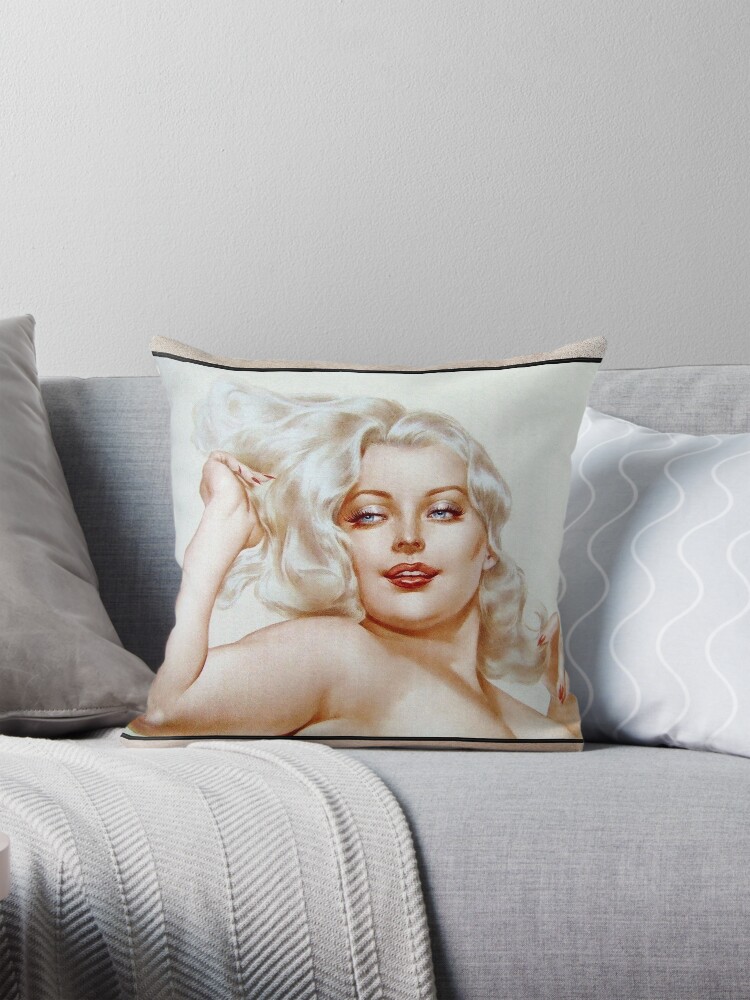
Table des matières
Le sujet principal: The Sensual Woman
Le centre d'intervention de “Voluptuous Platinum Blonde” is undoubtedly the woman herself. The subject of the painting is a voluptuous, platinum blonde woman with a smooth and glowing complexion that captures the viewer’s attention immediately. She possesses a classic beauty, with delicate features that include full lips, arched eyebrows, and large, yeux expressifs. Son regard, while direct, is softened by a gentle smile that hints at both confidence and vulnerability. She seems to gaze beyond the viewer, lost in her own thoughts or daydreams, adding an element of mystery to her character.
Ses cheveux, a cascade of platinum blonde waves, is effortlessly tousled, as though the wind has just swept through it. The texture of her hair is captured with great attention to detail—each strand appears to flow in a natural rhythm, contributing to the ethereal mood of the piece. The woman’s pose is fluid yet grounded, her arm raised to touch her hair, suggesting a moment of calm introspection or simply the act of adjusting her locks. This subtle movement contrasts with the otherwise still atmosphere of the image, giving the figure a sense of life.
Le thème et l'ambiance: Glamour and Sensuality
“Voluptuous Platinum Blonde” embodies themes of sensuality, élégance, and glamour, hallmarks of Vargas’ travail. The mood conveyed is one of subtle eroticism, without overtly sexualized imagery. The figure is undeniably seductive, yet there is an air of dignity and poise to the woman that suggests she is aware of her own beauty but not consumed by it. This portrayal aligns with the classic ideals of femininity that were celebrated in Vargas’ ère, evoking a sense of timeless allure. The subject’s allure is not just about her physical beauty but also about the quiet strength and confidence she exudes, a strength that does not need to be loud to be impactful.
The painting carries a serene yet powerful atmosphere, accentuated by the soft yet vivid colors Vargas employs. The woman’s smooth, fair skin and platinum blonde hair glow against the more muted, neutral backdrop. The soft gradient of the background gives the painting a dreamy, sensation presque surnaturelle, as if the viewer is peering into a moment suspended in time. Vargas’ expert use of light enhances the subject’s features, creating a lifelike, almost tactile quality to the painting that invites the viewer to feel as though they could reach out and touch the woman’s skin.
Matériaux et Techniques: Mastery of Light and Texture
Alberto Vargas was known for his technical precision, et “Voluptuous Platinum Blonde” ne fait pas exception. The artist’s use of oil paints lends the piece a rich, velvety texture, with the smoothness of the woman’s skin and hair juxtaposed against the softer background. Vargas expertly manipulates the paint to create a realistic effect, particularly in the way he captures the reflection of light on the woman’s skin and hair. L'utilisation de soft, blending tones allows for the subtle transitions between light and shadow, giving the figure a three-dimensional quality despite the flatness of the canvas.
The artist’s delicate brushwork and the precision with which he paints the details—such as the individual locks of hair and the soft curves of the woman’s body—reflect his exceptional skill in portraiture. Each curve and contour is carefully articulated, drawing the viewer’s eye across the canvas in a continuous motion. The juxtaposition of the warm hues of the woman’s skin and the cooler tones of her blonde hair further emphasizes her sensuality, highlighting the contrast between the warm and cool elements of the composition.
The background is a soft, blurred gradient that transitions from a light, warm beige to a deeper, darker tone, enhancing the three-dimensionality of the subject and making her stand out even more vividly. This contrast allows the viewer to focus solely on the woman, while the backdrop serves as an atmospheric complement to her figure.
Conclusion
Alberto Vargas’ “Voluptuous Platinum Blonde” is not just a painting of a woman; it is a timeless portrayal of feminine beauty and allure. With meticulous attention to detail and a deep understanding of light and form, Vargas creates a piece that speaks to the viewer’s senses, inviting them to appreciate the elegance and sensuality of the female figure. The work encapsulates the ideals of glamour and femininity that defined the mid-20th century, while maintaining a modern sophistication that still resonates today. A travers cette oeuvre, Vargas cements his legacy as a master of capturing both the visible and the intangible aspects of beauty, emotion, Et Allure.
Blonde platine voluptueuse par un artiste péruvien Alberto Vargas (1896 – 1982); pour son art de pin-up séduisant et exquis et considéré comme le plus célèbre du genre d'artiste pin-up.
Une voluptueuse blonde platine aux yeux bleus Vargas Pin-up Portrait, révélant la beauté sensuelle de la femme
Il s'agit d'une reproduction de maîtres anciens d'art numérique retouchée d'une image du domaine public.
Biographie de l'artiste
Info ci-dessous de Wikipedia.org
Né à Arequipa, Pérou, il était le fils du célèbre photographe péruvien Max T. Vargas. Alberto Vargas a déménagé aux États-Unis en 1916 après des études d'art en Europe, Zurich, et Genève avant la Première Guerre mondiale.
Alors qu'il était en Europe, il est tombé sur le magazine français La Vie Parisienne, avec une reprise de Raphael Kirchner, qui, selon lui, a eu une grande influence sur son travail.
Au début de sa carrière à New York, il a travaillé en tant qu'artiste pour les Ziegfeld Follies et pour de nombreux studios hollywoodiens.. Ziegfeld a accroché sa peinture d'Olive Thomas au théâtre, et elle était considérée comme l'une des premières filles Vargas.
Vargas’ l'œuvre cinématographique la plus célèbre était pour l'affiche du 1933 film Le péché de Nora Moran, qui montre une Zita Johann presque nue dans une pose de désespoir. L'affiche est souvent nommée l'une des plus grandes affiches de cinéma jamais réalisées.
Il est devenu largement connu dans les années 1940 en tant que créateur de pin-up emblématiques de la Seconde Guerre mondiale pour le magazine Esquire connu sous le nom de “Filles Vargas.” Entre 1940 et 1946 Vargas produit 180 tableaux pour le magazine.
L'art du nez de nombreux avions américains et alliés de la Seconde Guerre mondiale a été inspiré et adapté de ces pin-up Esquire, ainsi que ceux de George Petty, et autres artistes.