

The Play Thing
The Play Thing c1897 by Italian Painter Vittorio Matteo Corcos (1859 – 1933); yn adnabyddus am ei waith celf genre yn darlunio dynion a merched wedi'u gwisgo'n gain ar adegau o hamdden a chwarae.
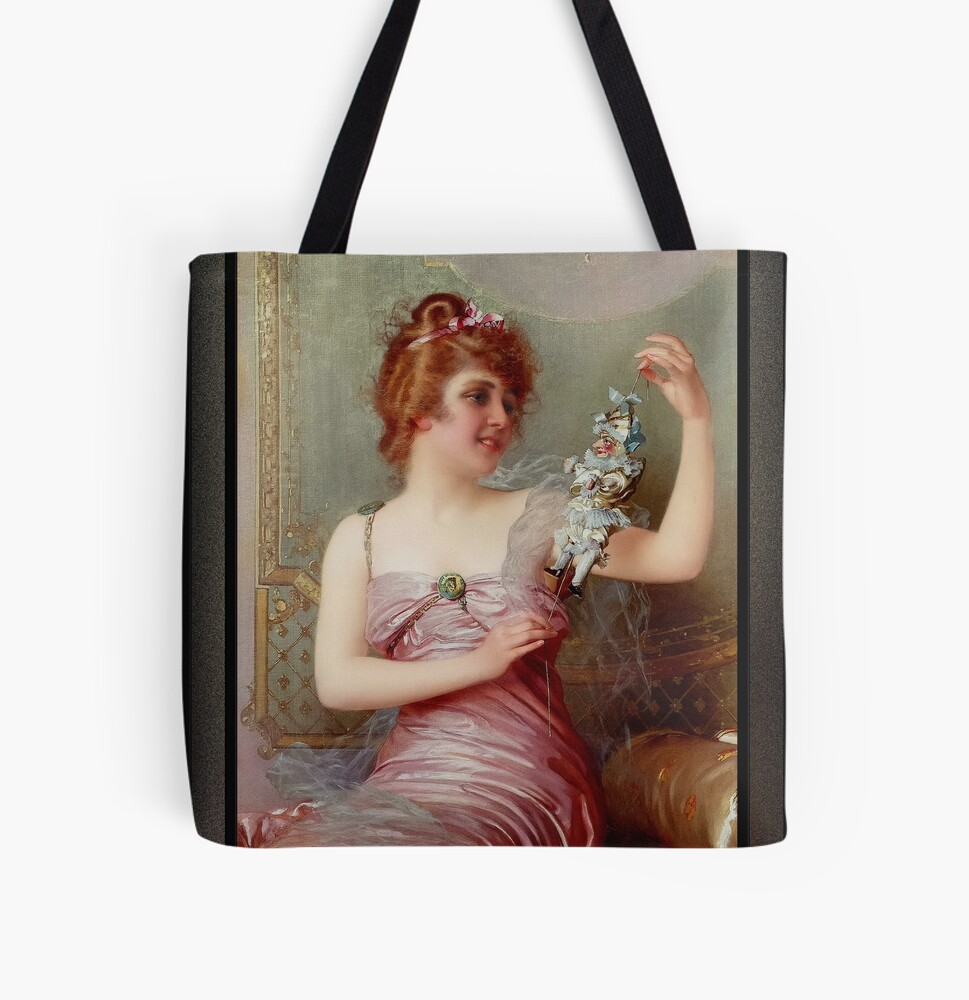
A beautiful young redhead with a red and white ribbon tied around her hair wearing a pink satin dress with chain shoulder straps and coin embellishments is playing with a puppet as she sits on a couch covered with embroidered satin cloth.
The Play Thing is a retouched digital art old masters reproduction of a public domain image, ac fel gyda'r holl waith celf sydd i'w gael ar wefan Xzendor7, mae ar gael i'w brynu ar-lein mewn amrywiaeth o fformatau deunydd gan gynnwys printiau cynfas, printiau acrylig, printiau metel, printiau pren, printiau wedi'u fframio, posteri, ac fel printiau cynfas wedi'u rholio mewn amrywiaeth o feintiau o 12 modfedd i 72 modfeddi yn dibynnu ar faint y gwaith celf gwirioneddol a'r siop argraffu ar alw y byddwch yn dewis prynu'r celf ohoni.
Gwybodaeth Islaw sy'n Deillio o Wikipedia.org
Vittorio was born to Jewish parents, Isacco e Giuditta Baquis, in Livorno, and at the age of 16, he obtained is artistic training at the Academy of Fine Arts of Florence under the tutelage of Italian Painter Enrico Pollastrini (1817 – 1876).
Then between 1878 a 1879 he worked under Italian Painter Domenico Morelli (1826 – 1901) in Naples; known for producing historical and religious paintings; and who was considered to be a great influence in the arts of the second half of the 19th Century.
Vittorio then traveled to Paris where he met French Painter Léon Bonnat (1833 – 1922), and signed a contract with the Goupil & Cie a leading dealership in 19th century France, from which he was able to supplement his income as a portrait painter with illustrations for magazines.
He frequented the circles of Italian Painter Giuseppe De Nittis (considered to be one of the most important Italian Painters of the 19th century); ac o 1881 tan 1886, he frequently exhibited at the Salon.

Yn 1886 Vittorio returned to Italy, putatively to join the army, and then settled in Florence. At which time he converted to Catholicism and married a widow named Emma Ciabatti.
In Florence, he made friends in the intellectual circles of the time, and made portraits of Italian Realist painter Silvestro Lega (1826 – 1895), Italian Poet Giosue Carducci (1835 – 1907), and Italian Composer Pietro Mascagni (1863 – 1945).
Wedi 1900, he wrote for the Florentine Journal Il Marzocco.; as well as published a short story in the magazine Fanfulla della Domenica titled Mademoiselle Leprince.
Yn 1904, he traveled to Potsdam to paint Emperor William II (1859 – 1941) and other members of the German monarchy.
During World War I in 1916, Vittorio’s son died in battle. Later in the 1920s he joined the Gruppo Labronico along with Italian Painters Plinio Nomellini (1866 – 1943) and Ulvi Liegi (1858 – 1939).
He also painted portraits of Mussolini (Benito Amilcare Andrea Mussolini 1883 – 1945) yn 1928; Countess Annina Morosini (1924 – 1965); Countess Nerina Volpi di Misurata; Carducci, Puccini and Mascagni; Queen Amélie of Portugal and Princess of Orleans.