

The Play Thing
The Play Thing c1897 by Italian Painter Vittorio Matteo Corcos (1859 – 1933); kjent for sitt sjangerkunstverk som skildrer fint kledde menn og kvinner i tider med fritid og lek.
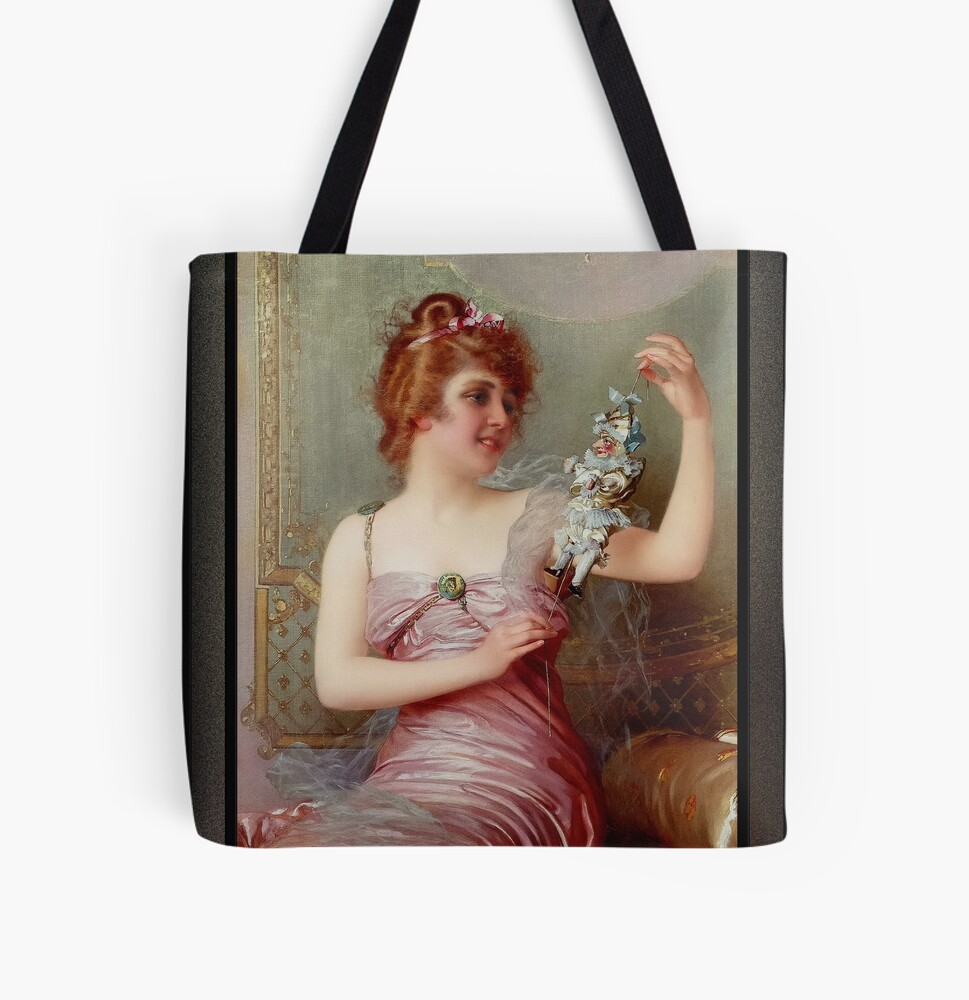
A beautiful young redhead with a red and white ribbon tied around her hair wearing a pink satin dress with chain shoulder straps and coin embellishments is playing with a puppet as she sits on a couch covered with embroidered satin cloth.
The Play Thing is a retouched digital art old masters reproduction of a public domain image, og som med alle kunstverkene som finnes på Xzendor7-nettstedet, er det tilgjengelig for kjøp online i en rekke materialformater, inkludert lerretstrykk, akryltrykk, metalltrykk, treutskrifter, innrammede trykk, plakater, og som rullede lerretstrykk i en rekke størrelser fra 12 tommer til 72 tommer avhengig av størrelsen på det faktiske kunstverket og print on demand-butikken du velger å kjøpe kunsten fra.
Info nedenfor avledet fra Wikipedia.org
Vittorio ble født av jødiske foreldre, Isaac og Giuditta Baquis, i Livorno, og i en alder av 16, he obtained is artistic training at the Academy of Fine Arts of Florence under the tutelage of Italian Painter Enrico Pollastrini (1817 – 1876).
Then between 1878 og 1879 he worked under Italian Painter Domenico Morelli (1826 – 1901) in Naples; known for producing historical and religious paintings; and who was considered to be a great influence in the arts of the second half of the 19th Century.
Vittorio then traveled to Paris where he met French Painter Léon Bonnat (1833 – 1922), and signed a contract with the Goupil & Cie a leading dealership in 19th century France, from which he was able to supplement his income as a portrait painter with illustrations for magazines.
He frequented the circles of Italian Painter Giuseppe De Nittis (considered to be one of the most important Italian Painters of the 19th century); og fra 1881 før 1886, he frequently exhibited at the Salon.

I 1886 Vittorio returned to Italy, putatively to join the army, and then settled in Florence. At which time he converted to Catholicism and married a widow named Emma Ciabatti.
In Florence, he made friends in the intellectual circles of the time, and made portraits of Italian Realist painter Silvestro Lega (1826 – 1895), Italian Poet Giosue Carducci (1835 – 1907), and Italian Composer Pietro Mascagni (1863 – 1945).
After 1900, he wrote for the Florentine Journal Il Marzocco.; as well as published a short story in the magazine Fanfulla della Domenica titled Mademoiselle Leprince.
I 1904, he traveled to Potsdam to paint Emperor William II (1859 – 1941) and other members of the German monarchy.
During World War I in 1916, Vittorio’s son died in battle. Later in the 1920s he joined the Gruppo Labronico along with Italian Painters Plinio Nomellini (1866 – 1943) and Ulvi Liegi (1858 – 1939).
He also painted portraits of Mussolini (Benito Amilcare Andrea Mussolini 1883 – 1945) i 1928; Countess Annina Morosini (1924 – 1965); Countess Nerina Volpi di Misurata; Carducci, Puccini and Mascagni; Queen Amélie of Portugal and Princess of Orleans.