

Goddess of Water
Goddess of Water by Russian Painter Konstantin Makovsky (1839 – 1915); gespecialiseerd in Russische historische schilderijen die een geïdealiseerd beeld geven van het Russische leven in de afgelopen eeuwen.
Het schilderij “Goddess of Water” is a masterful depiction of the divine beauty and power of water through classical mythology. The artist’s rich use of color, dramatische verlichting, and careful attention to detail create a vivid and serene representation of the goddess of water as she is transported by swans across a vast oceanic expanse.
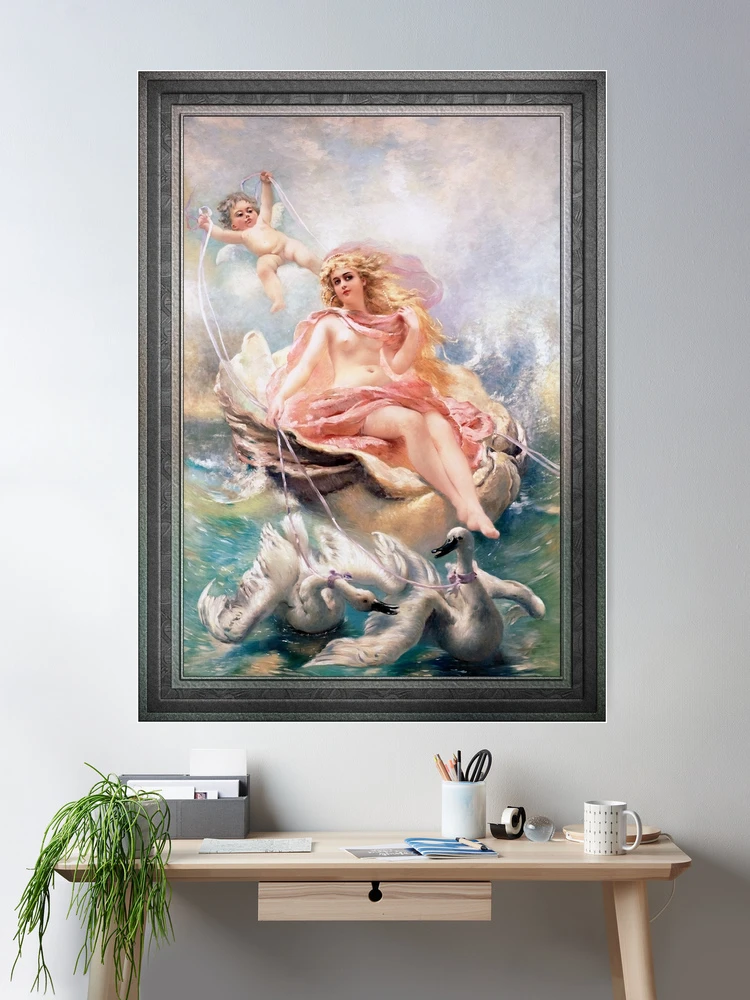
The central figure in the artwork is the goddess herself, a beautiful woman with flowing golden locks, her body partially draped in a pink and soft mauve sheer cloth that clings delicately to her form, revealing the curves of her body.
The goddess is seated serenely in a boat-like structure made of what appears to be soft seashells, floating on undulating waves, with a faint glow surrounding her, symbolizing her divine nature. Haar gezicht, calm and composed, carries an air of grace and timeless beauty, reinforcing the ethereal nature of her character.
Achter haar, a cherubic figure, a child-like angel, is tethered to the goddess by ribbons, symbolizing a divine connection between the mortal and the immortal. This child, whose face expresses innocence and purity, seems to guide or assist in the goddess’s journey across the waters.
The angel holds onto ribbons that extend out into the air, tethering the goddess to the swans pulling her vessel. The gentle hands of the cherub grasp the flowing ribbons with precision, and his childlike features lend a sense of playful innocence to the otherwise tranquil scene.
The swans, regal and powerful, are the carriers of the goddess, their long necks extending gracefully through the scene, and their white feathers rendered with a soft, almost glowing light, enhancing their majestic appearance.
The swans pull the boat forward, seemingly in motion as the ripples of water, shown through the smooth, soft waves, reflect the calmness of the scene. The swans’ presence in mythology often symbolizes purity and spiritual grace, which complements the goddess’s serene and powerful nature.
The background of the painting is a vast and dreamy oceanic landscape, badend in zacht, warm light, as if the sun itself is fading into the horizon. Het water, although calm and peaceful, seems to ripple with the movement of the swans, adding life and a sense of motion to the otherwise still moment. The sky above is filled with soft, billowy clouds, reminiscent of a serene and timeless world where the goddess’s presence is natural and eternal.
The mood of the painting is peaceful, sereen, and divine. The soft pastel colors used in the piece lend a sense of tranquility, while the glowing light surrounding the goddess and the angel enhances the mystical nature of the scene. There is a harmony in the painting that speaks to the balance of the elements—water, air, and earth—through the goddess’s gentle interaction with the swans, the water, and the sky.
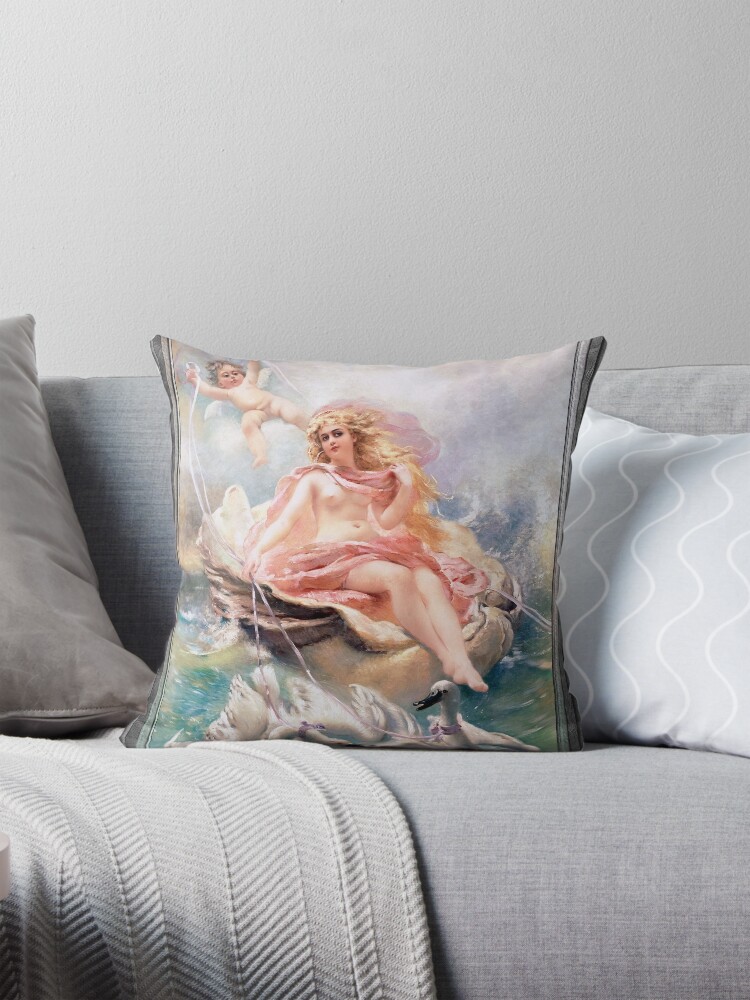
Makovsky’s mastery of classical techniques shines through in the detailed depiction of the figures, textures, and natural elements. The soft texture of the goddess’s flowing hair, the delicate folds of her clothing, and the smoothness of the swans’ feathers all demonstrate his skill in bringing the ethereal into the visual realm. Het licht, radiant atmosphere throughout the artwork communicates the theme of purity, goddelijkheid, and the eternal cycle of nature.
The theme of water as a symbol of life, zuiverheid, and fertility is prevalent in the painting. The goddess of water, accompanied by the cherubic guide and the swans, creates a powerful and harmonious image of nature’s beauty and divine intervention.
Water in mythological contexts often represents fluidity, change, and the nurturing aspects of life, all of which are conveyed through the painting’s serene depiction of the goddess as she floats effortlessly across the waters.
This painting embodies the 19th-century Russian fascination with classical themes, blending mythological subjects with a refined and sophisticated approach to realism. It showcases a period of artistic exploration that was both romantic and idealized, drawing on ancient mythological figures to embody ideals of beauty, elegantie, and divine connection with nature.
Tot slot, “Goddess of Water” is a masterpiece that combines the beauty of nature with the divine, creating a serene, mystical atmosphere that is both timeless and transcendent. The detailed execution, the symbolic presence of the goddess, angel, and swans, en de zachte, flowing colors make this piece a vivid representation of classical mythology, encapsulating the quiet power of water as an eternal, life-giving force.
Info hieronder afgeleid van Wikipedia.org
Konstantin Makovsky was een invloedrijke Russische schilder, aangesloten bij de “Peredvizhniki (Zwervers)”. Veel van zijn historische schilderijen, zoals onder de kroon (1889) ook bekend als de kleding van de Russische bruid en voor de bruiloft, toonde een geïdealiseerd beeld van het Russische leven van voorgaande eeuwen. Hij wordt vaak beschouwd als een vertegenwoordiger van de academische kunst.
Konstantin Makovsky werd geboren in Moskou. Zijn vader was de Russische kunstfiguur en amateurschilder, Yegor Ivanovitsj Makovsky. Zijn moeder was een componist, en ze hoopte dat haar zoon op een dag in haar voetsporen zou treden. Zijn jongere broers Vladimir en Nikolay en zijn zus Alexandra werden ook schilders.
In 1851 Makovsky ging naar de Moskouse schilderschool, Beeldhouwkunst en architectuur waar hij de beste student werd, gemakkelijk alle beschikbare onderscheidingen krijgen. Zijn leraren waren Karl Bryullov en Vasily Tropinin. Makovsky's neigingen tot romantiek en decoratieve effecten kunnen worden verklaard door de invloed van Bryullov.
Hoewel kunst zijn passie was, hij dacht ook na over wat zijn moeder had gewild dat hij deed. Hij ging op zoek naar componisten naar wie hij kon verwijzen, en ging eerst naar Frankrijk. Voordat, hij was altijd een liefhebber van klassieke muziek geweest, en luisterde naar veel stukken. Hij wenste vaak dat hij de melodie kon veranderen, of stijl van sommigen om ze leuker te maken. Later in zijn leven kwam het uit.
In 1858 Makovsky ging naar de keizerlijke kunstacademie in Sint-Petersburg. Van 1860 hij nam deel aan de tentoonstellingen van de Academie met schilderijen zoals Curing of the Blind (1860) en agenten van de valse Dmitry doden de zoon van Boris Godunov (1862). In 1863 Makovsky en dertien andere studenten hielden een protest tegen de instelling van onderwerpen uit de Scandinavische mythologie door de Academie in de competitie voor de Grote Gouden Medaille van de Academia; allen verlieten de academie zonder een formeel diploma.
Makovsky werd lid van een coöperatie (artel) van kunstenaars onder leiding van Ivan Kramskoi, typisch het produceren van Wanderers-schilderijen over het dagelijks leven (Weduwe 1865, Haring-verkoper 1867, enz.). Van 1870 hij was een van de oprichters van de Society for Traveling Art Exhibitions en bleef werken aan schilderijen die gewijd waren aan het dagelijks leven. Hij exposeerde zijn werken op zowel de Academia-tentoonstellingen als de Travelling Art Exhibitions of the Wanderers.
Een belangrijke verandering in zijn stijl vond plaats na een reis naar Egypte en Servië in het midden van de jaren 1870. Zijn interesses veranderden van sociale en psychologische problemen naar de artistieke problemen van kleur en vorm.
In de jaren 1880 werd hij een modieuze auteur van portretten en historische schilderijen. Op de Wereldtentoonstelling van 1889 in Parijs ontving hij de Grote Gouden Medaille voor zijn schilderijen Dood van Ivan de Verschrikkelijke, Het oordeel van Parijs, en Demon en Tamara. Hij was een van de meest gewaardeerde en best betaalde Russische kunstenaars van die tijd. Veel democratische critici beschouwden hem als een afvallige van de Wanderers’ idealen, produceren (zoals Henryk Siemiradzki) opvallende maar oppervlakkige werken,[2] terwijl anderen hem zien als een voorloper van het Russische impressionisme.
Makovsky werd vermoord in 1915 toen zijn paardenkoets werd aangereden door een elektrische tram in Sint-Petersburg.