

The Russian Brides Attire
The Russian Brides Attire c1889 by Russian Painter Konstantin Makovsky (1839 – 1915); specialiserad på ryska historiska målningar som visar en idealiserad syn på det ryska livet under tidigare århundraden.
Konstantin Makovsky’s The Russian Brides Attire (1889) presents a captivating glimpse into the ceremonial preparations of a Russian bride in a traditional 19th-century setting. The scene is set within an intimate, richly adorned room where the bride-to-be, poised in anticipation, is surrounded by her closest family and friends. This historical genre painting, rooted deeply in Russian culture, reflects both the bride’s personal moment and the social customs of the time.
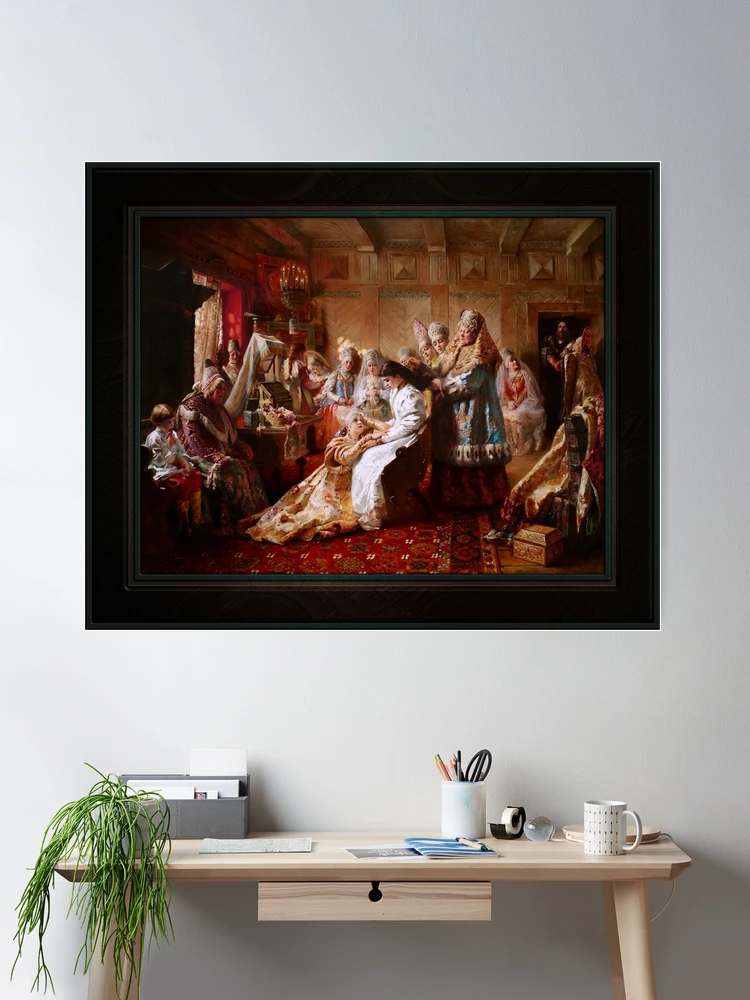
At the heart of the painting sits the young bride, dressed in an opulent, meticulously detailed gown of traditional Russian wedding attire. The intricacies of her attire are striking; every fold and embellishment in her richly embroidered dress echoes the skill and craftsmanship of the period. The gown’s texture, enhanced by the gentle play of light, emphasizes its luxurious fabric, hinting at the bride’s high social standing.
Klänningen, with its intricate patterns and vibrant colors, combines tradition with beauty, setting her apart as the central figure in the composition. Hennes uttryck, serene yet tinged with the anticipation of the upcoming union, contributes to the painting’s overall sense of reverence for this momentous life event.
The surrounding figures enhance the emotional depth of the scene. Bridesmaids, family members, and an attentive mother are present, each contributing to the bride’s preparations. The bridal party’s clothing is also detailed, showcasing the opulence typical of the Russian aristocracy during the era.
These individuals are all engaged in the intimate tasks of finalizing the bride’s appearance, with one figure seated at the bride’s feet, holding her hands tenderly—a subtle gesture of familial connection and support. I kontrast, a young man, possibly the groom, appears at the threshold of the room, holding a gift box. His presence is restrained, his access to the bride’s space halted by a gentle but firm barrier, as custom would dictate.
The setting further complements the mood of the painting. The room is lavishly decorated, with dark, rich tones contrasting against the soft glow of candlelight and the bride’s radiant attire. This use of light symbolizes both the bride’s purity and the solemnity of the occasion.
The opulent, antique furniture and the delicate furnishings suggest an upper-class household, indicative of the wealth and status of the bride’s family. These elements come together to transport the viewer to the Russian nobility’s private spaces, where tradition and social rituals were deeply ingrained.
Makovsky’s approach to the painting reflects his expertise in academic art and historical realism, grounded in his training and experience with the Peredvizhniki (Vandrare) rörelse. Known for portraying the everyday lives of Russians, Makovsky’s work in Den ryska brudens klädsel transcends mere documentation, offering an emotional portrait of a pivotal moment in a young woman’s life. His mastery of detail, Färg, and light conveys a sense of reverence for the traditions of Russian weddings, while the gentle interactions between the figures in the scene imbue the work with a sense of warmth and familial love.
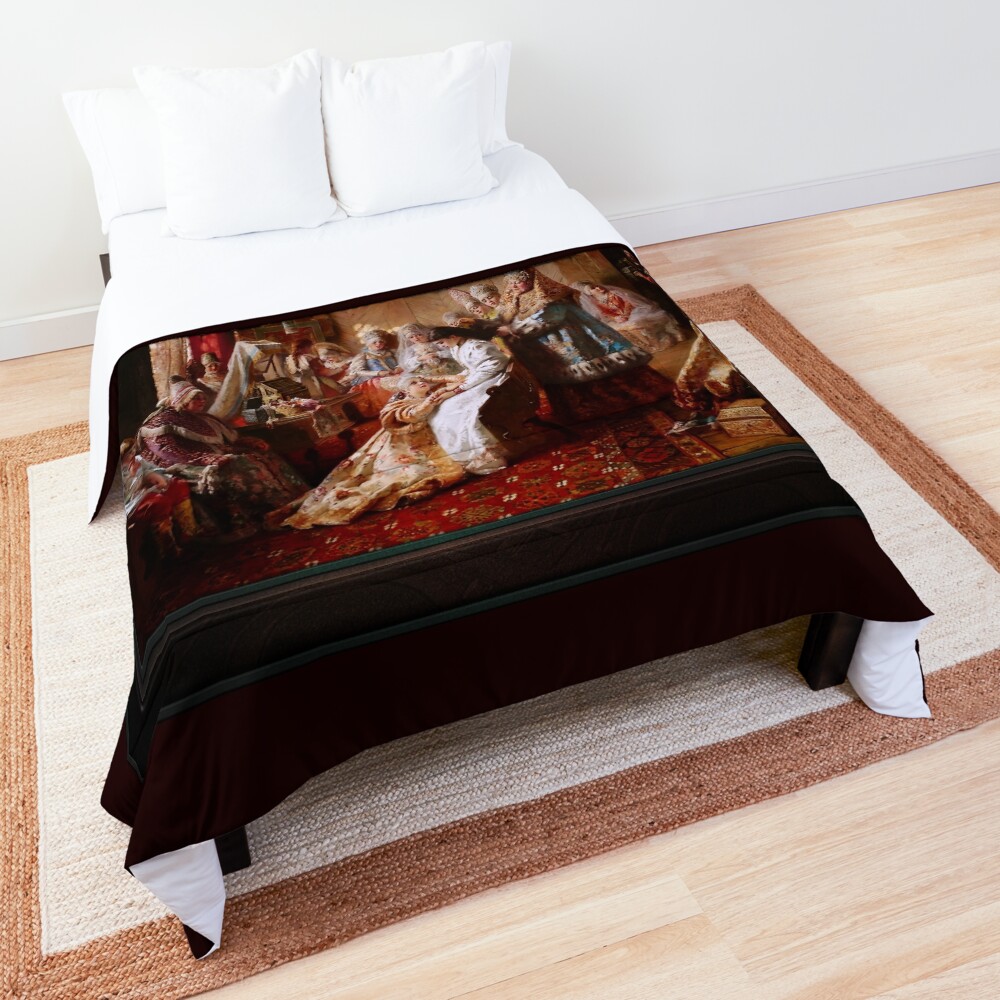
The mood of the painting is one of quiet anticipation, ceremonial dignity, and a deep respect for cultural traditions. The bride is presented not just as the central figure in a social ritual, but as a symbol of purity, continuity, and heritage.
The work conveys a mixture of joy and solemnity, emphasizing the gravity of the wedding ceremony while celebrating the familial bonds that are integral to it. The groom, awaiting his bride’s arrival, is a figure of patience and longing, and the space between the bride and groom symbolizes the sacredness and exclusivity of the pre-wedding ritual.
Stilmässigt, Den ryska brudens klädsel is a quintessential example of Russian academic realism. Makovsky’s technique, with its sharp focus on the textures of fabrics, the naturalism of facial expressions, and the subtle play of light, creates a vivid, almost tangible atmosphere.
The figures are carefully posed to convey a sense of unity and purpose, while the careful rendering of the bride’s dress and the surrounding details showcases the artist’s skill in depicting texture and material.
Tematiskt, the work explores the cultural importance of the Russian wedding, which was more than just a personal event—it was a public and familial milestone. Through the artist’s portrayal of the bride’s attire, the familial interaction, and the ceremonial anticipation, the viewer is invited to witness an intimate, yet highly structured moment in Russian society. The painting also highlights the role of tradition in Russian culture, where customs surrounding marriage were highly ritualized and carefully observed.
Den ryska brudens klädsel is not only a visual narrative of a traditional wedding but also an insightful reflection of the values and customs of 19th-century Russian aristocracy. It stands as a testament to Konstantin Makovsky’s ability to blend historical accuracy with emotional depth, offering the viewer a vivid portrayal of Russian cultural heritage at its most beautiful and ceremonial.
Detta är en retuscherad digital konst gammal mästare reproduktion av en public domain image.
Info nedan härledd från Wikipedia.org
Konstantin Makovsky var en inflytelserik rysk målare, anslutna till “Peredvizhniki (Vandrare)”. Många av hans historiska målningar, såsom Beneath the Crown (1889) även känd som The Russian Bride's Attire och Before the Wedding, visade en idealiserad syn på det ryska livet under tidigare århundraden. Han anses ofta vara en representant för akademisk konst.
Konstantin Makovsky föddes i Moskva. Hans far var den ryska konstfiguren och amatörmålaren, Yegor Ivanovich Makovsky. Hans mamma var en kompositör, och hon hoppades att hennes son en dag skulle följa i hennes fotspår. Hans yngre bröder Vladimir och Nikolay och hans syster Alexandra blev också målare.
I 1851 Makovsky gick in i Moskvaskolan för måleri, Skulptur och arkitektur där han blev toppstudent, enkelt få alla tillgängliga utmärkelser. Hans lärare var Karl Bryullov och Vasily Tropinin. Makovskys böjelser för romantik och dekorativa effekter kan förklaras av Bryullovs inflytande.
Även om konsten var hans passion, han funderade också på vad hans mamma hade velat att han skulle göra. Han gav sig iväg för att leta efter kompositörer han kunde hänvisa till, och åkte först till Frankrike. Innan, han hade alltid varit en älskare av klassisk musik, och lyssnade på många stycken. Han önskade ofta att han kunde ändra låten, eller stil på några av dem för att göra dem roligare. Senare i hans liv blev det verklighet.
I 1858 Makovsky gick in på Imperial Academy of Arts i Sankt Petersburg. Från 1860 han deltog i Akademiens utställningar med målningar som Curing of the Blind (1860) och Agenter of the False Dmitry dödar Boris Godunovs son (1862). I 1863 Makovsky och tretton andra studenter höll en protest mot Akademins inställning av ämnen från skandinavisk mytologi i tävlingen om den stora guldmedaljen för akademin; alla lämnade akademin utan formellt diplom.
Makovsky blev medlem i ett kooperativ (artel) av konstnärer under ledning av Ivan Kramskoi, producerar typiskt Wanderers-målningar i vardagen (Änka 1865, Sill-säljare 1867, etc.). Från 1870 han var en av grundarna av Society for Travelling Art Exhibitions och fortsatte att arbeta med målningar som ägnas åt vardagslivet. Han ställde ut sina verk på både Academia-utställningarna och Vandrarnas resande konstutställningar.
En betydande förändring i hans stil inträffade efter att ha rest till Egypten och Serbien i mitten av 1870-talet. Hans intressen förändrades från sociala och psykologiska problem till de konstnärliga problemen med färger och form.
På 1880-talet blev han en fashionabel författare av porträtt och historiska målningar. På världsutställningen i 1889 i Paris fick han den stora guldmedaljen för sina målningar Ivan den förskräckliges död, Parisdomen, och Demon och Tamara. Han var en av den tidens mest uppskattade och högt betalda ryska artister. Många demokratiska kritiker ansåg honom som en överlöpare från Wanderers’ ideal, producerar (som Henryk Siemiradzki) slående men ytliga verk,[2] medan andra ser honom som en föregångare till den ryska impressionismen.
Makovsky dödades i 1915 när hans häst och vagn blev påkörd av en elektrisk spårvagn i Sankt Petersburg.