

Goddess of Water
Goddess of Water by Russian Painter Konstantin Makovsky (1839 – 1915); specialiserad på ryska historiska målningar som visar en idealiserad syn på det ryska livet under tidigare århundraden.
Målningen “Goddess of Water” is a masterful depiction of the divine beauty and power of water through classical mythology. The artist’s rich use of color, dramatisk belysning, and careful attention to detail create a vivid and serene representation of the goddess of water as she is transported by swans across a vast oceanic expanse.
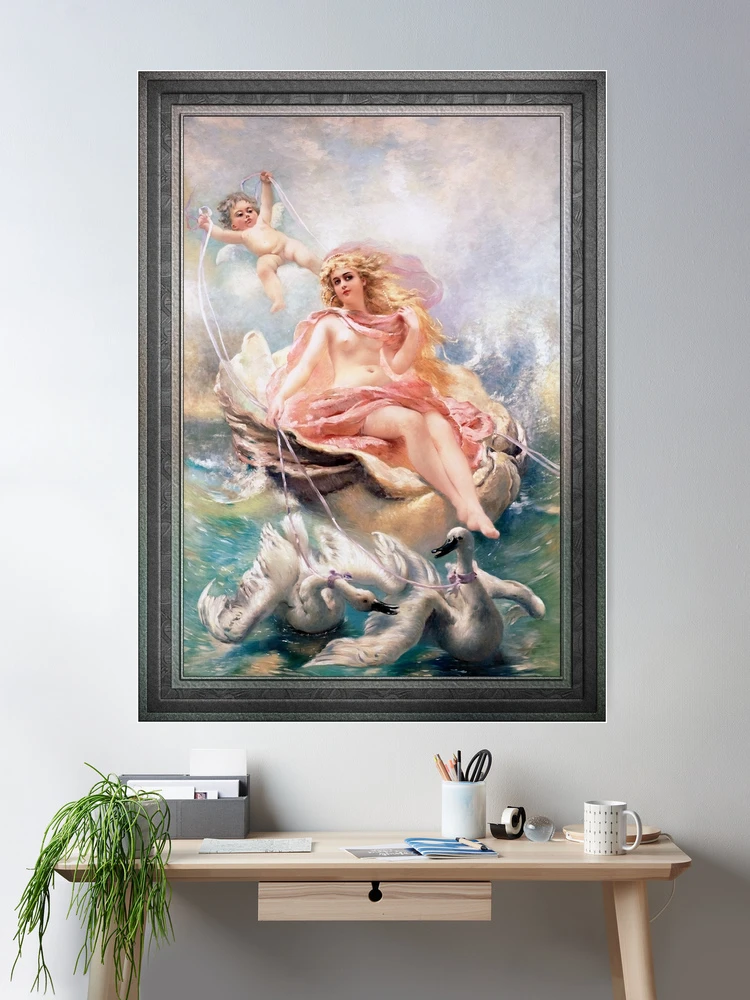
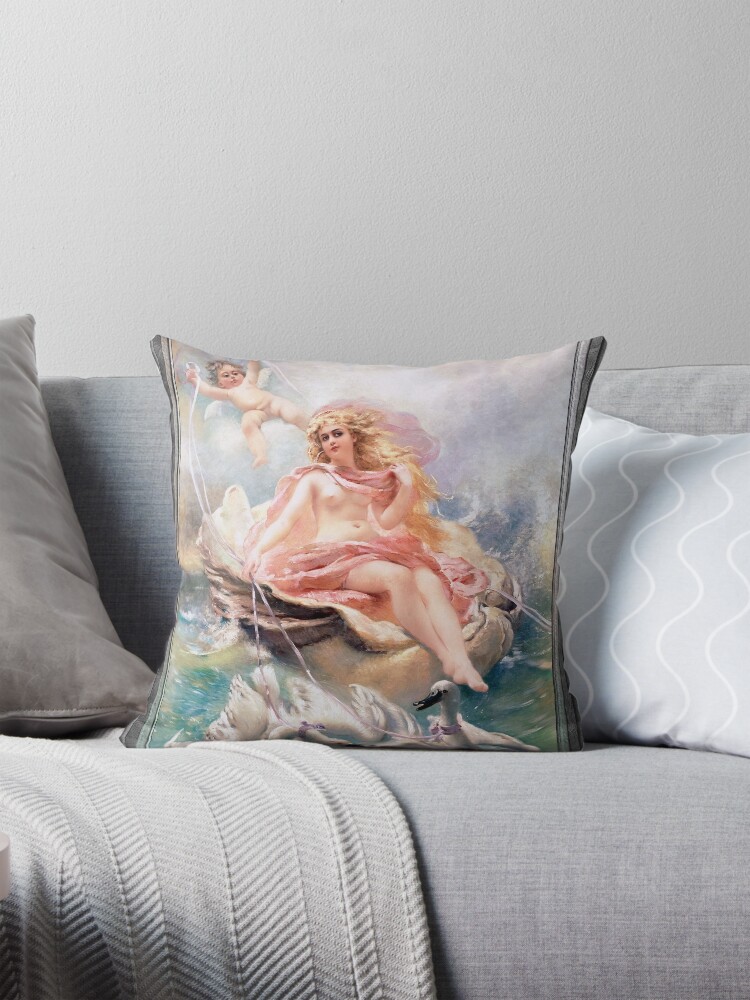
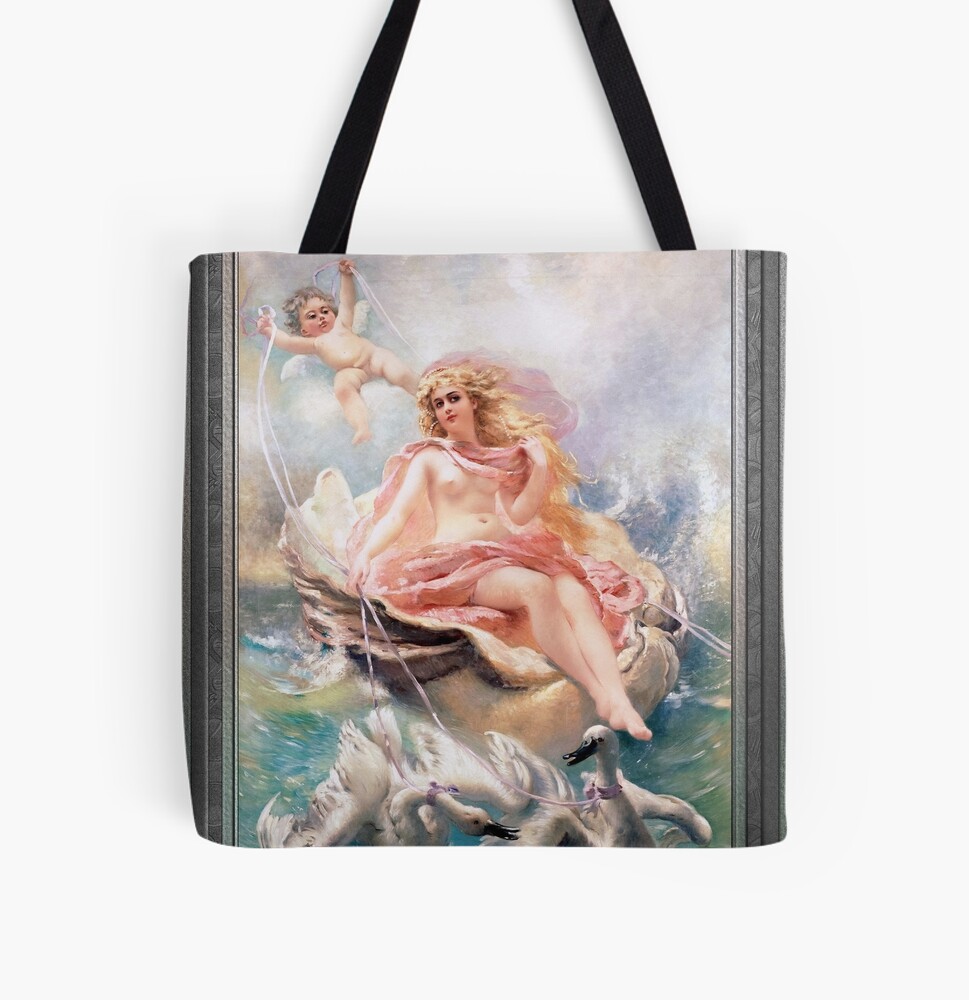
The central figure in the artwork is the goddess herself, a beautiful woman with flowing golden locks, her body partially draped in a pink and soft mauve sheer cloth that clings delicately to her form, revealing the curves of her body.
The goddess is seated serenely in a boat-like structure made of what appears to be soft seashells, floating on undulating waves, with a faint glow surrounding her, symbolizing her divine nature. Hennes ansikte, calm and composed, carries an air of grace and timeless beauty, reinforcing the ethereal nature of her character.
Bakom henne, a cherubic figure, a child-like angel, is tethered to the goddess by ribbons, symbolizing a divine connection between the mortal and the immortal. This child, whose face expresses innocence and purity, seems to guide or assist in the goddess’s journey across the waters.
The angel holds onto ribbons that extend out into the air, tethering the goddess to the swans pulling her vessel. The gentle hands of the cherub grasp the flowing ribbons with precision, and his childlike features lend a sense of playful innocence to the otherwise tranquil scene.
The swans, regal and powerful, are the carriers of the goddess, their long necks extending gracefully through the scene, and their white feathers rendered with a soft, almost glowing light, enhancing their majestic appearance.
The swans pull the boat forward, seemingly in motion as the ripples of water, shown through the smooth, soft waves, reflect the calmness of the scene. The swans’ presence in mythology often symbolizes purity and spiritual grace, which complements the goddess’s serene and powerful nature.
The background of the painting is a vast and dreamy oceanic landscape, badade i mjukt, warm light, as if the sun itself is fading into the horizon. Vattnet, although calm and peaceful, seems to ripple with the movement of the swans, adding life and a sense of motion to the otherwise still moment. The sky above is filled with soft, billowy clouds, reminiscent of a serene and timeless world where the goddess’s presence is natural and eternal.
The mood of the painting is peaceful, lugn, and divine. The soft pastel colors used in the piece lend a sense of tranquility, while the glowing light surrounding the goddess and the angel enhances the mystical nature of the scene. There is a harmony in the painting that speaks to the balance of the elements—water, air, and earth—through the goddess’s gentle interaction with the swans, vattnet, and the sky.
Makovsky’s mastery of classical techniques shines through in the detailed depiction of the figures, texturer, and natural elements. The soft texture of the goddess’s flowing hair, the delicate folds of her clothing, and the smoothness of the swans’ feathers all demonstrate his skill in bringing the ethereal into the visual realm. Ljuset, radiant atmosphere throughout the artwork communicates the theme of purity, gudomlighet, and the eternal cycle of nature.
The theme of water as a symbol of life, renhet, and fertility is prevalent in the painting. The goddess of water, accompanied by the cherubic guide and the swans, creates a powerful and harmonious image of nature’s beauty and divine intervention.
Water in mythological contexts often represents fluidity, ändra, and the nurturing aspects of life, all of which are conveyed through the painting’s serene depiction of the goddess as she floats effortlessly across the waters.
This painting embodies the 19th-century Russian fascination with classical themes, blending mythological subjects with a refined and sophisticated approach to realism. It showcases a period of artistic exploration that was both romantic and idealized, drawing on ancient mythological figures to embody ideals of beauty, nåd, and divine connection with nature.
Sammanfattningsvis, “Goddess of Water” is a masterpiece that combines the beauty of nature with the divine, creating a serene, mystical atmosphere that is both timeless and transcendent. The detailed execution, the symbolic presence of the goddess, angel, and swans, och den mjuka, flowing colors make this piece a vivid representation of classical mythology, encapsulating the quiet power of water as an eternal, life-giving force.
Info nedan härledd från Wikipedia.org
Konstantin Makovsky var en inflytelserik rysk målare, anslutna till “Peredvizhniki (Vandrare)”. Många av hans historiska målningar, såsom Beneath the Crown (1889) även känd som The Russian Bride's Attire och Before the Wedding, visade en idealiserad syn på det ryska livet under tidigare århundraden. Han anses ofta vara en representant för akademisk konst.
Konstantin Makovsky föddes i Moskva. Hans far var den ryska konstfiguren och amatörmålaren, Yegor Ivanovich Makovsky. Hans mamma var en kompositör, och hon hoppades att hennes son en dag skulle följa i hennes fotspår. Hans yngre bröder Vladimir och Nikolay och hans syster Alexandra blev också målare.
I 1851 Makovsky gick in i Moskvaskolan för måleri, Skulptur och arkitektur där han blev toppstudent, enkelt få alla tillgängliga utmärkelser. Hans lärare var Karl Bryullov och Vasily Tropinin. Makovskys böjelser för romantik och dekorativa effekter kan förklaras av Bryullovs inflytande.
Även om konsten var hans passion, han funderade också på vad hans mamma hade velat att han skulle göra. Han gav sig iväg för att leta efter kompositörer han kunde hänvisa till, och åkte först till Frankrike. Innan, han hade alltid varit en älskare av klassisk musik, och lyssnade på många stycken. Han önskade ofta att han kunde ändra låten, eller stil på några av dem för att göra dem roligare. Senare i hans liv blev det verklighet.
I 1858 Makovsky gick in på Imperial Academy of Arts i Sankt Petersburg. Från 1860 han deltog i Akademiens utställningar med målningar som Curing of the Blind (1860) och Agenter of the False Dmitry dödar Boris Godunovs son (1862). I 1863 Makovsky och tretton andra studenter höll en protest mot Akademins inställning av ämnen från skandinavisk mytologi i tävlingen om den stora guldmedaljen för akademin; alla lämnade akademin utan formellt diplom.
Makovsky blev medlem i ett kooperativ (artel) av konstnärer under ledning av Ivan Kramskoi, producerar typiskt Wanderers-målningar i vardagen (Änka 1865, Sill-säljare 1867, etc.). Från 1870 han var en av grundarna av Society for Travelling Art Exhibitions och fortsatte att arbeta med målningar som ägnas åt vardagslivet. Han ställde ut sina verk på både Academia-utställningarna och Vandrarnas resande konstutställningar.
En betydande förändring i hans stil inträffade efter att ha rest till Egypten och Serbien i mitten av 1870-talet. Hans intressen förändrades från sociala och psykologiska problem till de konstnärliga problemen med färger och form.
På 1880-talet blev han en fashionabel författare av porträtt och historiska målningar. På världsutställningen i 1889 i Paris fick han den stora guldmedaljen för sina målningar Ivan den förskräckliges död, Parisdomen, och Demon och Tamara. Han var en av den tidens mest uppskattade och högt betalda ryska artister. Många demokratiska kritiker ansåg honom som en överlöpare från Wanderers’ ideal, producerar (som Henryk Siemiradzki) slående men ytliga verk,[2] medan andra ser honom som en föregångare till den ryska impressionismen.
Makovsky dödades i 1915 när hans häst och vagn blev påkörd av en elektrisk spårvagn i Sankt Petersburg.