

The Three Aces
“The Three Aces” is a magnificent painting created by Italian artist Vittorio Matteo Corcos (1859 – 1933) in the late 19th to early 20th century, specifically around 1900. Nasceu em 1859, Corcos became renowned for his vivid depictions of elegant women, their expressions, and social settings that reflect both the aristocracy and the refined societal circles of the time. Esta pintura, marked by his impeccable attention to detail, invites the viewer into a world of sophisticated leisure and subtle intrigue. It presents a scene of high society, offering not only a glimpse into the lives of the upper class but also insight into the artist’s remarkable technique.
Índice
O Assunto Principal e Composição
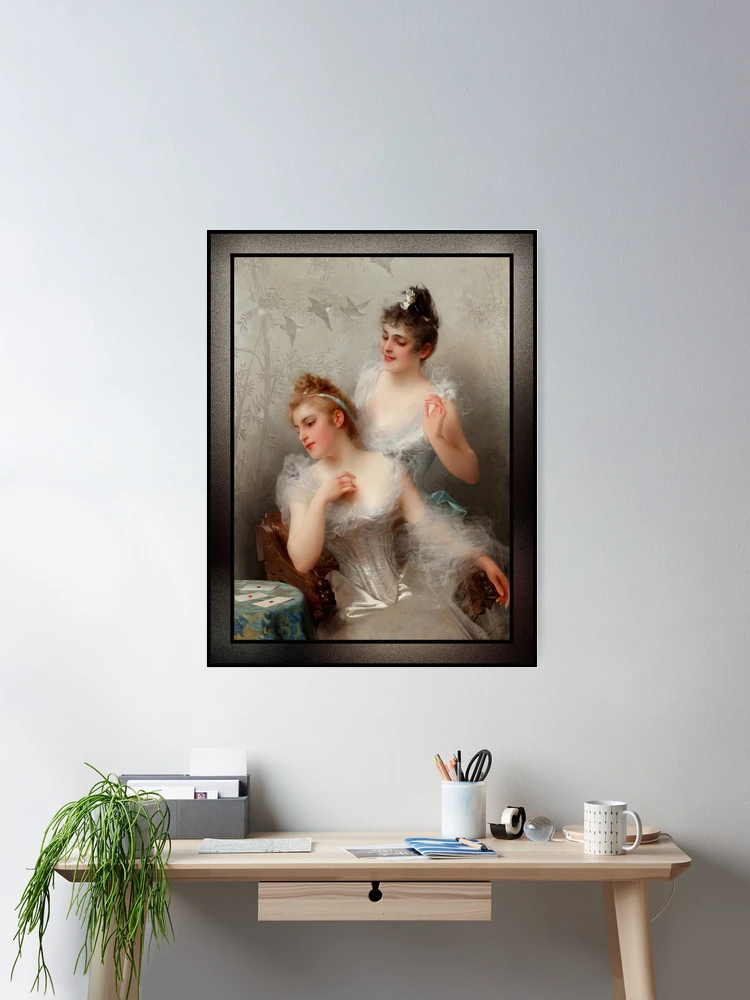
Dentro “The Three Aces,” the focus is on two women sitting together at a table, engaged in a playful moment. The scene is rich with subtle emotion, portraying two women in intricate, opulent attire, suggesting the care and attention given to their roles as part of society’s elite.
One of the women is seated in the foreground, her delicate, almost ethereal appearance marked by soft pastel hues. She is dressed in a corset that hugs her figure and is adorned with lace and fine fabric, creating a sense of formality, while her soft expression carries a hint of amusement. Her companion, standing behind her, seems more relaxed, offering a slight, playful smile that adds an air of intimacy and lightness to the composition.
The table between them adds a layer of interaction in the piece, its surface adorned with scattered playing cards. The presence of the cards is intriguing, as it symbolizes both a game of chance and a metaphorical reflection on life and fortune. The game is seemingly a part of their casual leisure, but it also hints at the uncertainties and playful risks inherent in high society, where appearance and reality often blur.
The two women’s hairstyles are another key element of the composition. Their luxurious hair is meticulously styled, with the first woman wearing a headband of blue that contrasts softly against the light tones of her hair. The other woman’s hair is slightly darker, adorned with flowers in the style of the period, symbolizing both youth and fertility. Their coiffures are not just fashion statements but also markers of their social status and refinement.
O cenário e os materiais
The background of the painting is just as significant as the figures in the foreground. O macio, muted tones of the room complement the vibrant yet refined colors of the women’s attire. The neutral background is filled with delicate, almost dreamlike birds flying, adding a touch of motion to the otherwise still scene.
These ethereal creatures, drawn with great attention to detail, are almost like a breath of air against the otherwise soft, heavy atmosphere of the women’s lavish surroundings. A sala, faintly textured with floral wallpaper, is furnished with antique furniture, subtly reinforcing the sense of wealth and comfort.
The light that falls on the women and the surrounding environment highlights the masterful technique Corcos employed. The use of soft lighting and shadows creates a harmonious blend of realism and idealization. O pálido, translucent fabrics of the women’s dresses glow in the light, and the texture of the lace and delicate veils they wear suggests an almost tactile reality that pulls the viewer into their world. Corcos’ command of light and texture captures the subtle shimmer of silk and lace, elevating the scene to an almost romantic level of beauty.
Estilo, Tema, e humor
Corcos’ style in this piece is a harmonious blend of realism with a touch of idealization that was characteristic of the late 19th century and early 20th century art. His use of soft pastels and delicate brushwork aligns with the aesthetic of the Belle Époque period, onde a beleza, leisure, and luxury were celebrated through visual art. The women in “The Three Aces” are painted with a refined elegance that speaks to their high social status and an inherent sense of grace.
The theme of the painting is one of leisure, beleza, and subtle interaction. There is a palpable tension between the playful nature of the card game and the elegance of the women involved. It’s as if the cards represent a moment of respite in the lives of women who, despite their opulence, are engaged in the simple joys of companionship and a fleeting game of chance. Their poised yet serene expressions suggest that, even in moments of frivolity, they are part of a larger social dance where appearances are carefully managed.
The mood of the painting is one of quiet contemplation, with an undertone of intrigue. The playfulness of the game contrasts with the reserved expressions of the women, hinting at an inner world that is not immediately apparent. The softness of the colors and textures reinforces the tranquil atmosphere, making this work both visually striking and emotionally resonant. There is an element of timelessness in the painting, where the transient nature of the game is captured alongside the eternal qualities of beauty and poise.
Conclusão
Dentro “The Three Aces,” Vittorio Matteo Corcos has once again demonstrated his mastery in capturing the nuances of high society life. Through his meticulous rendering of his subjects and their environment, he invites us to appreciate both the elegance and the fleeting nature of the moment he portrays. The painting is not just a representation of two women in a luxurious setting, but a window into a world where the richness of life and the allure of social games coexist with beauty, graça, and the quiet tension of everyday interactions.
The Three Aces is a retouched digital art old masters reproduction of a public domain image.
BIO do artista derivado de Wikipedia.org
Vittorio was born to Jewish parents, Isacco e Giuditta Baquis, in Livorno, e na idade de 16, he obtained is artistic training at the Academy of Fine Arts of Florence under the tutelage of Italian Painter Enrico Pollastrini (1817 – 1876).
Then between 1878 e 1879 he worked under Italian Painter Domenico Morelli (1826 – 1901) in Naples; known for producing historical and religious paintings; and who was considered to be a great influence in the arts of the second half of the 19th Century.
Vittorio then traveled to Paris where he met French Painter Léon Bonnat (1833 – 1922), and signed a contract with the Goupil & Cie a leading dealership in 19th century France, from which he was able to supplement his income as a portrait painter with illustrations for magazines.
He frequented the circles of Italian Painter Giuseppe De Nittis (considered to be one of the most important Italian Painters of the 19th century); e de 1881 até 1886, he frequently exhibited at the Salon.
Dentro 1886 Vittorio returned to Italy, putatively to join the army, and then settled in Florence. At which time he converted to Catholicism and married a widow named Emma Ciabatti.
In Florence, he made friends in the intellectual circles of the time, and made portraits of Italian Realist painter Silvestro Lega (1826 – 1895), Italian Poet Giosue Carducci (1835 – 1907), and Italian Composer Pietro Mascagni (1863 – 1945).
Depois 1900, he wrote for the Florentine Journal Il Marzocco.; as well as published a short story in the magazine Fanfulla della Domenica titled Mademoiselle Leprince.
Dentro 1904, he traveled to Potsdam to paint Emperor William II (1859 – 1941) and other members of the German monarchy.
During World War I in 1916, Vittorio’s son died in battle. Later in the 1920s he joined the Gruppo Labronico along with Italian Painters Plinio Nomellini (1866 – 1943) and Ulvi Liegi (1858 – 1939).
He also painted portraits of Mussolini (Benito Amilcare Andrea Mussolini 1883 – 1945) no 1928; Countess Annina Morosini (1924 – 1965); Countess Nerina Volpi di Misurata; Carducci, Puccini and Mascagni; Queen Amélie of Portugal and Princess of Orleans.