

The Toilet of Venus
The Enchanting Ritual: Examining François Boucher’s “The Toilet of Venus”
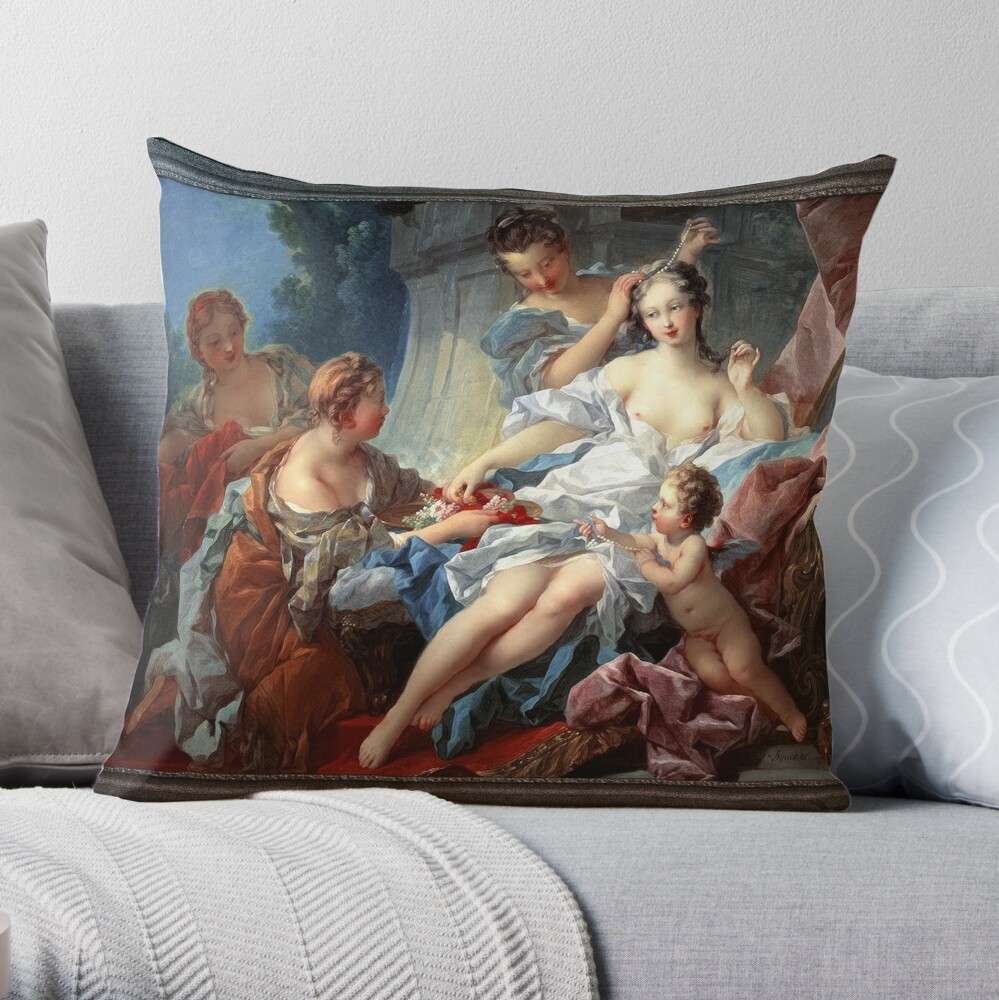
The Toilet of Venus, painted by François Boucher’s (1703 – 1770) around 1746, stands as a quintessential example of Rococo art, embodying its characteristic lightness, sensualitat, and decorative elegance. This large-scale canvas, currently housed in the Louvre Museum, transports viewers to an idyllic, dreamlike realm where the goddess Venus is attended by nymphs during her morning toilette. The painting isn’t merely a depiction of bathing; it’s a carefully orchestrated scene designed to evoke pleasure, bellesa, and a sense of refined leisure.
Taula de continguts
Harmonia compositiva & Configuració
The composition unfolds within a shallow, theatrical space defined by classical architectural elements – columns, pilasters, and an arched niche – that frame the central action. These structures are rendered with a soft focus, appearing more as decorative backdrops than structurally significant components. The setting itself is deliberately ambiguous; it’s neither explicitly earthly nor entirely divine, contributing to the painting’s ethereal quality. Lush foliage spills in from the left side of the canvas, further blurring the boundaries between reality and fantasy. A rich red curtain drapes behind Venus, adding a touch of opulent warmth to the scene. The overall effect is one of secluded intimacy within a timeless paradise.
Venus: La figura central
Venus, the goddess of love and beauty, occupies the focal point of the painting. She reclines languidly on an ornate chaise lounge, her body partially draped in flowing blue fabric that reveals much more than it conceals. Her pose is relaxed and graceful, conveying a sense of effortless allure. Boucher masterfully captures the softness of her flesh through delicate brushstrokes and subtle gradations of light and shadow. La seva expressió és serena, gairebé separada, as she engages with the attendants surrounding her. She isn’t actively participating in the toilette; una mica, she seems to be enjoying the attention and the beauty of the moment.
The Attendants: Nymphs & Cupid
Surrounding Venus are several female figures – nymphs – each engaged in a specific task related to her morning ritual. One nymph carefully arranges flowers into a bouquet, while another offers Venus a mirror for inspection. A third gently tends to her hair with a comb and brush. These attendants aren’t portrayed as servants; they appear more like companions or handmaidens, sharing in the goddess’s pleasure and contributing to the overall atmosphere of indulgence. In the lower right corner, Cupid playfully observes the scene, his presence reinforcing the theme of love and desire that permeates the painting. He is depicted with a mischievous grin, adding a touch of lightheartedness to the composition.
Paleta de colors & Llum
Boucher’s use of color is integral to the painting’s aesthetic appeal. The palette is dominated by soft pastels – pinks, blaus, verd, and creams – creating a harmonious and visually pleasing effect. These colors are applied with a delicate touch, resulting in a luminous quality that enhances the sense of dreamlike beauty. Light plays a crucial role in shaping the forms and defining the mood. It emanates from an unseen source, softly illuminating Venus and her attendants while leaving portions of the background shrouded in shadow. This chiaroscuro effect accentuates the figures’ sensuality and creates a sense of depth within the shallow space.
Rococo Style & Boucher’s Influence
“The Toilet of Venus” is a prime example of Rococo style, which emerged in France during the 18th century as a reaction against the more formal and grandiose Baroque aesthetic. Rococo art emphasized grace, elegància, and playful sensuality. Boucher was one of the leading exponents of this style, and his paintings were highly sought after by members of the French aristocracy. His work helped to define the Rococo aesthetic, influencing countless artists and shaping the taste of the era. The painting’s focus on pleasure, bellesa, and refined leisure reflects the values and aspirations of the French court during the reign of Louis XV.
Technical Mastery & Llegat
Boucher’s technical skill is evident in every detail of “The Toilet of Venus.” His ability to render flesh tones with such subtlety and realism was remarkable for his time. The painting’s composition, paleta de colors, and lighting all contribute to its overall effect of beauty and enchantment. “The Toilet of Venus” remains a celebrated masterpiece of Rococo art, admired for its exquisite beauty, sensual allure, and masterful execution. It continues to inspire artists and captivate viewers with its timeless depiction of feminine grace and idyllic pleasure.
Artista Bio de Wikipedia.org
Natiu de París, Boucher era fill d'un pintor menys conegut Nicolas Boucher, que li va donar la seva primera formació artística. Als disset anys, un quadre de Boucher va ser admirat pel pintor François Lemoyne. Més tard, Lemoyne va nomenar Boucher com a aprenent, però després de només tres mesos, va anar a treballar per al gravador Jean-François Cars.
En 1720, va guanyar el Gran Premi d'elit de Roma de pintura, però no va aprofitar la conseqüent oportunitat per estudiar a Itàlia fins cinc anys després, per problemes econòmics de la Reial Acadèmia de Pintura i Escultura.[1] En tornar dels estudis a Itàlia va ser admès a la refundada Académie de peinture et de sculpture on 24 de novembre 1731. La seva peça de recepció (peça de recepció) va ser el seu Rinaldo i Armida de 1734.
Boucher es va casar amb Marie-Jeanne Buzeau a 1733. La parella va tenir tres fills junts. Boucher es va convertir en membre de la facultat 1734 i la seva carrera es va accelerar a partir d'aquest punt, ja que va ser ascendit a Professor i després Rector de l'Acadèmia, esdevenint inspector de la Royal Gobelins Manufactory i finalment Premier Peintre du Roi (Primer Pintor del Rei) dins 1765. Retrat de Marie-Louise O'Murphy c. 1752
Boucher va morir 30 maig 1770 al seu París natal. El seu nom, juntament amb la de la seva patrona Madame de Pompadour, s'havia convertit en sinònim de l'estil rococó francès, conduint els germans Goncourt a escriure: “Boucher és un d'aquells homes que representen el gust d'un segle, que expressen, personificar-lo i encarnar-lo.”
Boucher és famós per dir que la natura ho és “massa verd i poc il·luminat” (massa verd i mal il·luminat).
Boucher estava associat amb el gravador de pedres precioses Jacques Guay, a qui va ensenyar a dibuixar. També va ser mentor del pintor moràu-austríac Martin Ferdinand Quadal així com del pintor neoclàssic Jacques-Louis David a 1767.[4] Més tard, Boucher va fer una sèrie de dibuixos d'obres de Guay que Madame de Pompadour va gravar i va distribuir com un volum ben enquadernat als cortesans preferits.
The Toilet of Venus is a retouched digital art reproduction of a public domain image which you can purchase as a Impressió de tela enrotllada en línia.