

Die Toilette der Venus
The Enchanting Ritual: Examining François Boucher’s “The Toilet of Venus”
Die Toilette der Venus, painted by François Boucher’s (1703 – 1770) um 1746, stands as a quintessential example of Rococo art, embodying its characteristic lightness, Sinnlichkeit, and decorative elegance. This large-scale canvas, currently housed in the Louvre Museum, transports viewers to an idyllic, dreamlike realm where the goddess Venus is attended by nymphs during her morning toilette. The painting isn’t merely a depiction of bathing; it’s a carefully orchestrated scene designed to evoke pleasure, Schönheit, and a sense of refined leisure.
Inhaltsverzeichnis
Kompositorische Harmonie & Einstellung
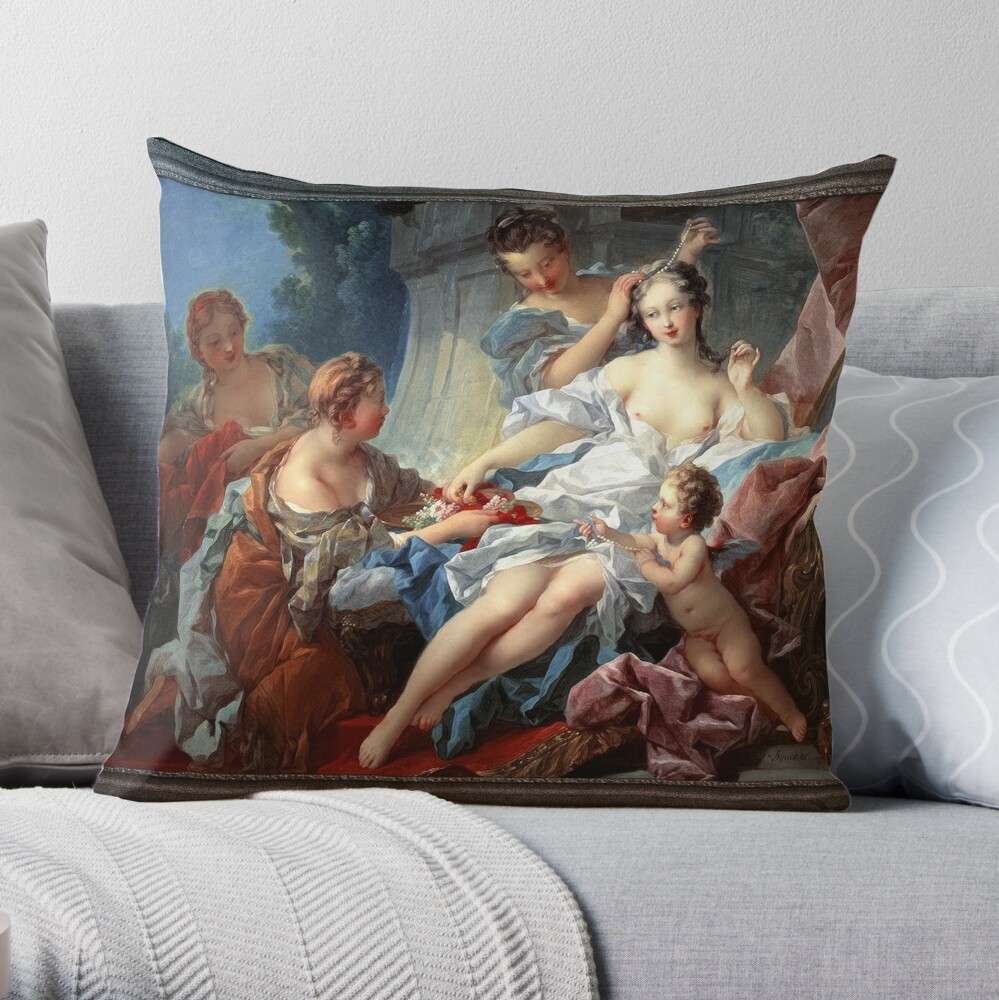
The composition unfolds within a shallow, theatrical space defined by classical architectural elements – columns, pilasters, and an arched niche – that frame the central action. These structures are rendered with a soft focus, appearing more as decorative backdrops than structurally significant components. The setting itself is deliberately ambiguous; it’s neither explicitly earthly nor entirely divine, contributing to the painting’s ethereal quality. Lush foliage spills in from the left side of the canvas, further blurring the boundaries between reality and fantasy. A rich red curtain drapes behind Venus, adding a touch of opulent warmth to the scene. The overall effect is one of secluded intimacy within a timeless paradise.
Venus: Die zentrale Figur
Venus, the goddess of love and beauty, occupies the focal point of the painting. She reclines languidly on an ornate chaise lounge, her body partially draped in flowing blue fabric that reveals much more than it conceals. Her pose is relaxed and graceful, conveying a sense of effortless allure. Boucher masterfully captures the softness of her flesh through delicate brushstrokes and subtle gradations of light and shadow. Her expression is serene, almost detached, as she engages with the attendants surrounding her. She isn’t actively participating in the toilette; eher, she seems to be enjoying the attention and the beauty of the moment.
Die Begleiter: Nymphs & Amor
Surrounding Venus are several female figures – nymphs – each engaged in a specific task related to her morning ritual. One nymph carefully arranges flowers into a bouquet, while another offers Venus a mirror for inspection. A third gently tends to her hair with a comb and brush. These attendants aren’t portrayed as servants; they appear more like companions or handmaidens, sharing in the goddess’s pleasure and contributing to the overall atmosphere of indulgence. In the lower right corner, Cupid playfully observes the scene, his presence reinforcing the theme of love and desire that permeates the painting. He is depicted with a mischievous grin, adding a touch of lightheartedness to the composition.
Farbpalette & Licht
Boucher’s use of color is integral to the painting’s aesthetic appeal. The palette is dominated by soft pastels – pinks, Blues, Grüns, and creams – creating a harmonious and visually pleasing effect. These colors are applied with a delicate touch, resulting in a luminous quality that enhances the sense of dreamlike beauty. Light plays a crucial role in shaping the forms and defining the mood. It emanates from an unseen source, softly illuminating Venus and her attendants while leaving portions of the background shrouded in shadow. This chiaroscuro effect accentuates the figures’ sensuality and creates a sense of depth within the shallow space.
Rococo Style & Boucher’s Influence
“Die Toilette der Venus” is a prime example of Rococo style, which emerged in France during the 18th century as a reaction against the more formal and grandiose Baroque aesthetic. Rococo art emphasized grace, Eleganz, and playful sensuality. Boucher was one of the leading exponents of this style, and his paintings were highly sought after by members of the French aristocracy. His work helped to define the Rococo aesthetic, influencing countless artists and shaping the taste of the era. The painting’s focus on pleasure, Schönheit, and refined leisure reflects the values and aspirations of the French court during the reign of Louis XV.
Technische Meisterschaft & Vermächtnis
Boucher’s technical skill is evident in every detail of “The Toilet of Venus.” His ability to render flesh tones with such subtlety and realism was remarkable for his time. The painting’s composition, Farbpalette, and lighting all contribute to its overall effect of beauty and enchantment. “Die Toilette der Venus” remains a celebrated masterpiece of Rococo art, admired for its exquisite beauty, sensual allure, und meisterhafte Ausführung. It continues to inspire artists and captivate viewers with its timeless depiction of feminine grace and idyllic pleasure.
Künstler Bio von Wikipedia.org
Ein gebürtiger Pariser, Boucher war der Sohn eines weniger bekannten Malers Nicolas Boucher, wer gab ihm seine erste künstlerische Ausbildung. Im Alter von siebzehn Jahren, Ein Gemälde von Boucher wurde vom Maler François Lemoyne bewundert. Lemoyne ernannte später Boucher zu seinem Lehrling, aber nach nur drei Monaten, Er arbeitete für den Kupferstecher Jean-François Cars.
Im 1720, Er gewann den Elite Grand Prix de Rome für Malerei, nutzte aber erst fünf Jahre später die Gelegenheit, in Italien zu studieren, aufgrund finanzieller Probleme an der Royal Academy of Painting and Sculpture.[1] Nach seiner Rückkehr vom Studium in Italien wurde er in die neu gegründete Académie de Peinture et de Sculpture am aufgenommen 24 November 1731. Sein Empfangsstück (Empfangsstück) war sein Rinaldo und Armida von 1734.
Boucher heiratete Marie-Jeanne Buzeau in 1733. Das Paar hatte drei Kinder zusammen. Boucher wurde Fakultätsmitglied in 1734 und seine Karriere beschleunigte sich von diesem Punkt an, als er zum Professor und dann zum Rektor der Akademie befördert wurde, Inspektor der Royal Gobelins Manufaktur und schließlich Premier Peintre du Roi (Erster Maler des Königs) im 1765. Porträt von Marie-Louise O’Murphy c. 1752
Boucher starb am 30 Kann 1770 in seiner Heimat Paris. Sein Name, zusammen mit dem seiner Patronin Madame de Pompadour, war zum Synonym für den französischen Rokoko-Stil geworden, die Goncourt-Brüder zum Schreiben führen: “Boucher ist einer jener Männer, die den Geschmack eines Jahrhunderts repräsentieren, die ausdrücken, personifizieren und verkörpern es.”
Boucher ist berühmt dafür, dass die Natur es ist “zu grün und schlecht beleuchtet” (zu grün und schlecht beleuchtet).
Boucher war mit dem Edelsteinstecher Jacques Guay verbunden, wen er lehrte zu zeichnen. Er betreute auch den mährisch-österreichischen Maler Martin Ferdinand Quadal sowie den neoklassizistischen Maler Jacques-Louis David in 1767.[4] Später, Boucher fertigte eine Reihe von Zeichnungen von Werken Guays an, die Madame de Pompadour dann gravierte und als hübsch gebundenen Band an bevorzugte Höflinge verteilte
The Toilet of Venus is a retouched digital art reproduction of a public domain image which you can purchase as a gerollter Leinwanddruck online.