

Toalettet til Venus
The Enchanting Ritual: Examining François Boucher’s “The Toilet of Venus”
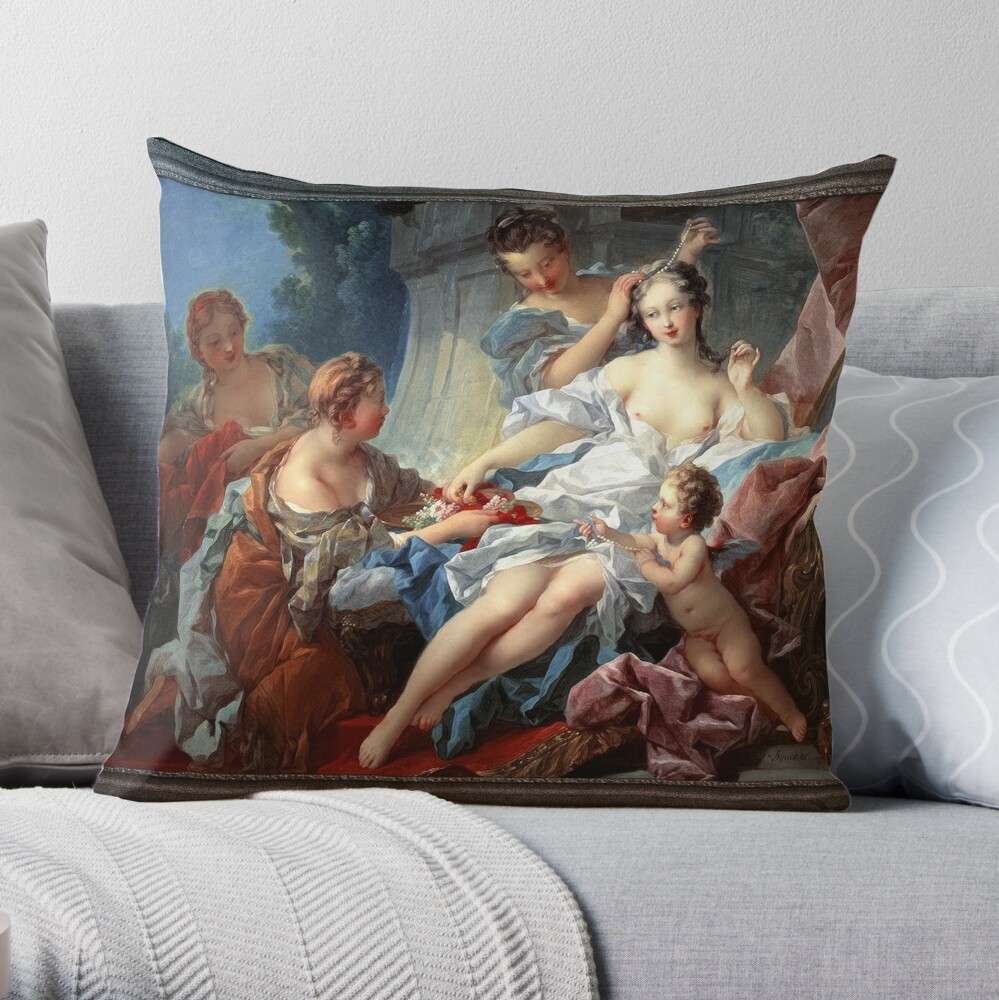
Toalettet til Venus, painted by François Boucher’s (1703 – 1770) omkring 1746, stands as a quintessential example of Rococo art, embodying its characteristic lightness, sensualitet, and decorative elegance. Dette storskala lerretet, currently housed in the Louvre Museum, transports viewers to an idyllic, dreamlike realm where the goddess Venus is attended by nymphs during her morning toilette. The painting isn’t merely a depiction of bathing; it’s a carefully orchestrated scene designed to evoke pleasure, skjønnhet, and a sense of refined leisure.
Innholdsfortegnelse
Komposisjonell harmoni & Setting
The composition unfolds within a shallow, theatrical space defined by classical architectural elements – columns, pilasters, and an arched niche – that frame the central action. These structures are rendered with a soft focus, appearing more as decorative backdrops than structurally significant components. The setting itself is deliberately ambiguous; it’s neither explicitly earthly nor entirely divine, contributing to the painting’s ethereal quality. Lush foliage spills in from the left side of the canvas, further blurring the boundaries between reality and fantasy. A rich red curtain drapes behind Venus, adding a touch of opulent warmth to the scene. The overall effect is one of secluded intimacy within a timeless paradise.
Venus: Den sentrale figuren
Venus, the goddess of love and beauty, occupies the focal point of the painting. She reclines languidly on an ornate chaise lounge, her body partially draped in flowing blue fabric that reveals much more than it conceals. Her pose is relaxed and graceful, conveying a sense of effortless allure. Boucher masterfully captures the softness of her flesh through delicate brushstrokes and subtle gradations of light and shadow. Uttrykket hennes er rolig, almost detached, as she engages with the attendants surrounding her. She isn’t actively participating in the toilette; ganske, she seems to be enjoying the attention and the beauty of the moment.
The Attendants: Nymphs & Cupid
Surrounding Venus are several female figures – nymphs – each engaged in a specific task related to her morning ritual. One nymph carefully arranges flowers into a bouquet, while another offers Venus a mirror for inspection. A third gently tends to her hair with a comb and brush. These attendants aren’t portrayed as servants; they appear more like companions or handmaidens, sharing in the goddess’s pleasure and contributing to the overall atmosphere of indulgence. In the lower right corner, Cupid playfully observes the scene, his presence reinforcing the theme of love and desire that permeates the painting. He is depicted with a mischievous grin, adding a touch of lightheartedness to the composition.
Fargepalett & Lys
Boucher’s use of color is integral to the painting’s aesthetic appeal. The palette is dominated by soft pastels – pinks, blues, greener, and creams – creating a harmonious and visually pleasing effect. These colors are applied with a delicate touch, resulting in a luminous quality that enhances the sense of dreamlike beauty. Light plays a crucial role in shaping the forms and defining the mood. It emanates from an unseen source, softly illuminating Venus and her attendants while leaving portions of the background shrouded in shadow. This chiaroscuro effect accentuates the figures’ sensuality and creates a sense of depth within the shallow space.
Rococo Style & Boucher’s Influence
“Toalettet til Venus” is a prime example of Rococo style, which emerged in France during the 18th century as a reaction against the more formal and grandiose Baroque aesthetic. Rococo art emphasized grace, eleganse, and playful sensuality. Boucher was one of the leading exponents of this style, and his paintings were highly sought after by members of the French aristocracy. His work helped to define the Rococo aesthetic, influencing countless artists and shaping the taste of the era. The painting’s focus on pleasure, skjønnhet, and refined leisure reflects the values and aspirations of the French court during the reign of Louis XV.
Teknisk mestring & Arv
Boucher’s technical skill is evident in every detail of “The Toilet of Venus.” His ability to render flesh tones with such subtlety and realism was remarkable for his time. The painting’s composition, fargepalett, and lighting all contribute to its overall effect of beauty and enchantment. “Toalettet til Venus” remains a celebrated masterpiece of Rococo art, admired for its exquisite beauty, sensual allure, and masterful execution. It continues to inspire artists and captivate viewers with its timeless depiction of feminine grace and idyllic pleasure.
Artistbio fra Wikipedia.org
Innfødt i Paris, Boucher var sønn av en mindre kjent maler Nicolas Boucher, som ga ham sin første kunstneriske opplæring. I en alder av sytten, et maleri av Boucher ble beundret av maleren François Lemoyne. Lemoyne utnevnte senere Boucher som lærling, men etter bare tre måneder, han gikk på jobb for graveren Jean-François Cars.
I 1720, han vant eliten Grand Prix de Rome for maleri, men tok ikke den konsekvensene av å studere i Italia før fem år senere, på grunn av økonomiske problemer ved Royal Academy of Painting and Sculpture.[1] Da han kom tilbake fra studiet i Italia, ble han tatt opp på den refunderte Académie de peinture et de sculpture på 24 november 1731. Mottakelsen hans (mottaksbrikke) var hans Rinaldo og Armida av 1734.
Boucher giftet seg med Marie-Jeanne Buzeau i 1733. Paret hadde tre barn sammen. Boucher ble et fakultetsmedlem i 1734 og karrieren hans akselererte fra dette tidspunktet da han ble forfremmet til professor, da rektor for akademiet, blir inspektør ved Royal Gobelins Manufactory og til slutt Premier Peintre du Roi (Første maler av kongen) i 1765. Portrett av Marie-Louise O'Murphy c. 1752
Boucher døde den 30 Kan 1770 i hjemlandet Paris. Navnet hans, sammen med sin beskytter Madame de Pompadour, hadde blitt synonymt med den franske rokokostilen, ledet Goncourt -brødrene til å skrive: “Boucher er en av de mennene som representerer smaken av et århundre, som uttrykker, personifisere og legemliggjøre det.”
Boucher er kjent for å si at naturen er det “for grønt og dårlig opplyst” (for grønt og dårlig opplyst).
Boucher ble assosiert med edelstenens graver Jacques Guay, som han lærte å tegne. Han veiledet også den moravisk-østerrikske maleren Martin Ferdinand Quadal samt den nyklassisistiske maleren Jacques-Louis David i 1767.[4] Seinere, Boucher laget en serie tegninger av verk av Guay som Madame de Pompadour deretter graverte og distribuerte som et godt bundet bind til favoriserte hoffmenn.
The Toilet of Venus er en retusjert digital kunstreproduksjon av et offentlig domenebilde som du kan kjøpe som en rullet lerretstrykk online.