

Angelica and Medoro
Angelica and Medoro: A Rococo Dreamscape by François Boucher
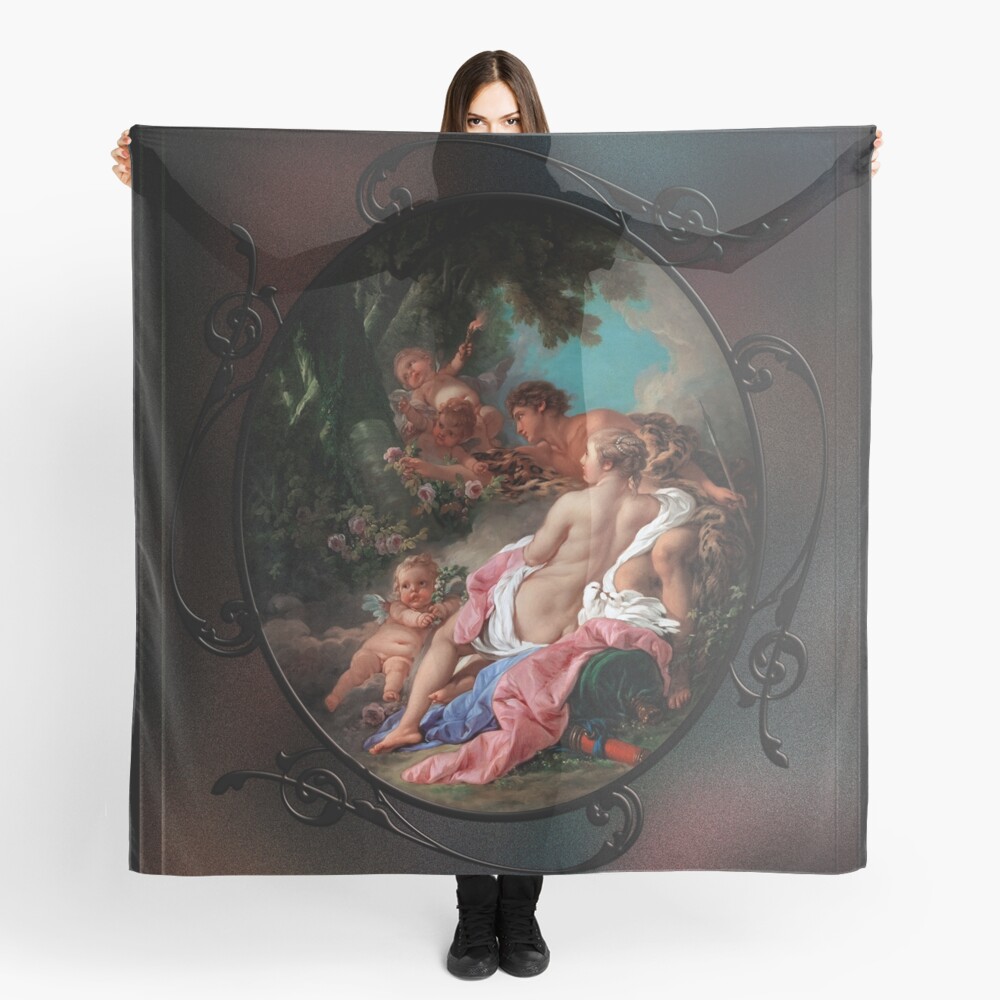
Francois Boucher’s “Angelica and Medoro,” malt rundt 1763, exemplifies the height of the Rococo style in French art. This captivating work, currently housed at the Musée du Louvre, transports viewers to a realm of idyllic beauty and sensual delight, characteristic of Boucher’s artistic vision. The painting depicts a scene drawn from Ariosto’s epic poem Orlando Furioso, where Angelica, a beautiful pagan princess, has fallen asleep in a woodland glade, attended by playful putti and the captive knight Medoro.
Innholdsfortegnelse
Komposisjonell harmoni & Narrative Context
The composition is carefully orchestrated to create a sense of harmonious balance and visual pleasure. Boucher employs a pyramidal structure, with Angelica at its apex, drawing the eye immediately to her figure. The lush foliage forms a verdant backdrop, framing the central figures and enhancing the feeling of seclusion and enchantment. Medoro sits beside Angelica, his gaze fixed upon her face, conveying a sense of tender devotion. He is partially draped in armor, hinting at his former role as a warrior, now softened by his proximity to the sleeping princess. The scene unfolds within a dense forest setting; trees with vibrant green foliage create an immersive atmosphere.
Figures and Their Representation
Angelica’s portrayal embodies the Rococo ideal of feminine beauty: soft skin, flytende hår, and a languid pose that suggests both vulnerability and allure. Her dress, rendered in delicate pinks and whites, cascades around her form, emphasizing her graceful contours. The artist’s masterful use of light and shadow sculpts her body, highlighting its curves and creating a sense of ethereal beauty. Medoro is depicted with a more muscular physique, yet his posture is relaxed and gentle as he gazes at Angelica. His attire blends elements of armor and softer fabrics, reflecting his transition from warrior to lover.
The Role of the Putti
Adding to the scene’s whimsical charm are several putti – cherubic figures often associated with love and playfulness in Renaissance and Baroque art. These small figures frolic around Angelica and Medoro, scattering flowers and engaging in playful antics. Their presence reinforces the painting’s overall atmosphere of carefree joy and sensual indulgence. One putto sits at Angelica’s feet, gently touching her hand, while others playfully toss blossoms into the air. The putti are rendered with a delicate touch, their forms soft and rounded, further contributing to the painting’s aesthetic appeal.
Boucher’s Artistic Technique & Stil
Boucher’s technique is characterized by his fluid brushstrokes, subtle gradations of color, and an emphasis on texture. He skillfully employs sfumato, a technique popularized by Leonardo da Vinci, to soften edges and create a hazy, drømmeaktig kvalitet. The colors are rich and vibrant, with a particular focus on pastel hues – pinks, blues, greener, and creams – that evoke the atmosphere of a sun-drenched garden. Boucher’s style is distinctly Rococo; it prioritizes elegance, nåde, and sensual pleasure over realism or historical accuracy. He was known for his decorative paintings intended to adorn the homes of wealthy patrons, and “Angelica and Medoro” perfectly embodies this aesthetic.
Lys & Atmosfære
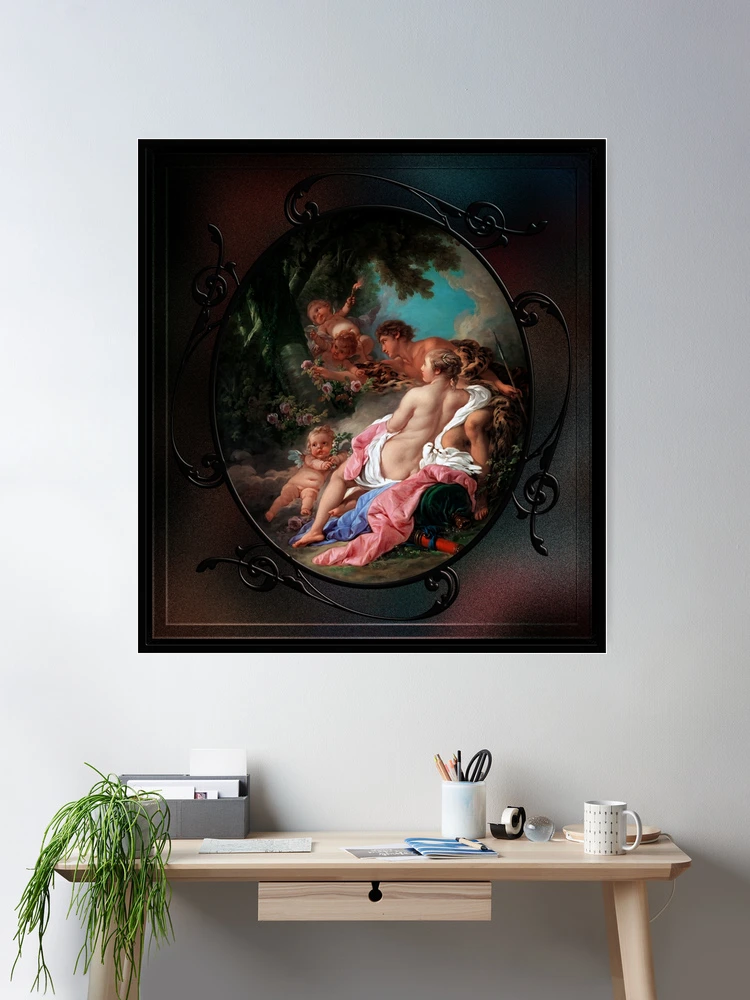
Belysningen inn “Angelica and Medoro” is soft and diffused, creating a gentle glow that bathes the scene in warmth. The light source appears to be coming from above, illuminating Angelica’s face and highlighting her delicate features. This creates a sense of intimacy and tranquility, drawing the viewer into the idyllic setting. The atmospheric perspective – the gradual blurring of details in the background – enhances the feeling of depth and distance, further immersing the viewer in the painting’s world.
Totalinntrykk & Arv
“Angelica and Medoro” is more than just a depiction of a literary scene; it’s an embodiment of Rococo ideals—beauty, pleasure, and escapism. Boucher’s masterful technique and evocative imagery have made this painting one of his most celebrated works, and a quintessential example of the Rococo style. It continues to captivate audiences with its exquisite beauty and timeless appeal, offering a glimpse into the world of 18th-century French art and culture. The work’s enduring popularity stems from its ability to evoke feelings of romance, ro, and sensual delight, qualities that remain highly valued even today.
Decorative Accents Used In This Piece Are Available At HeritageType
Artistbio avledet fra Wikipedia.org
Innfødt i Paris, Boucher var sønn av en mindre kjent maler Nicolas Boucher, som ga ham sin første kunstneriske opplæring. I en alder av sytten, et maleri av Boucher ble beundret av maleren François Lemoyne. Lemoyne utnevnte senere Boucher som lærling, men etter bare tre måneder, han gikk på jobb for graveren Jean-François Cars.
I 1720, han vant eliten Grand Prix de Rome for maleri, men tok ikke den konsekvensene av å studere i Italia før fem år senere, på grunn av økonomiske problemer ved Royal Academy of Painting and Sculpture.[1] Da han kom tilbake fra studiet i Italia, ble han tatt opp på den refunderte Académie de peinture et de sculpture på 24 november 1731. Mottakelsen hans (mottaksbrikke) var hans Rinaldo og Armida av 1734.
Boucher giftet seg med Marie-Jeanne Buzeau i 1733. Paret hadde tre barn sammen. Boucher ble et fakultetsmedlem i 1734 og karrieren hans akselererte fra dette tidspunktet da han ble forfremmet til professor, da rektor for akademiet, blir inspektør ved Royal Gobelins Manufactory og til slutt Premier Peintre du Roi (Første maler av kongen) i 1765. Portrett av Marie-Louise O'Murphy c. 1752
Boucher døde den 30 Kan 1770 i hjemlandet Paris. Navnet hans, sammen med sin beskytter Madame de Pompadour, hadde blitt synonymt med den franske rokokostilen, ledet Goncourt -brødrene til å skrive: “Boucher er en av de mennene som representerer smaken av et århundre, som uttrykker, personifisere og legemliggjøre det.”
Boucher er kjent for å si at naturen er det “for grønt og dårlig opplyst” (for grønt og dårlig opplyst).
Boucher ble assosiert med edelstenens graver Jacques Guay, som han lærte å tegne. Han veiledet også den moravisk-østerrikske maleren Martin Ferdinand Quadal samt den nyklassisistiske maleren Jacques-Louis David i 1767.[4] Seinere, Boucher laget en serie tegninger av verk av Guay som Madame de Pompadour deretter graverte og distribuerte som et godt bundet bind til favoriserte hoffmenn.