

La toilette de Vénus: The Allure of Leisure
La toilette de Vénus, this version was painted by François Boucher (1703 – 1770) autour 1751; and stands as a quintessential example of Rococo art, embodying its characteristic sensuality, élégance, and playful depiction of mythological themes. Cette toile à grande échelle, currently residing in the Louvre Museum, transports viewers to a realm of idyllic beauty and leisurely indulgence, showcasing Boucher’s mastery of color, lumière, et composition. The painting is not merely a representation of the goddess Venus; it’s an exploration of feminine grace within a carefully constructed fantasy landscape.
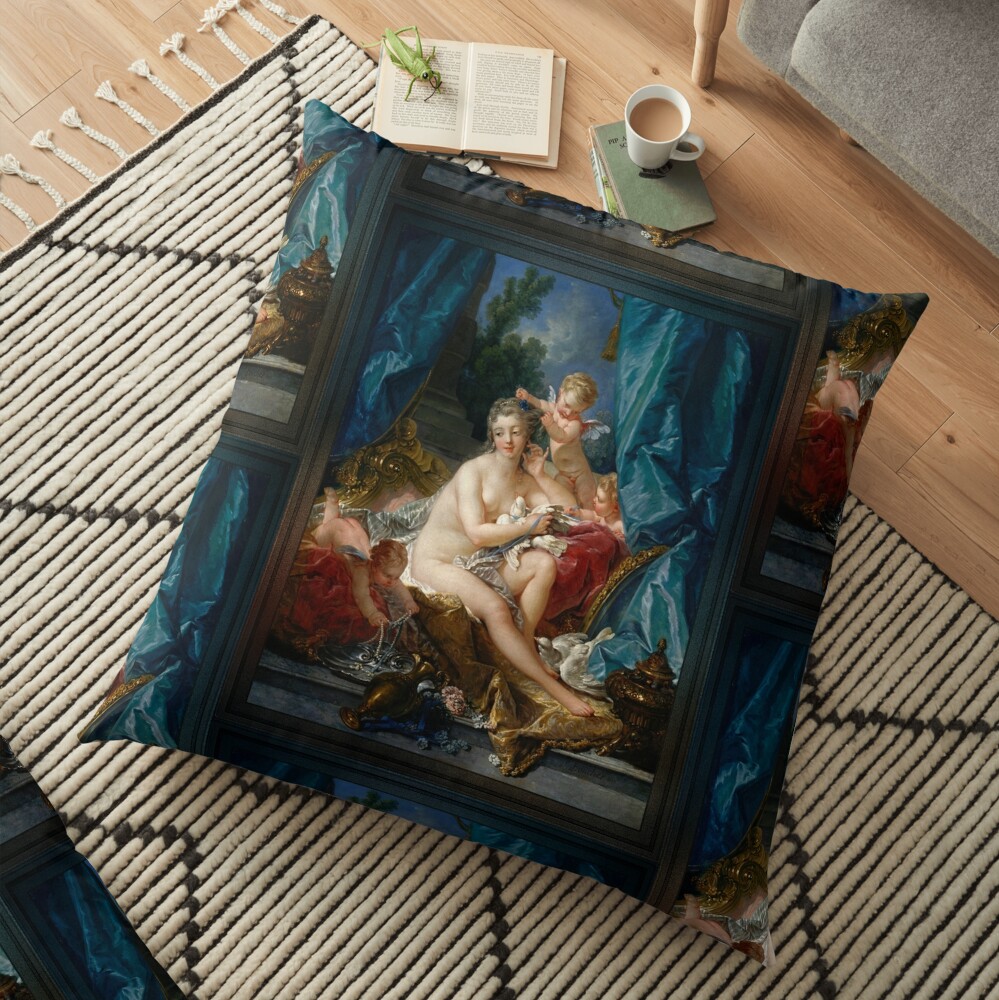
Table des matières
A Scene of Delicate Rituals
Le personnage central, undeniably Venus (Aphrodite in Greek mythology), reclines upon a lavishly adorned chaise lounge. She is depicted mid-action, engaged in the intimate act of dressing her hair. Her posture is relaxed and graceful, conveying an air of serene contentment rather than any sense of formality or grandeur. The artist’s focus isn’t on portraying Venus as a powerful deity but rather as a beautiful woman enjoying a moment of personal care.
She holds a small mirror to one side, seemingly admiring her reflection while a handmaid gently arranges ribbons in her hair. This intimate scene is far removed from the heroic narratives often associated with classical mythology; plutôt, it emphasizes domesticity and private pleasure.
Cherubic Companions & Decorative Details
Surrounding Venus are several cherubs, characteristic figures within Rococo art. These playful spirits flit about, attending to the goddess’s needs. One cherub playfully blows bubbles, while another offers a bouquet of flowers. Their presence adds an element of lightness and whimsy to the scene, reinforcing the overall atmosphere of carefree enjoyment.
The chaise lounge itself is a masterpiece of decorative detail, featuring intricate carvings and luxurious fabrics in rich reds and golds. Scattered around Venus are various objects associated with beauty and adornment: perfume bottles, scattered roses, bijoux, and a small white rabbit – all contributing to the painting’s opulent aesthetic.
A Stage Setting of Opulence & La nature
The setting for this idyllic scene is equally important. Heavy blue draperies frame the composition on either side, creating a sense of theatricality and enclosure. Beyond these curtains lies a glimpse of a lush garden with verdant trees and classical architecture in the distance. This carefully constructed backdrop suggests a secluded paradise, further enhancing the feeling of privacy and indulgence. L'utilisation de la lumière est particulièrement remarquable; Boucher masterfully employs soft, diffused lighting to illuminate Venus’s figure, highlighting her skin’s luminosity and creating a sense of warmth and intimacy.
Palette de couleurs & Technique Artistique
Boucher’s color palette in “The Toilet of Venus” is dominated by pastel hues – pinks, bleus, légumes verts, and golds – which are hallmarks of the Rococo style. These soft colors contribute to the painting’s overall feeling of lightness and delicacy. His brushwork is loose and fluid, Créer un sentiment de mouvement et de spontanéité. The artist’s technique prioritizes capturing the essence of beauty and pleasure over strict realism. He uses subtle gradations of color to model Venus’s form, emphasizing her curves and contours while maintaining an ethereal quality.

Contexte & Héritage
“The Toilet of Venus” was created during a period when Rococo art flourished in France, particularly under the patronage of Madame de Pompadour, Louis XV’s influential mistress. Boucher became the leading artist of this style, connu pour ses peintures décoratives qui répondaient aux goûts de l'aristocratie. The painting reflects the prevailing cultural values of the time – an emphasis on pleasure, beauté, et loisir raffiné.
It’s a testament to Boucher’s ability to create visually stunning works that captured the spirit of the Rococo era and continues to captivate audiences with its charm and elegance. The work’s influence can be seen in subsequent artistic trends, particularly in depictions of idealized feminine figures and the use of decorative elements to enhance visual appeal.
Artiste Bio de Wikipedia.org
Originaire de Paris, Boucher était le fils d'un peintre moins connu Nicolas Boucher, qui lui a donné sa première formation artistique. À l'âge de dix-sept ans, un tableau de Boucher a été admiré par le peintre François Lemoyne. Lemoyne nomma plus tard Boucher son apprenti, mais après seulement trois mois, il est allé travailler pour le graveur Jean-François Cars.
Dans 1720, il a remporté le Grand Prix élite de Rome pour la peinture, mais n'a saisi l'occasion conséquente d'étudier en Italie que cinq ans plus tard, due to financial problems at the Académie royale de peinture et de sculpture.[1] À son retour des études en Italie, il a été admis à l'Académie de peinture et de sculpture refondée sur 24 novembre 1731. His morceau de réception (pièce de réception) était son Rinaldo et Armida de 1734.
Boucher a épousé Marie-Jeanne Buzeau en 1733. Le couple a eu trois enfants ensemble. Boucher est devenu membre du corps professoral en 1734 et sa carrière s'est accélérée à partir de ce moment, car il a été promu professeur puis recteur de l'Académie, devenir inspecteur à la Manufacture Royale des Gobelins et enfin Premier Peintre du Roi (Premier peintre du roi) dans 1765. Portrait de Marie-Louise O’Murphy c. 1752
Boucher est décédé le 30 Mai 1770 dans son Paris natal. Son nom, avec celle de sa patronne Madame de Pompadour, était devenu synonyme du style rococo français, amenant les frères Goncourt à écrire: “Boucher fait partie de ces hommes qui représentent le goût d'un siècle, qui expriment, personnifiez-le et incarnez-le.”
Boucher est célèbre pour dire que la nature est “trop verte et mal éclairée” (trop vert et mal éclairé).
Boucher était associé au graveur de pierres précieuses Jacques Guay, à qui il a appris à dessiner. Il a également encadré le peintre morave-autrichien Martin Ferdinand Quadal ainsi que le peintre néoclassique Jacques-Louis David dans 1767.[4] Plus tard, Boucher a réalisé une série de dessins d'œuvres de Guay que Madame de Pompadour a ensuite gravées et distribuées sous forme de volume joliment relié à des courtisans privilégiés.
La toilette de Vénus est une reproduction d'art numérique retouchée d'une image du domaine public, which can be purchased as a impression sur toile.