

Heksernes sabbat
The Witch’s Sabbath: Exploring The Allure of Night
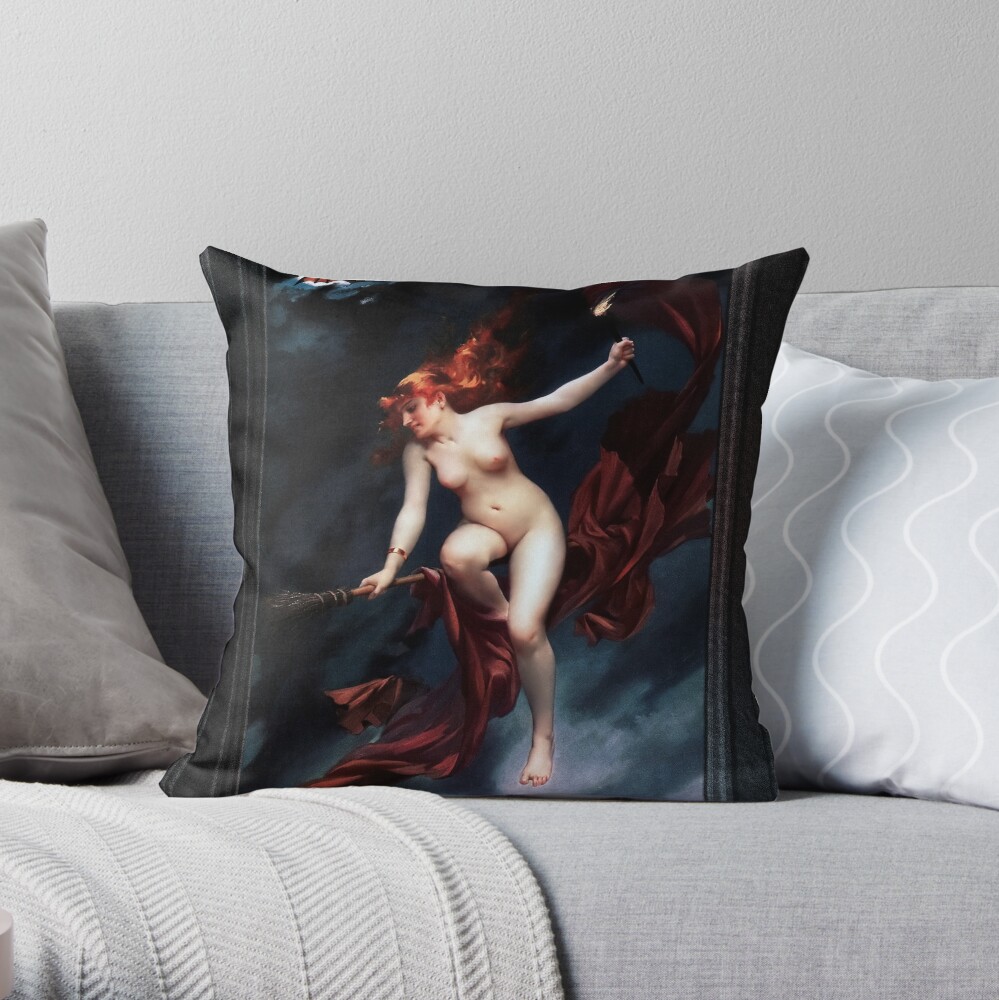
The Witches Sabbath by Luis Ricardo Falero (1851-1896) was a Spanish painter known for his evocative depictions of mythological and fantastical subjects, often imbued with a romantic sensibility. His work frequently explored themes of the supernatural and the allure of the night, drawing inspiration from folklore and literary sources. “The Witch’s Sabbath,” painted around 1880, stands as one of Falero’s most celebrated pieces, capturing a moment of ethereal flight and nocturnal mystery. The painting is an example of academic art with elements of symbolism and romanticism that were popular during the late nineteenth century.
Indholdsfortegnelse
Kompositionselementer & Narrative Suggestion
The composition immediately draws the viewer’s eye upward towards a central figure suspended in mid-air amidst a swirling, tempestuous sky. Denne figur, a nude woman with fiery red hair, is the focal point of the artwork. She appears to be engaged in an act of flight, propelled by a broomstick held firmly beneath her. The dramatic diagonal line created by the broom and her outstretched arm contributes significantly to the dynamism of the scene, suggesting movement and upward momentum.
The background is dominated by a dark, brooding sky filled with swirling clouds illuminated by a crescent moon. This celestial backdrop reinforces the nocturnal setting and lends an air of mystery and foreboding to the overall atmosphere. A single bat flies across the moon, adding another layer of symbolism associated with the supernatural. The artist’s skillful use of chiaroscuro – the contrast between light and dark – further enhances the drama and emphasizes the figure’s form against the shadowy background.
Figure & Kunstnerisk Teknik
Falero’s rendering of the female figure is notable for its anatomical accuracy, a hallmark of academic training. Her pose is graceful yet powerful, conveying a sense of both vulnerability and control. The artist meticulously details her skin tone, highlighting the subtle curves and contours of her body. The flowing red fabric that drapes around her adds to the visual interest, creating a dynamic interplay of light and shadow as it billows in the wind.
Falero’s brushwork is evident throughout the painting, particularly in the rendering of the clouds and the woman’s hair. The artist employs loose, expressive strokes to capture the movement and texture of these elements, while maintaining a level of detail in the figure itself. The color palette is dominated by cool tones – blues, Grå, and blacks – which contribute to the overall sense of mystery and melancholy. Imidlertid, the warm hues of the woman’s hair and the red fabric provide a striking contrast, drawing the viewer’s attention to these key elements.
Symbolik & Fortolkning
“The Witch’s Sabbath” draws heavily on European folklore and traditions surrounding witchcraft. The image of a witch flying through the night sky on a broomstick is a recurring motif in such narratives, often associated with gatherings of witches performing rituals under the light of the full moon. Falero’s painting taps into this rich cultural heritage, evoking a sense of both fascination and apprehension.
The crescent moon itself carries symbolic weight, representing cycles, change, and the feminine principle. The bat, traditionally linked to darkness and the supernatural, further reinforces the painting’s association with the occult. While the artwork doesn’t explicitly depict any ritualistic actions, it suggests a moment of transformation or transcendence – a departure from the mundane world into a realm of magic and mystery.
Kunstneriske påvirkninger & Arv
Falero’s work reflects the influence of several artistic movements prevalent during his time. The academic training evident in his meticulous rendering of the human form aligns with the traditions of classical art. Imidlertid, the painting’s emphasis on emotion, atmosphere, and the supernatural also reveals a connection to Romanticism, which celebrated imagination, individualism, and the power of nature.
“The Witch’s Sabbath” remains a compelling example of Falero’s artistic skill and his ability to capture the allure of the fantastical. The painting has been widely reproduced and admired for its dramatic composition, evocative atmosphere, and enduring appeal. It stands as a testament to the artist’s talent and his contribution to the rich tapestry of nineteenth-century Spanish art.
Technical Details & Provenance
The artwork is executed in oil on canvas. It measures approximately 105 x 74 cm (41.3 x 29.1 tommer). The painting’s provenance, or history of ownership, has been documented through various collections and exhibitions over the years. It currently resides within a private collection. The signature “Falero – 1880” is visible in the lower right corner of the canvas.
Artist Bio Derived Wikipedia.org
Falero blev født i Granada og fulgte oprindeligt en karriere i den spanske flåde, men gav det op til sine forældres skuffelse; da han besluttede at rejse til Paris, hvor han studerede kunst, kemi og maskinteknik.
I løbet af er studier i kemi og maskinteknik; han betragtede de eksperimenter, som han måtte udføre for farlige, hvilket fik ham til at fokusere sin opmærksomhed på kun at male.
Som et resultat blev han studerende af fransk portrætmaler og orientalist Gabriel-Joseph-Marie-Augustin Ferrier (1847 – 1914). Efter Paris, han flyttede til London, hvor han fortsatte sine studier, og til sidst bosatte sig.
Falero havde en særlig interesse for astronomi og indarbejdede himmelske konstellationer i mange af hans værker, såsom “En komets ægteskab” og “Twin Stars”. Hans interesse og viden om astronomi fik ham også til at illustrere værkerne fra Camille Flammarion.
I 1896, året for hans død, Maud Harvey sagsøgte Falero for faderskab. Tøjet hævdede, at Falero forførte Harvey, da hun var 17, først tjente som sin huspige, og derefter hans model. Da han opdagede, at hun var gravid, han afskedigede hende.
Hun vandt sagen og blev tildelt fem shilling om ugen til støtte for deres barn. Falero døde på University College Hospital, London, i en alder af 45
The Witches Sabbath er en retoucheret digital kunst gamle mestre gengivelse af et offentligt image; og som med alt det kunstværk, der kan findes på Xzendor7-webstedet, kan det købes online i en række materialeformater, herunder lærredstryk, akryltryk, metaltryk, trætryk, indrammede tryk, plakater, og som rullede lærredstryk i forskellige størrelser fra 12 tommer til 72 inches depending on the size of the actual artwork and the print on demand shop you choose to buy the art from..