

Izar bikiak: A Celestial Dance in Falero’s Vision
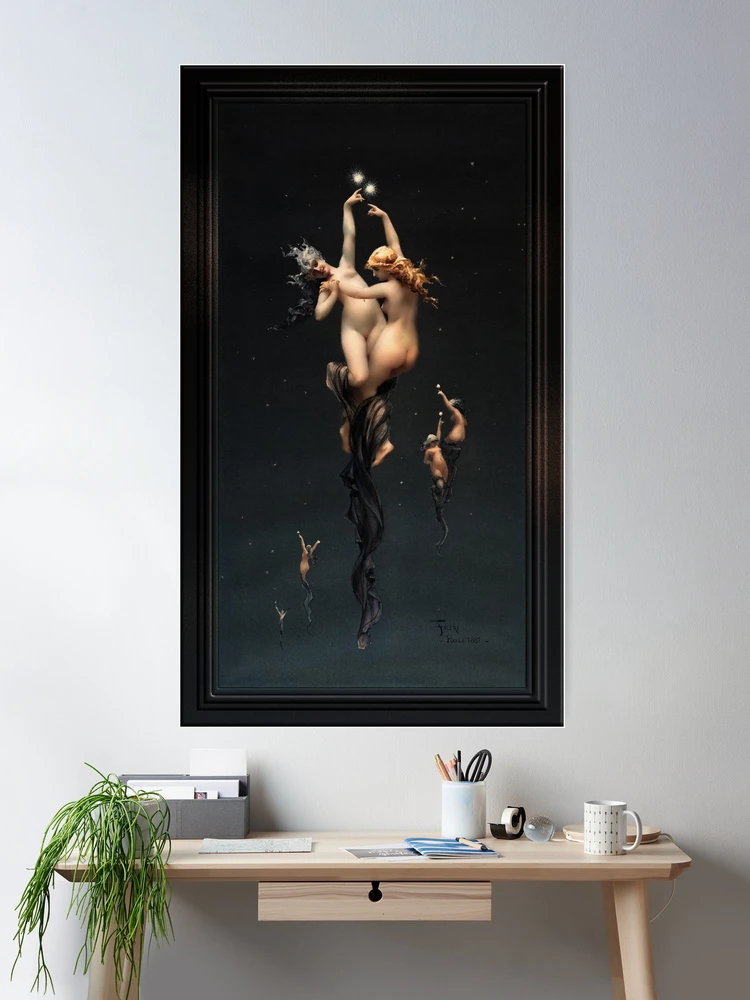
Izar bikiak Luis Ricardo Faleroren eskutik (1851-1896) was a Spanish painter known for his allegorical and mythological scenes rendered with meticulous detail and a distinct Romantic sensibility. “Izar bikiak,” inguruan sortua 1881, exemplifies these qualities, presenting a captivating vision of ethereal beauty and otherworldly grace. The painting is characterized by its dramatic composition, rich color palette, and the artist’s skillful rendering of light and shadow, all contributing to an atmosphere of dreamlike wonder.
Edukien taula
Konposizio-elementuak & Iradokizun narratiboa
The artwork’s central focus rests upon a female figure suspended in mid-air against a deep, almost impenetrable black background. Kontraste ikaragarri horrek berehala erakartzen du ikuslearen arreta argiztaturiko subjektuarekiko. Konposizioa bertikalki orientatuta dago, figuraren goranzko mugimendua eta igoera azpimarratuz. Bere azpian, hainbat irudi txikiago gorantz flotatzen edo noraezean agertzen dira, goiko zeruko argirantz marraztuta dirudi. Haien formak erdiko irudia baino gutxiago definituta daude, misterioaren sentipenari laguntzea eta eraldaketa edo goratze espiritualaren narrazioa iradokitzea.
Antolaketa ez da zurrun simetrikoa; baizik, mugimenduaren eta jariakortasunaren sentsazioa areagotzen duen asimetria dinamikoa du. Irudi nagusiaren inguruan dagoen draperiak nabarmen laguntzen du eragin horretan, begiak eszena arakatzen duen bitartean jarraitzeko ikus-bideak sortzea. Falero’s use of negative space – the vast expanse of black surrounding the figures – amplifies their luminosity and isolates them within a realm that feels both distant and intimate.
Erdiko Irudia: Azterketa bat Argian & Forma
The female figure is depicted nude, but her nudity isn’t presented with any overt sensuality. Horren ordez, it serves to highlight the purity and vulnerability of her form as she interacts with the celestial elements. Her skin glows with an inner light, contrasting sharply with the darkness that surrounds her. Falero’s mastery of chiaroscuro – the dramatic interplay of light and shadow – is evident in the way he sculpts her body, emphasizing its curves and contours while simultaneously obscuring portions within deep shadows.
Ilea, a vibrant shade of auburn, cascades around her shoulders and blends with the swirling fabric that envelops her lower half. This fabric isn’t merely clothing; it appears to be an extension of the surrounding atmosphere, blurring the boundaries between the figure and the environment. Her gaze is directed upwards towards two bright stars, which are the focal point of the entire composition. Her arms are extended, reaching as if to grasp or embrace these celestial bodies.
The Significance of the Stars & Irudi osagarriak
The twin stars themselves hold symbolic weight within the painting’s narrative. They could represent ideals, aspirations, or perhaps a connection to a higher power. Their brightness contrasts with the surrounding darkness, symbolizing hope and guidance in an otherwise uncertain world. Falero’s choice to depict them as twins suggests duality – balance, harmonia, or opposing forces that ultimately converge.
The smaller figures floating below contribute to the painting’s overall sense of mystery. They appear to be undergoing a similar transformation as the central figure, ascending towards the light and stars. Their indistinct forms suggest they are not fully realized individuals but rather representations of souls or spirits in transit. Their varied poses – some reaching upwards, others seemingly drifting passively – add depth and complexity to the narrative.
Teknika Artistikoa & Eraginak
Falero’s technique demonstrates a clear influence from the academic tradition of his time, particularly the emphasis on anatomical accuracy and meticulous detail. Alabaina, he also incorporates elements of Romanticism, evident in the painting’s dramatic lighting, intentsitate emozionala, and focus on otherworldly themes. The smooth blending of colors and subtle gradations of tone create a sense of realism while simultaneously imbuing the scene with an ethereal quality.
The use of impasto – applying paint thickly to the canvas – is minimal but strategically employed to highlight certain areas, such as the stars and portions of the central figure’s body. This technique adds texture and visual interest, further enhancing the painting’s overall impact. The dark background, achieved through layers of carefully applied black pigment, creates a sense of depth and envelopment, ikuslea eszenara erakartzea.
Inpresio orokorra & Ondarea
“Izar bikiak” is a captivating work that invites contemplation on themes of aspiration, eraldaketa, and the human connection to the cosmos. Faleroren teknika trebeak eta irudi iradokitzaileak ametsezko harridura giroa sortzen du, ikusleari inpresioa iraunkorra utziz. Margolanak bere talentu artistikoaren eta teknika klasikoak sentsibilitate erromantikoarekin nahasteko duen gaitasunaren erakusgarri dira, edertasun eta esangura iraunkorreko lanak egiteko.. mendeko espainiar artearen adibide erakargarria izaten jarraitzen du eta gaur egun ikusleen oihartzuna izaten jarraitzen du.
Artistaren bio eratorria Wikipedia.org
Falero Granadan jaio zen eta jatorriz Espainiako Armadan egin zuen karrera, baina gurasoen etsipenari utzi zion; Parisera bidaiatzea erabaki baitzuen, non artea ikasi zuen, kimika eta ingeniaritza mekanikoa.
Kimika eta ingeniaritza mekanikoko ikasketak egiten ditu; arriskutsuegitzat jo zituen berak egin behar zituen esperimentuak, horrela, arreta pinturan bakarrik zentratzera eraman zuen.
Ondorioz, Gabriel-Joseph-Marie-Augustin Ferrier frantses erretratu-margolari eta orientalistaren ikasle bihurtu zen. (1847 – 1914). Parisen ondoren, Londresera joan zen bizitzera, bertan jarraitu zituen ikasketak, eta azkenean finkatu.
Falerok astronomiarekiko interes berezia zuen eta zeruko konstelazioa sartu zuen bere lan askotan, esaterako “Kometa baten ezkontza” eta “Izar bikiak”. Astronomiarekiko interesak eta ezagutzak Camille Flammarionen lanak ilustratzera ere eraman zuten.
In 1896, bere heriotzaren urtea, Maud Harveyk aitatasunagatik auzitara eraman zuen Falero. Trajeak Falerok Harvey liluratu zuela esaten zuen hura zegoenean 17, lehenik bere etxeko neskame gisa, eta gero bere eredua. Haurdun zegoela jakin zuenean, baztertu egin zuen.
Kasua irabazi zuen eta astean bost txelin ematen zizkioten haien seme-alaben alde. Falero University College ospitalean hil zen, Londres, urterekin 45
Twin Stars domeinu publikoko irudi baten erreprodukzio zaharreko arte digitala da.