

Vase of Flowers c1645
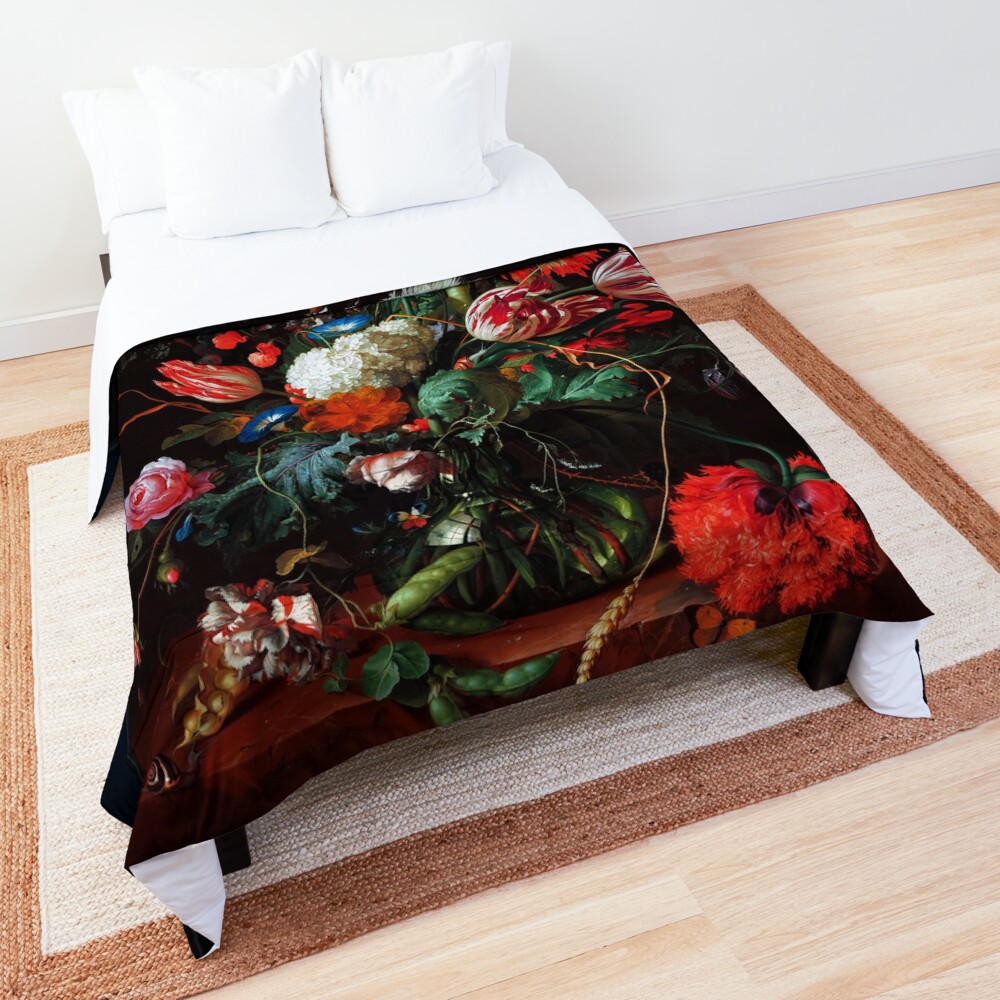
“Vase of Flowers,” gemaakt in 1645 by the renowned Dutch Artist Jan Davidsz de Heem (1606 – 1684), is an exquisite example of the flourishing genre of Dutch still life painting during the Golden Age. Known for his mastery of rendering floral arrangements, de Heem captures the complexity of nature with remarkable detail and technical skill. Het schilderij, which depicts an elaborate bouquet of flowers arranged in a fine vase, is a prime representation of the Baroque period, marked by its rich textures, ingewikkelde details, and vibrant use of color.
Inhoudsopgave
Onderwerp en compositie
The focal point of this painting is the large, overflowing vase brimming with an assortment of flowers, which include tulips, rozen, peonies, and lilies, among others. De Heem’s ability to present the organic forms of the flowers with such lifelike accuracy reflects his profound understanding of botanical subjects. The flowers in the vase are placed atop a dark, wooden table, and their vivid hues contrast sharply with the deep, almost velvety background. This contrast between the colorful foreground and the dark background draws the viewer’s attention to the flowers’ delicate textures and intricate forms.
To the left of the bouquet, a butterfly flutters above the arrangement, symbolizing the fleeting nature of life, a common theme in Dutch vanitas still life paintings. The butterfly, along with a few insects delicately perched on the petals, adds an element of life to the otherwise serene and static composition. At the lower section of the vase, je ziet een assortiment bladeren en fruit over de rand lopen, waarbij de weelde en overvloed van de natuur verder worden benadrukt. De manier waarop De Heem de subtiele doorschijnendheid van de rozenblaadjes en de textuur van de fluweelzachte bladeren vastlegt, demonstreert zijn technische expertise.
Objecten en symboliek
De bloemen zelf dragen lagen van symbolische betekenis, typisch voor de periode. Tulpen, bijvoorbeeld, werden in de 17e eeuw in Nederland zeer gewaardeerd, vooral tijdens de “Tulpenmanie” periode, toen tulpen werden beschouwd als symbolen van rijkdom en status. Ook de rozen en pioenrozen in het boeket dragen hun eigen symboliek, vaak geassocieerd met liefde, schoonheid, en vergankelijkheid, het versterken van het vanitas-thema. De toevoeging van fruit en andere organische elementen dient als herinnering aan de levenscyclus, groei, verval, en dood. Deze combinatie van weelderige bloemen en rottend fruit creëert een spanning tussen schoonheid en de onvermijdelijkheid van sterfelijkheid, een kenmerk van barokke stillevenschilderkunst.
Terrein en omgeving
De bloemen in de vaas steken af tegen een donkere achtergrond, bijna etherische achtergrond, wat een typische techniek was van Nederlandse barokkunstenaars. Deze donkere achtergrond, vaak aangeduid als “clair-obscur,” zorgt ervoor dat de bloemen in scherp reliëf naar voren komen, accentueren hun levendige kleuren en zachte texturen. De tafel waarop de vaas staat is met opmerkelijke precisie weergegeven, de houtnerf suggereert een gevoel van stabiliteit, het aarden van de anders etherische schoonheid van de bloemen.
Er zit een gevoel van diepte in de compositie, terwijl de bloemen op de voorgrond uit de vaas lijken te stromen en in het onderste deel van het schilderij terechtkomen, met enkele bloemblaadjes op het tafeloppervlak. The background remains a shadowy void, further enhancing the sense of depth and focusing the viewer’s attention entirely on the floral arrangement.
Materialen en technieken
Jan Davidsz de Heem was known for his meticulous attention to detail and his ability to render textures with incredible realism. The painting is executed in oil, a medium that allowed him to achieve the rich, luminous quality of the flowers and the subtle gradations of light and shadow. The artist’s use of oil paints enabled him to create delicate layers of color that brought a three-dimensionality to the flowers, making them appear almost tangible. The soft gradients on the petals, the fine details of the veins in the leaves, and the shimmer of light on the dewdrops reflect his thorough understanding of light, textuur, and materiality.
De achtergrond, which is painted in deep, almost black tones, creates a striking contrast against the flowers and enhances their brightness. This technique draws attention to the vase’s intricate floral display and emphasizes the symbolism of nature’s beauty amid the darkness of mortality. De Heem’s use of light, schaduw, and color is masterful, resulting in a work that seems to glow with vitality, yet carries an underlying sense of impermanence.
Stijl, Thema, en stemming
“Vase of Flowers” is quintessentially Baroque in style, with its emphasis on detail, rich textures, and the use of chiaroscuro to create dramatic contrast. The opulence of the flowers and the meticulous care with which they are painted speak to the wealth and sophistication of the period, while the symbolic elements suggest deeper reflections on the fleeting nature of life. The mood of the painting is both celebratory and contemplative, evoking awe at the beauty of nature while reminding the viewer of the transience of life.
The Baroque style, with its emotional intensity and attention to minute details, was particularly well-suited to the still life genre, allowing artists like de Heem to explore the interplay of life and death, beauty and decay. In “Vase of Flowers,” de Heem successfully combines naturalistic representation with a poignant philosophical commentary, a hallmark of the Baroque era’s fascination with both the splendor and fragility of existence.
Conclusie
Tot slot, “Vase of Flowers” by Jan Davidsz de Heem is a stunning example of Dutch Baroque still life painting. Through his masterful technique and careful selection of flowers, fruits, and symbolic elements, de Heem captures not only the exquisite beauty of nature but also the deeper philosophical reflections on life and death. The painting is both a feast for the eyes and a meditation on the passage of time, inviting the viewer to marvel at the fleeting beauty of life while contemplating its inevitable end.
Dit is een remastered reproductie van digitale kunst oude meesters van een openbaar domeinafbeelding dat beschikbaar is als a canvas print online.
Bio -kunstenaar
Below Derived From Wikipedia.org
Jan was born to David de Heem the Elder (1570 – 1631), and first studied with his father before studying under Dutch Golden Age Still Life Painter Balthasar van der Ast (1593-94 – 1657); dan in 1629 op de leeftijd van 23 studied under Dutch Golden Age Painter David Bailly (1584 – 1657).
Toen hij was 29 he moved to the Southern Netherlands and joined the Guild of Saint Luke burgher (upper middle class individual) of that city in 1637.
Often considered to be one of the greatest painters of his time, he was always in great demand and was well paid for the artwork which he produced during the Dutch Golden Age.