

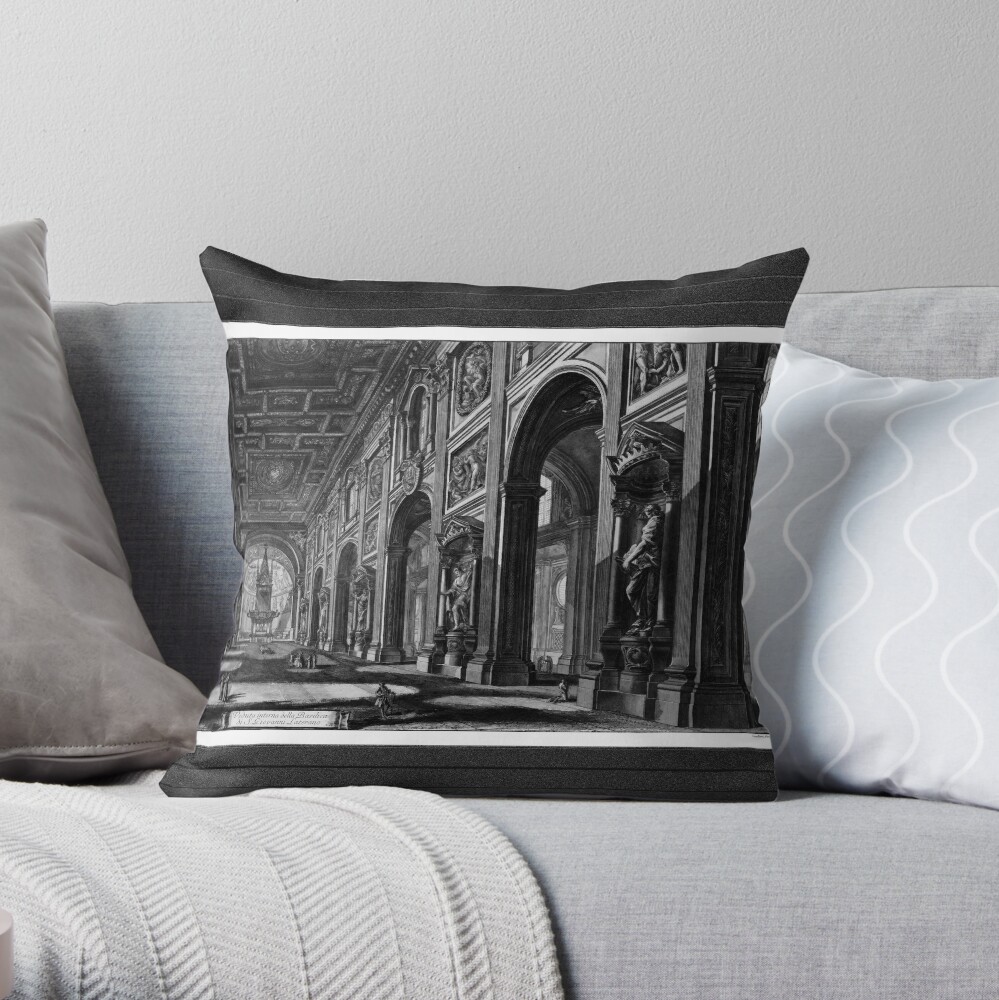
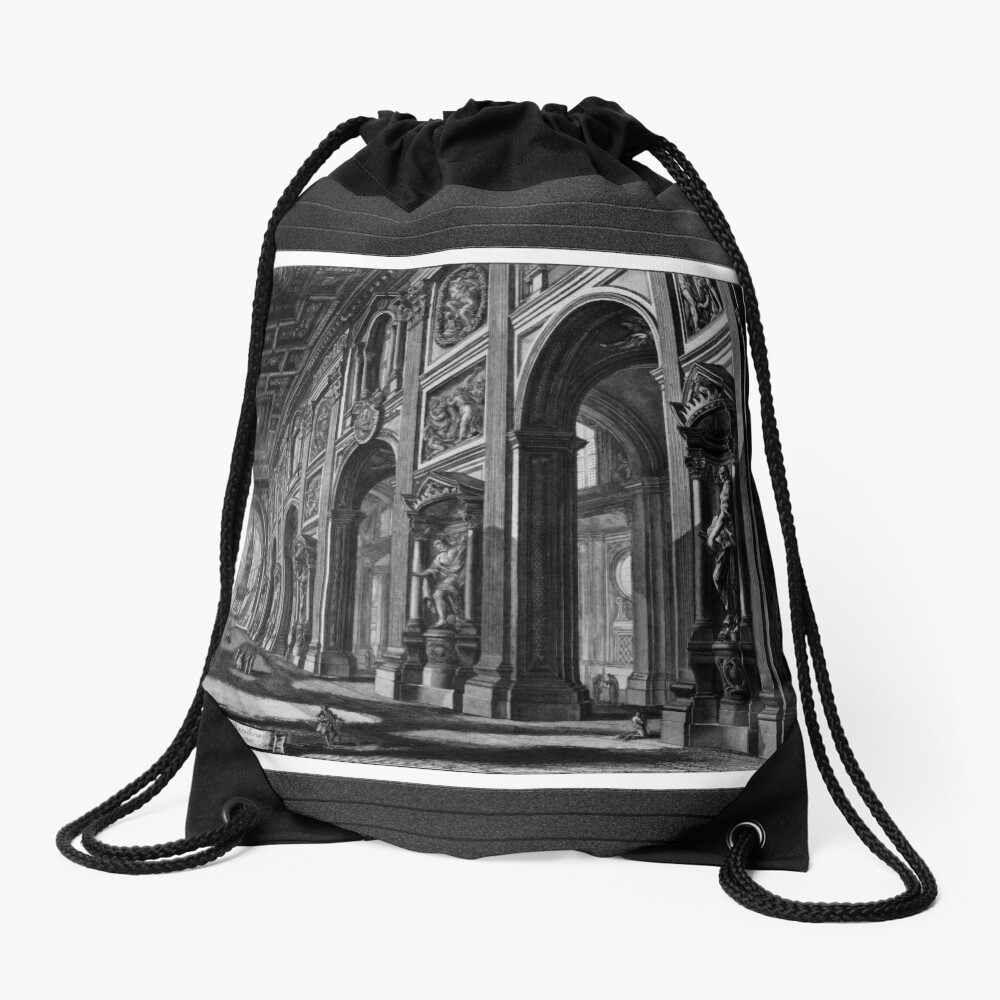
Innvendig utsikt over basilikaen S. Giovanni Laterano
Innvendig utsikt over basilikaen S. Giovanni Laterano by Italian Engraver Giovanni Battista Piranesi (1720 – 1778); maler, classical archaeologist and architect know for his etchings of Rome and fictitious atmospheric prisons.
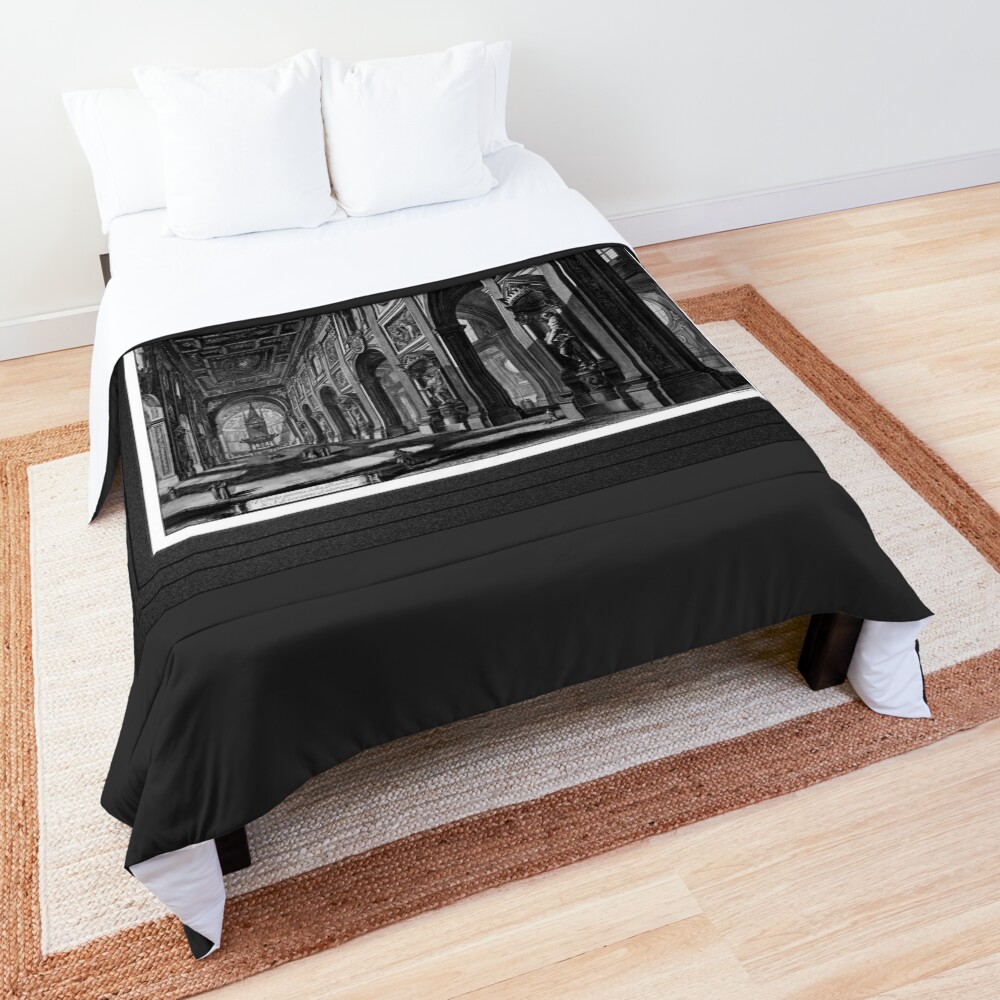
This is a beautiful engraving of the Internal View Of The Basilica Of San (Saint) Giovanni Laterano which was commissioned by the Roman Emperor Constantine and consecrated in 324 AD.
It was the first Christian Basilica built in Rome, and was the main place of worship until the late 14th century; and to this day is the official Cathedral of Rome and the Pope’s seat as the bishop of Rome.
Dette er en remastret digital kunst, gammel mesterreproduksjon av et offentlig domenebilde som er tilgjengelig for kjøp online som en rullet lerretstrykk.
Info nedenfor avledet fra Wikipedia.org
Piranesi was the son of a stonemason and was born in Venice, in the parish of S. Moisè where he was baptized. His brother Andrea introduced him to Latin literature and ancient Greco-Roman civilization.
Later he was apprenticed under his uncle, Matteo Lucchesi, som var en ledende arkitekt i Magistrato delle Acque, den statlige organisasjonen som er ansvarlig for prosjektering og restaurering av historiske bygninger.
Fra 1740, Giovanni hadde en mulighet til å jobbe i Roma som tegner for Marco Foscarini, den venetianske ambassadøren til den nye paven Benedikt XIV.
Han bodde i Palazzo Venezia og studerte under Giuseppe Vasi, som introduserte ham for etsning og gravering av byen og dens monumenter.
Giuseppe Vasi found that Giovanni’s talent was much greater than that of a mere engraver; according to Legrand, Vasi told Piranesi that “you are too much of a painter, my friend, to be an engraver.”
After his studies with Vasi concluded, he collaborated with pupils of the French Academy in Rome to produce a series of vedute (views) of the city.
I 1743 Giovanni created his first work the Prima parte di Architettura e Prospettive, and followed that up in 1745 with Varie Vedute di Roma Antica e Moderna.
Fra 1743 til 1747 Giovanni was mainly in Venice where, according to some sources, he often visited Giovanni Battista Tiepolo, a leading artist in Venice.
It was Tiepolo who expanded the restrictive conventions of reproductive, topographical and antiquarian engravings.
Giovanni then returned to Rome, where he opened a workshop in Via del Corso; og i 1748 – 1774 he created an important series of vedute of the city which established his fame.
In the meantime Piranesi devoted himself to the measurement of many of the ancient buildings, which led to the publication of Le Antichità Romane de’ tempo della prima Repubblica e dei primi imperatori (“Roman Antiquities of the Time of the First Republic and the First Emperors”).
I 1761 he became a member of the Accademia di San Luca and opened a printing house of his own. I 1762 the Campo Marzio dell’antica Roma collection of engravings was printed.
The following year he was commissioned by Pope Clement XIII to restore the choir of San Giovanni in Laterano, but the work did not materialize.
I 1764, one of the Pope’s nephews, Cardinal Rezzonico, appointed him to start his only architectural work, the restoration of the church of Santa Maria del Priorato in the Villa of the Knights of Malta, on Rome’s Aventine Hill.
He combined Classical Architectural Elements, trophies and escutcheons with his own particular imaginative genius for the design of the facade of the church and the walls of the adjacent Piazza dei Cavalieri di Malta.
I 1767 he was made a knight of the Golden Spur, which enabled him to sign himself “Cav[aliere] Piranesi”. I 1769 his publication of a series of ingenious and sometimes bizarre designs for chimneypieces, as well as an original range of furniture pieces, established his place as a versatile and resourceful designer.
I 1776 he created his best known work as a ‘restorer’ of ancient sculpture, the Piranesi Vase, og i 1777 – 78 he published Avanzi degli Edifici di Pesto (Remains of the Edifices of Paestum).