

Venere: A Study in Classical Beauty and Allegory
Alexandre Cabanel’s (1823 – 1889) “Venere,"dipinto in giro 1875, stands as a quintessential example of French Academic art during the late 19th century. The painting embodies the era’s fascination with classical mythology and idealized beauty, rendered with meticulous technical skill and an emphasis on harmonious composition. This work quickly gained notoriety for its depiction of the nude female form, sparking both admiration and controversy within artistic circles and beyond. Cabanel’s “Venus” is not merely a portrait; it is a carefully constructed allegory steeped in symbolism and referencing established artistic traditions.
Sommario
Compositional Structure and Setting
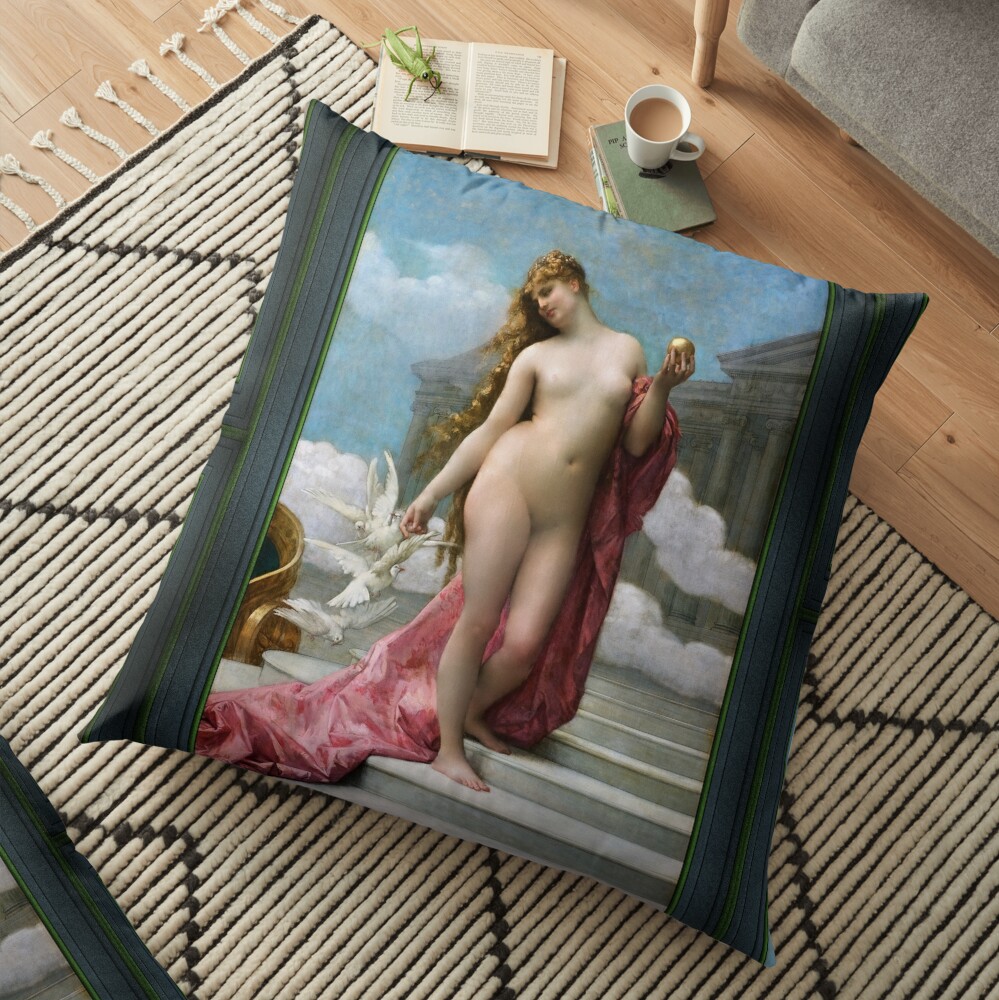
The artwork presents Venus, the Roman equivalent of the Greek goddess Aphrodite, descending from a celestial realm into a classical architectural setting. The composition is structured around a central pyramidal form, with Venus at its apex. She stands on a broad, white marble staircase that leads down towards the viewer, creating a sense of gradual descent and accessibility.
Behind her rises a grand, neoclassical building, partially obscured by swirling clouds and bathed in soft light. This architectural backdrop suggests a temple or palace, further reinforcing the divine nature of the subject. The lower left corner features a gilded chair and a cluster of doves, adding layers of symbolic meaning to the scene.
Venere: Form and Pose
Cabanel’s rendering of Venus is characterized by an almost sculptural quality. Her body is depicted with smooth, flowing lines and a flawless complexion, adhering to the Academic tradition of idealizing the human form. The artist demonstrates mastery in depicting flesh tones, capturing subtle variations in light and shadow to create a sense of volume and realism. Venus’s pose is both graceful and deliberate; she stands with one foot firmly planted on the step while the other is slightly raised, suggesting movement. Her head is turned towards the right, her gaze directed toward a golden orb held delicately in her outstretched hand. This gesture introduces an element of narrative intrigue – what does this sphere represent?
Simbolismo e allegoria
The painting’s symbolism is rich and layered. The golden orb, often interpreted as representing beauty or divine favor, is central to the allegory. It suggests that Venus embodies a principle beyond mere physical attractiveness; she represents something more profound and enduring. The doves, traditionally associated with love and peace, cluster around her feet, further reinforcing this theme.
The classical architecture evokes the grandeur of ancient civilizations and connects Venus to the artistic heritage of Greece and Rome. Even the clouds surrounding the building contribute to the ethereal atmosphere, emphasizing Venus’s divine status and separation from the earthly realm. The choice of a nude figure was not intended as provocative but rather as an homage to classical sculpture, where nudity frequently symbolized purity and ideal form.

Artistic Technique and Style
Cabanel’s technique is exemplary of Academic painting. He employed meticulous brushwork, blending colors seamlessly to create a smooth, polished surface. The application of paint is subtle; there are no visible brushstrokes, contributing to the overall sense of realism and refinement. The color palette is dominated by soft, warm tones – creams, rosa, ori, and blues – which contribute to the painting’s harmonious and serene atmosphere. Light plays a crucial role in the composition, illuminating Venus’s form and highlighting her beauty while casting subtle shadows that enhance the sense of depth and volume. The overall effect is one of exquisite craftsmanship and refined aesthetic sensibility.
Historical Context and Reception
“Venus” was exhibited at the Paris Salon of 1875, where it immediately generated considerable attention. While praised for its technical brilliance and adherence to classical ideals, the painting also sparked controversy due to its depiction of nudity. Some critics found the work overly sensual or lacking in spiritual depth, while others championed it as a triumph of artistic skill and a worthy successor to the great masters of antiquity.
Regardless of the critical response, “Venus” solidified Cabanel’s reputation as one of the leading artists of his generation and remains an iconic example of French Academic art. The painting reflects a broader cultural fascination with classical mythology and idealized beauty that characterized the 19th century, while also demonstrating the enduring power of artistic tradition.
Biografia dell'artista derivata da Wikipedia.org
According to Diccionario Enciclopedico Salvat, Cabanel è il miglior rappresentante dell’art pompier e il pittore preferito di Napoleone III. Cabanel entrò all'École des Beaux-Arts di Parigi all'età di diciassette anni, e ha studiato con François-Édouard Picot. Espone per la prima volta al Salon di Parigi 1844, e ha vinto la borsa di studio del Prix de Rome 1845 all'età di 22.
Cabanel è stato eletto membro dell'Istituto nel 1863. Fu nominato professore all'École des Beaux-Arts nel 1864 and taught there until his death. Era strettamente legato al Salon di Parigi: “Fu eletto regolarmente nella giuria dei Salon e i suoi allievi si contavano a centinaia ai Salons.
Attraverso loro, Cabanel ha fatto più di ogni altro artista della sua generazione per formare il carattere della pittura francese della belle époque”.
Il suo rifiuto, insieme a William-Adolphe Bouguereau, di permettere al pittore impressionista Édouard Manet e a molti altri pittori di esporre le loro opere al Salon di 1863 portò alla creazione del Salon des Refusés da parte del governo francese. Cabanel ha vinto la Grande Médaille d'Honneur ai Salons di 1865, 1867, e 1878.
Un pittore accademico di successo, il suo 1863 il dipinto La Nascita di Venere è uno degli esempi più noti della pittura accademica del XIX secolo. Il quadro fu acquistato dall'imperatore Napoleone III; c'è anche una replica più piccola (dipinto dentro 1875 per un banchiere, Giovanni Lupo) al Metropolitan Museum of Art di New York City. Gli è stato dato da Wolf in 1893.
Questa è una riproduzione di vecchi maestri di arte digitale ritoccata di un'immagine di dominio pubblico disponibile online come a stampa artistica arrotolata.