

金星: A Study in Classical Beauty and Allegory
Alexandre Cabanel’s (1823 – 1889) “金星,」絵を描いた 1875, stands as a quintessential example of French Academic art during the late 19th century. The painting embodies the era’s fascination with classical mythology and idealized beauty, rendered with meticulous technical skill and an emphasis on harmonious composition. This work quickly gained notoriety for its depiction of the nude female form, sparking both admiration and controversy within artistic circles and beyond. Cabanel’s “Venus” is not merely a portrait; it is a carefully constructed allegory steeped in symbolism and referencing established artistic traditions.
目次
Compositional Structure and Setting
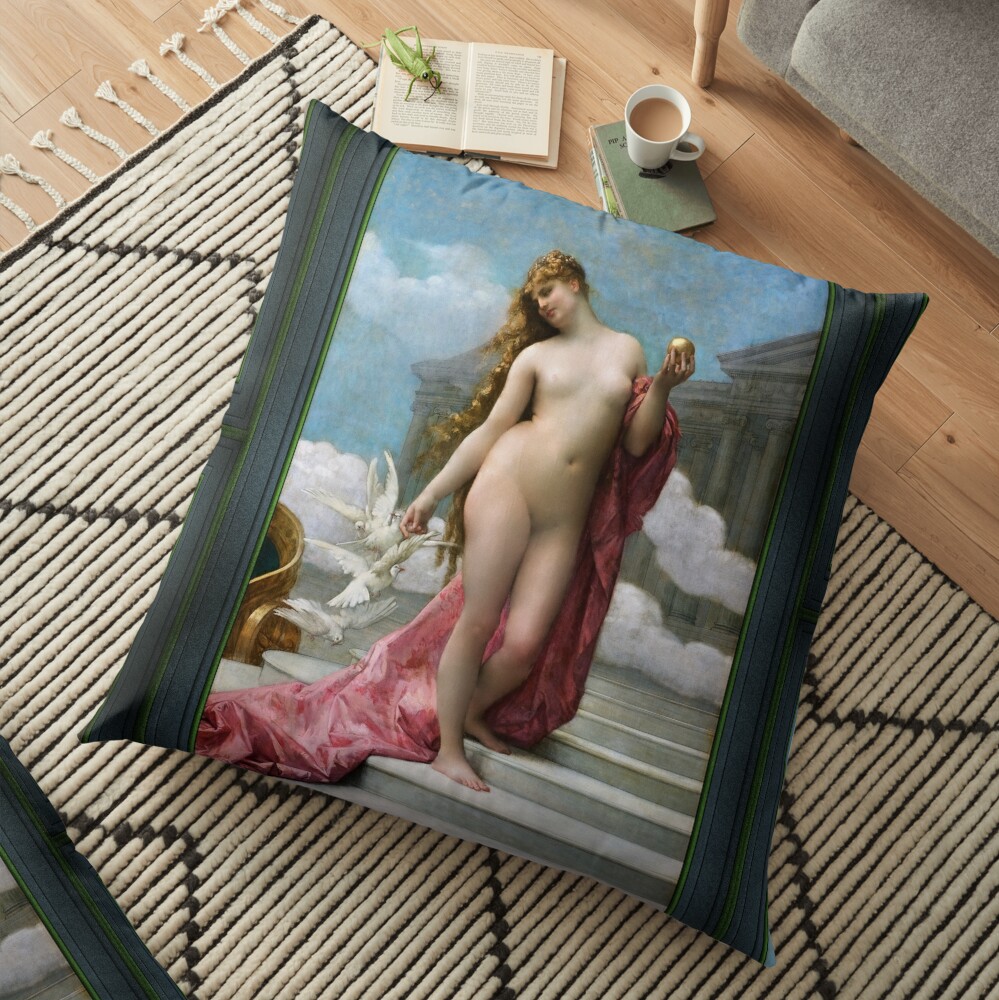
The artwork presents Venus, the Roman equivalent of the Greek goddess Aphrodite, descending from a celestial realm into a classical architectural setting. The composition is structured around a central pyramidal form, with Venus at its apex. She stands on a broad, white marble staircase that leads down towards the viewer, creating a sense of gradual descent and accessibility.
Behind her rises a grand, neoclassical building, partially obscured by swirling clouds and bathed in soft light. This architectural backdrop suggests a temple or palace, further reinforcing the divine nature of the subject. The lower left corner features a gilded chair and a cluster of doves, adding layers of symbolic meaning to the scene.
金星: Form and Pose
Cabanel’s rendering of Venus is characterized by an almost sculptural quality. Her body is depicted with smooth, flowing lines and a flawless complexion, adhering to the Academic tradition of idealizing the human form. The artist demonstrates mastery in depicting flesh tones, capturing subtle variations in light and shadow to create a sense of volume and realism. Venus’s pose is both graceful and deliberate; she stands with one foot firmly planted on the step while the other is slightly raised, suggesting movement. Her head is turned towards the right, her gaze directed toward a golden orb held delicately in her outstretched hand. This gesture introduces an element of narrative intrigue – what does this sphere represent?
Symbolism and Allegory
絵画の象徴性は豊かで階層化されています. The golden orb, often interpreted as representing beauty or divine favor, is central to the allegory. It suggests that Venus embodies a principle beyond mere physical attractiveness; she represents something more profound and enduring. The doves, traditionally associated with love and peace, cluster around her feet, further reinforcing this theme.
The classical architecture evokes the grandeur of ancient civilizations and connects Venus to the artistic heritage of Greece and Rome. Even the clouds surrounding the building contribute to the ethereal atmosphere, emphasizing Venus’s divine status and separation from the earthly realm. The choice of a nude figure was not intended as provocative but rather as an homage to classical sculpture, where nudity frequently symbolized purity and ideal form.

Artistic Technique and Style
Cabanel’s technique is exemplary of Academic painting. He employed meticulous brushwork, blending colors seamlessly to create a smooth, polished surface. The application of paint is subtle; there are no visible brushstrokes, contributing to the overall sense of realism and refinement. The color palette is dominated by soft, warm tones – creams, ピンク, 金, and blues – which contribute to the painting’s harmonious and serene atmosphere. Light plays a crucial role in the composition, illuminating Venus’s form and highlighting her beauty while casting subtle shadows that enhance the sense of depth and volume. The overall effect is one of exquisite craftsmanship and refined aesthetic sensibility.
Historical Context and Reception
“Venus” was exhibited at the Paris Salon of 1875, where it immediately generated considerable attention. While praised for its technical brilliance and adherence to classical ideals, the painting also sparked controversy due to its depiction of nudity. Some critics found the work overly sensual or lacking in spiritual depth, while others championed it as a triumph of artistic skill and a worthy successor to the great masters of antiquity.
Regardless of the critical response, “Venus” solidified Cabanel’s reputation as one of the leading artists of his generation and remains an iconic example of French Academic art. The painting reflects a broader cultural fascination with classical mythology and idealized beauty that characterized the 19th century, while also demonstrating the enduring power of artistic tradition.
アーティスト略歴の由来 Wikipedia.org
Diccionario Enciclopedico Salvat によると, カバネルは、ラル・ポンピエの最も優れた代表者であり、ナポレオン 3 世に好まれた画家です。. カバネルは17歳でパリのエコール・デ・ボザールに入学した, フランソワ=エドゥアール・ピコに師事. パリサロンに初出展。 1844, でローマ賞の奨学金を獲得しました。 1845 歳の時に 22.
カバネルは、2006 年に研究所のメンバーに選出されました。 1863. 彼はエコール・デ・ボザールの教授に任命されました。 1864 そして死ぬまでそこで教えられた. 彼はパリサロンと密接な関係がありました: “彼はサロンの審査員に定期的に選出され、彼の生徒はサロンで百人単位で数えられるほどでした。.
それらを通して, カバネルは、同世代の他のどの芸術家よりもベル・エポックのフランス絵画の性格を形成することに尽力しました。”.
彼はウィリアム・アドルフ・ブーグローとともに、印象派の画家エドゥアール・マネや他の多くの画家がサロンに作品を展示することを拒否した。 1863 フランス政府によるサロン・デ・ルフューゼの設立につながった. カバネルは、フランスのサロンでグランド・メダイユ・ドヌールを受賞しました。 1865, 1867, そして 1878.
成功した学術画家, 彼の 1863 絵画「ヴィーナスの誕生」は、19 世紀の学術絵画の最もよく知られた例の 1 つです. この絵は皇帝ナポレオン 3 世によって購入されました。; 小さいレプリカもあります (描かれた 1875 銀行家にとって, ジョン・ウルフ) ニューヨーク市のメトロポリタン美術館で. それはウルフによって彼らに与えられたものです 1893.
これは、オンラインで入手可能なパブリック ドメインの画像の修正されたデジタル アートの古いマスターの複製です。 ロールアートプリント.