

금성: A Study in Classical Beauty and Allegory
Alexandre Cabanel’s (1823 – 1889) “금성,”그 주위에 페인트 1875, stands as a quintessential example of French Academic art during the late 19th century. The painting embodies the era’s fascination with classical mythology and idealized beauty, rendered with meticulous technical skill and an emphasis on harmonious composition. This work quickly gained notoriety for its depiction of the nude female form, sparking both admiration and controversy within artistic circles and beyond. Cabanel’s “Venus” is not merely a portrait; it is a carefully constructed allegory steeped in symbolism and referencing established artistic traditions.
목차
Compositional Structure and Setting
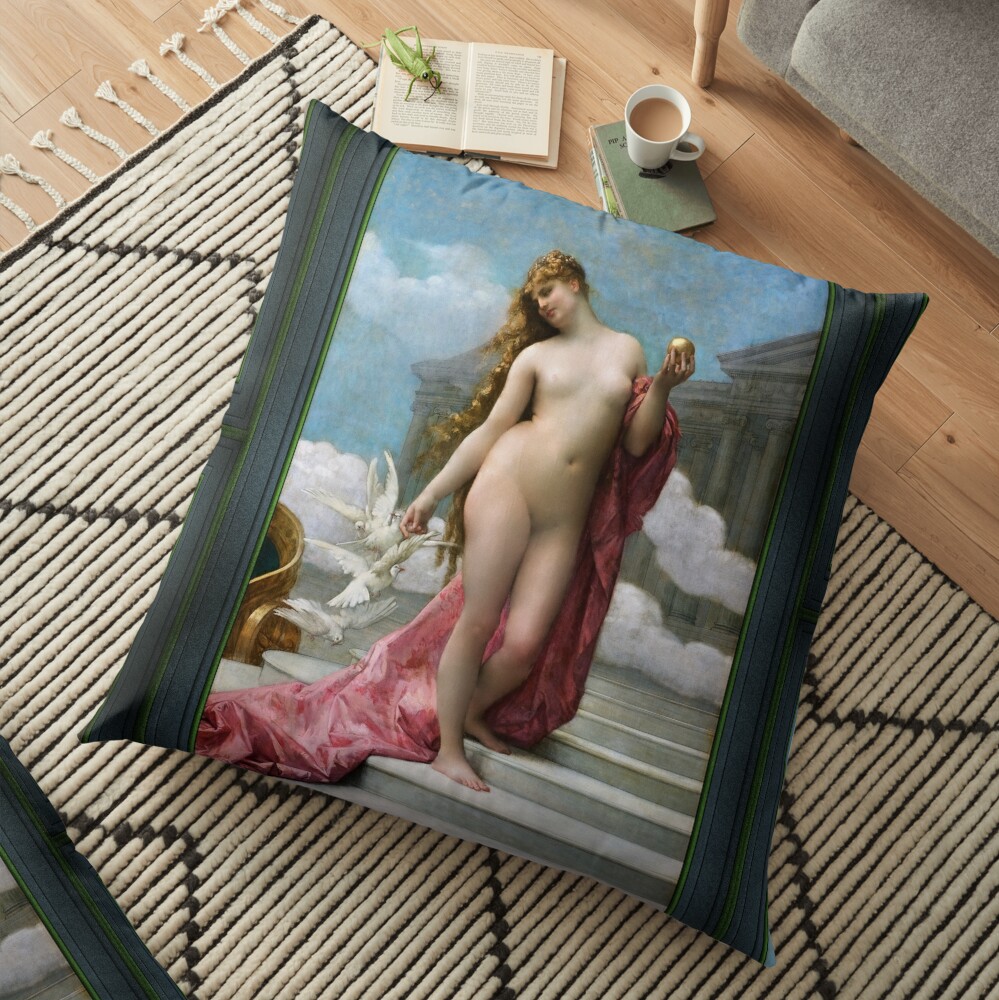
The artwork presents Venus, the Roman equivalent of the Greek goddess Aphrodite, descending from a celestial realm into a classical architectural setting. The composition is structured around a central pyramidal form, with Venus at its apex. She stands on a broad, white marble staircase that leads down towards the viewer, creating a sense of gradual descent and accessibility.
Behind her rises a grand, neoclassical building, partially obscured by swirling clouds and bathed in soft light. This architectural backdrop suggests a temple or palace, further reinforcing the divine nature of the subject. The lower left corner features a gilded chair and a cluster of doves, adding layers of symbolic meaning to the scene.
금성: Form and Pose
Cabanel’s rendering of Venus is characterized by an almost sculptural quality. Her body is depicted with smooth, flowing lines and a flawless complexion, adhering to the Academic tradition of idealizing the human form. The artist demonstrates mastery in depicting flesh tones, capturing subtle variations in light and shadow to create a sense of volume and realism. Venus’s pose is both graceful and deliberate; she stands with one foot firmly planted on the step while the other is slightly raised, suggesting movement. Her head is turned towards the right, her gaze directed toward a golden orb held delicately in her outstretched hand. This gesture introduces an element of narrative intrigue – what does this sphere represent?
상징주의와 우화
The painting’s symbolism is rich and layered. The golden orb, often interpreted as representing beauty or divine favor, is central to the allegory. It suggests that Venus embodies a principle beyond mere physical attractiveness; she represents something more profound and enduring. The doves, traditionally associated with love and peace, cluster around her feet, further reinforcing this theme.
The classical architecture evokes the grandeur of ancient civilizations and connects Venus to the artistic heritage of Greece and Rome. Even the clouds surrounding the building contribute to the ethereal atmosphere, emphasizing Venus’s divine status and separation from the earthly realm. The choice of a nude figure was not intended as provocative but rather as an homage to classical sculpture, where nudity frequently symbolized purity and ideal form.

예술적 기법과 스타일
Cabanel’s technique is exemplary of Academic painting. He employed meticulous brushwork, blending colors seamlessly to create a smooth, polished surface. The application of paint is subtle; there are no visible brushstrokes, contributing to the overall sense of realism and refinement. The color palette is dominated by soft, warm tones – creams, 분홍색, 금, and blues – which contribute to the painting’s harmonious and serene atmosphere. Light plays a crucial role in the composition, illuminating Venus’s form and highlighting her beauty while casting subtle shadows that enhance the sense of depth and volume. The overall effect is one of exquisite craftsmanship and refined aesthetic sensibility.
Historical Context and Reception
“Venus” was exhibited at the Paris Salon of 1875, where it immediately generated considerable attention. While praised for its technical brilliance and adherence to classical ideals, the painting also sparked controversy due to its depiction of nudity. Some critics found the work overly sensual or lacking in spiritual depth, while others championed it as a triumph of artistic skill and a worthy successor to the great masters of antiquity.
Regardless of the critical response, “Venus” solidified Cabanel’s reputation as one of the leading artists of his generation and remains an iconic example of French Academic art. The painting reflects a broader cultural fascination with classical mythology and idealized beauty that characterized the 19th century, while also demonstrating the enduring power of artistic tradition.
유래 된 아티스트 바이오 Wikipedia.org
Salvat 백과사전 사전에 따르면, Cabanel은 L'art pompier와 나폴레옹 3세가 선호하는 화가의 최고 대표자입니다.. Cabanel은 17세에 파리의 École des Beaux-Arts에 입학했습니다., François-Édouard Picot와 함께 공부했습니다.. 그는 파리 살롱에 처음으로 출품했다. 1844, 그리고 Prix de Rome 장학금을 받았습니다. 1845 세의 나이에 22.
Cabanel은 연구소의 회원으로 선출되었습니다. 1863. 그는 École des Beaux-Arts의 교수로 임명되었습니다. 1864 죽을 때까지 그곳에서 가르쳤습니다.. 파리 살롱과 인연이 깊다.: “그는 살롱 배심원단에 정기적으로 선출되었으며 그의 제자들은 살롱에서 백 단위로 셀 수 있었습니다..
그들을 통해, Cabanel은 벨 에포크 프랑스 회화의 성격을 형성하기 위해 그의 세대의 다른 어떤 예술가보다 더 많은 일을 했습니다.”.
인상파 화가 에두아르 마네(Édouard Manet)와 다른 많은 화가들이 의 살롱에서 자신의 작품을 전시하는 것을 윌리엄-아돌프 부게로(William-Adolphe Bouguereau)와 함께 거부했다. 1863 프랑스 정부의 살롱 데 Refusés 설립. Cabanel은 Salons of Honor에서 그랜드 메달 오브 아너(Grand Medal of Honor)를 수상했습니다. 1865, 1867, 과 1878.
성공적인 학문적 화가, 그의 1863 그림 비너스의 탄생은 19세기 학술 회화의 가장 잘 알려진 사례 중 하나입니다.. 이 그림은 황제 나폴레옹 3세가 구입했습니다.; 더 작은 복제본도 있습니다. (그린 1875 은행원을 위해, 존 울프) 뉴욕 메트로폴리탄 미술관에서. 그것은 늑대에 의해 그들에게 주어졌습니다. 1893.
이것은 온라인에서 사용할 수 있는 퍼블릭 도메인 이미지의 수정된 디지털 아트 올드 마스터 복제품입니다. rolled art print.