

Venus désarMent Cupid
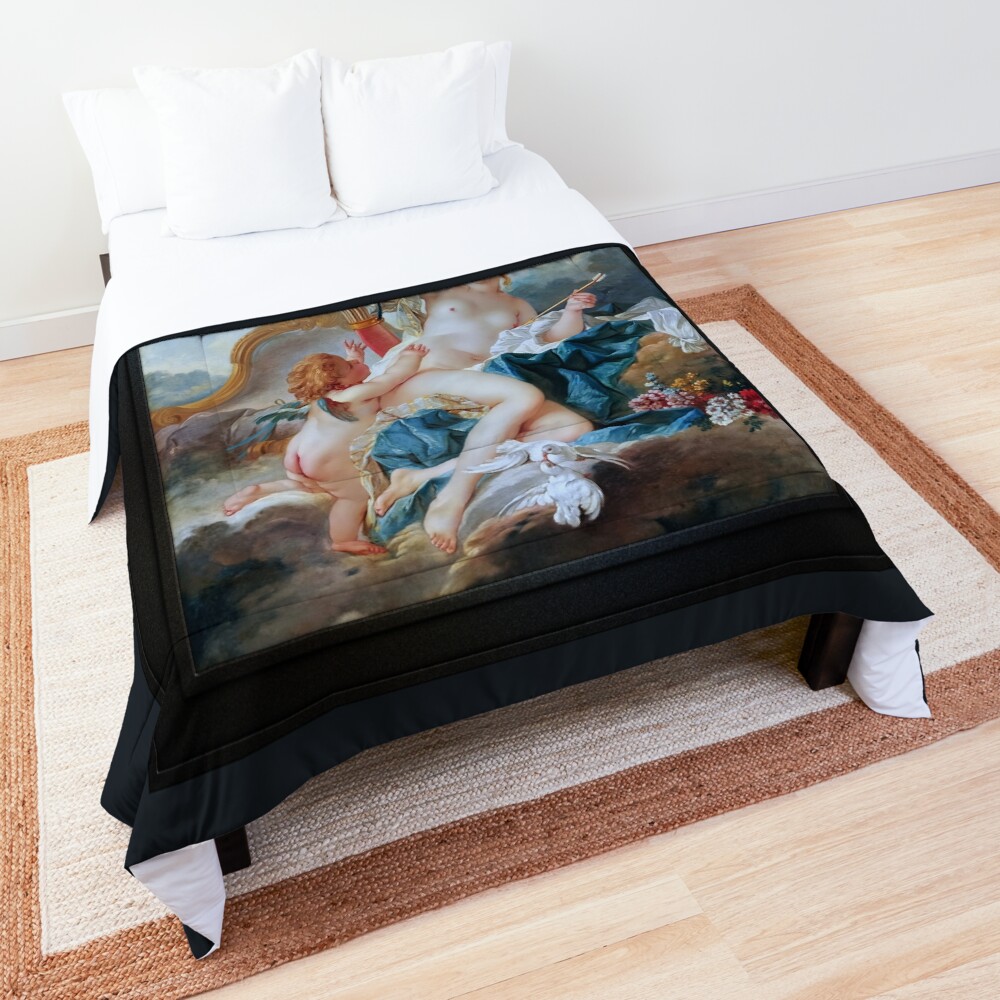
“Venus désarMent Cupid” (Venus disterming Cupid), air a chruthachadh a-steach 1751 leis an neach-ealain rococo ainmeil Francois Boucher (1703 – 1770), tha e na eisimpleir ceadaichte den dealbh-chluich, Cuspairean ciallach àbhaisteach an stoidhle Rococo. Na rudan a tha a 'nochdadh Venus, ban-dia Ròmanach, agus cupaid, a mac mì-mhodhail, Ann am mionaid tairgse agus dlùth-cheangal. Bidh an obair seo a 'nochdadh èadhar de bhog, seun, agus cridhe aotrom, a 'taisbeanadh sealladh beairteach ann an ciall samhlachail agus mion-fhiosrachadh lèirsinneach lusach.
Clàr-innse
Am Prìomh Chuspair: Venus agus Cupid
Anns a 'ghnìomhachd mìorbhuileach seo, Is e Venus am prìomh fhigear, a rèir coltais ann an socair, Suidheachadh a tha a 'cur air ais air couch pàiste air a tharraing ann an aodach sòghannach. Is i an epidome of gràs agus bòidhchead, with her delicate features framed by soft curls and a serene expression. Venus’ pose suggests both authority and gentleness, her body slightly turned towards Cupid as she lovingly and effortlessly disarms him. She holds the quiver of arrows, fhad 'sa bha Cupid, depicted as a playful, cherubic child, attempts to pull away, symbolizing the restrained power of love.
Cupid, a symbol of unrestrained desire and the unpredictable force of love, is shown in a vulnerable moment, trying to escape from Venus’s grasp. His youthful form is soft and round, his small wings spread wide as he pushes against Venus’s tender hold. The playful struggle between mother and son represents the balance between the power of love, both as an uncontrollable force (Cupid) and as something that can be tempered or moderated by wisdom and restraint (Venus).
Rudan agus samhlachas
In this Rococo masterpiece, objects within the scene are not merely decorative but carry profound symbolic weight. Venus’s quiver, from which she removes Cupid’s arrows, represents the tools of love and desire. The delicate arrows, typically seen as symbols of love’s unpredictability, are now disarmed and under Venus’s control, reinforcing her dominance over Cupid and, by extension, the power of love itself. The golden bow lying on the ground further emphasizes the shift from action to pause, and perhaps the temperance that Venus, mar bhan-dia a' ghràidh, represents.
The presence of doves at Venus’s feet adds another layer of meaning. In classical mythology, doves are often associated with love, purrachd, and harmony, making them fitting companions to Venus, the goddess who embodies these ideals. The flowers scattered at the lower right of the painting, including roses and other vibrant blooms, mirror the themes of beauty, gaol, agus torachas, reinforcing the sensuous atmosphere of the work.
Cruth-tìre agus Stuthan
The landscape within “Venus désarMent Cupid” is soft and atmospheric, filled with light clouds and a faint suggestion of a distant horizon. This background is not meant to be a focal point but rather provides a gentle, dream-like setting that complements the figures of Venus and Cupid. The terrain is open, unconfined, with no sharp boundaries, allowing the figures to appear as if floating in an idealized, serene world where love is the prevailing force.
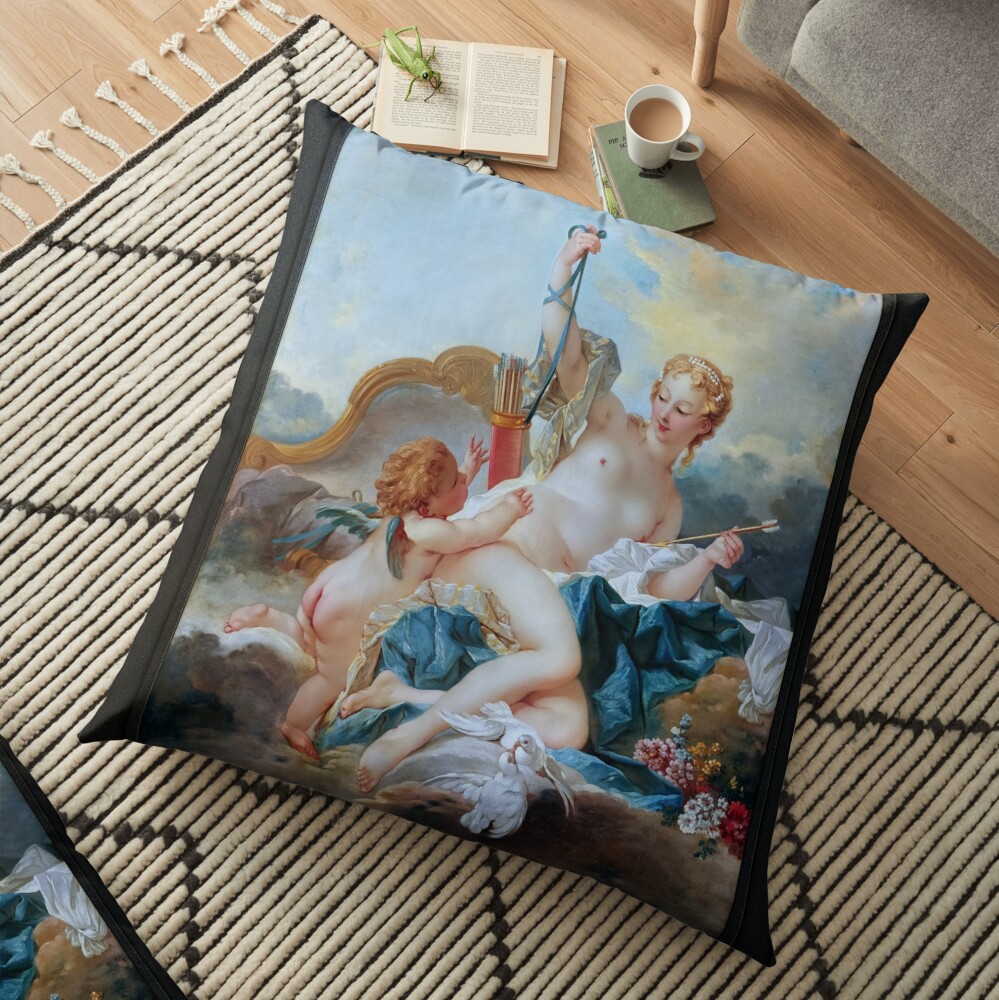
The materials depicted within the painting, rich fabrics, soft drapery, and the delicate textures of skin and hair—are rendered with incredible finesse, showcasing Boucher’s mastery of texture and detail. The smoothness of the skin contrasts beautifully with the lushness of the fabric surrounding the figures, emphasizing the ethereal quality of the scene. Venus’s gown, a flowing fabric of soft blues and whites, is meticulously painted to reflect light, enhancing the sense of movement and grace in her posture.
Stoidhle, Cuspair, agus Mood
François Boucher's “Venus désarMent Cupid” a’ nochdadh stoidhle Rococo, characterized by its light, airy compositions, playful themes, and emphasis on beauty and sensuality. The soft color palette of pastel blues, pincain, and whites gives the piece a delicate, almost otherworldly quality, aligning with the Rococo emphasis on grace, eireachdas, agus seun.
The rounded, soft forms of the figures, along with their fluid poses, tha iad nan comharra air mar a dhiùlt Rococo na loidhnichean cruaidh agus na sgrìobhaidhean dràmadach de obraichean Baróc na bu thràithe. Cleachdadh ainm-sgrìobhte Boucher de sholas is sgàil, còmhla ri mion-fhiosrachadh toinnte mu aodach Venus agus feartan cherubic Cupid, toirt air an dealbh nochdadh cha mhòr beò.
Tha faireachdainn an deilbh mar aon de spèis spòrsail. Tha an eadar-obrachadh eadar Venus agus Cupid a 'moladh chan e a-mhàin gràdh tairgse màthair dha a mac ach cuideachd an àrach, smachd air taobh a' ghràidh fèin. Chan eil Venus dìreach a’ dì-armachadh Cupid; tha i a' sealltainn dha gum faod gaol a bhith cumhachdach agus air a bhacadh. Tha an ceangal seo eadar smachd agus neo-chiontachd, neart agus caomhalachd, a’ toirt a-steach an dealbh le seun gun ùine.
Co-dhùnadh
“Venus désarMent Cupid” a’ seasamh mar eisimpleir iongantach de chomas François Boucher a bhith a’ ceangal bòidhchead fìnealta ri doimhneachd alegorical. Tro a mhaighstireachd air stoidhle Rococo, Bidh Boucher a’ glacadh nuances gaoil an dà chuid ann an cruthan spòrsail agus cumhachdach. Venus, mar am figear ceannasach ach àrach, agus cupaid, mar shamhla air neart neo-fhaicsinneach a’ ghràidh, còmhla cruthaich aithris gun ùine de ghaol, smachd, agus an dannsa shiorruidh eadar an dithis.
Tha Vénus désarmant Cupidon na ath-riochdachadh seann mhaighstirean ealain didseatach de ìomhaigh raon poblach a tha ri fhaighinn mar clò-bhualadh canabhas air-loidhne.
Fiosrachadh gu h-ìosal a thàinig bho Wikipedia.org
Rugadh e ann am Paris, B ’e Boucher mac peantair nach robh cho ainmeil Nicolas Boucher, a thug dha a ’chiad trèanadh ealanta aige. Aig aois seachd bliadhna deug, chaidh am peantadh le Boucher fhaicinn leis a ’pheantair François Lemoyne. An dèidh sin chuir Lemoyne Boucher an dreuchd mar phreantas, ach às deidh dìreach trì mìosan, chaidh e a dh ’obair airson an gràbhalaiche Jean-François Cars.
Ann an 1720, bhuannaich e am mionlach Grand Prix de Rome airson peantadh, ach cha do ghabh iad an cothrom mar thoradh air sin sgrùdadh a dhèanamh san Eadailt gu còig bliadhna às deidh sin, air sgàth duilgheadasan ionmhais aig Acadamaidh Rìoghail Peantadh agus Snaidheadh.[1] Nuair a thill e bho bhith ag ionnsachadh san Eadailt chaidh a leigeil a-steach don obair-shnaighte Académie de peinture et de air 24 An t-Samhain 1731. Am pìos fàilteachaidh aige (pìos fàilteachaidh) bha a Rinaldo agus Armida de 1734.
Phòs Boucher Marie-Jeanne Buzeau a-steach 1733. Bha triùir chloinne aig a ’chàraid còmhla. Thàinig Boucher gu bhith na bhall dàimhe ann an 1734 agus luathaich a chùrsa-beatha bhon àm seo oir chaidh àrdachadh gu bhith na Àrd-ollamh aig an àm sin na Cheannard air an Acadamaidh, gu bhith na neach-sgrùdaidh aig an Royal Gobelins Manufactory agus mu dheireadh Premier Peintre du Roi (Ciad Peantair an Rìgh) a-steach 1765. Dealbh de Marie-Louise O’Murphy c. 1752
Bhàsaich Boucher air 30 A 'Chèitean 1770 ann am Paris bho thùs. Ainm, còmhla ri neach-taic Madame de Pompadour, air fàs co-cheangailte ri stoidhle Rococo na Frainge, a ’toirt air na bràithrean Goncourt sgrìobhadh: “Is e Boucher aon de na fir sin a tha a ’riochdachadh blas ceud bliadhna, a tha a ’cur an cèill, pearsanachadh agus cuir a-steach e.”
Tha Boucher ainmeil airson a bhith ag ràdh gu bheil nàdar “ro uaine agus air a lasadh gu dona” (ro uaine agus air a lasadh gu dona).
Bha Boucher co-cheangailte ris an gràbhalaiche gemstone Jacques Guay, a theagaisg e a tharraing. Thug e cuideachd taic don pheantair Moravian-Ostair Martin Ferdinand Quadal a bharrachd air a ’pheantair neoclassical Jacques-Louis David ann an 1767.[4] Nas fhaide air adhart, Rinn Boucher sreath de dhealbhan de dh ’obair le Guay a rinn Madame de Pompadour an uairsin a ghràbhaladh agus a sgaoileadh mar leabhar le ceangal eireachdail ri luchd-cùirte a b’ fheàrr leotha