

Venus aalloilla
Venus aalloilla: A Rococo Dreamscape
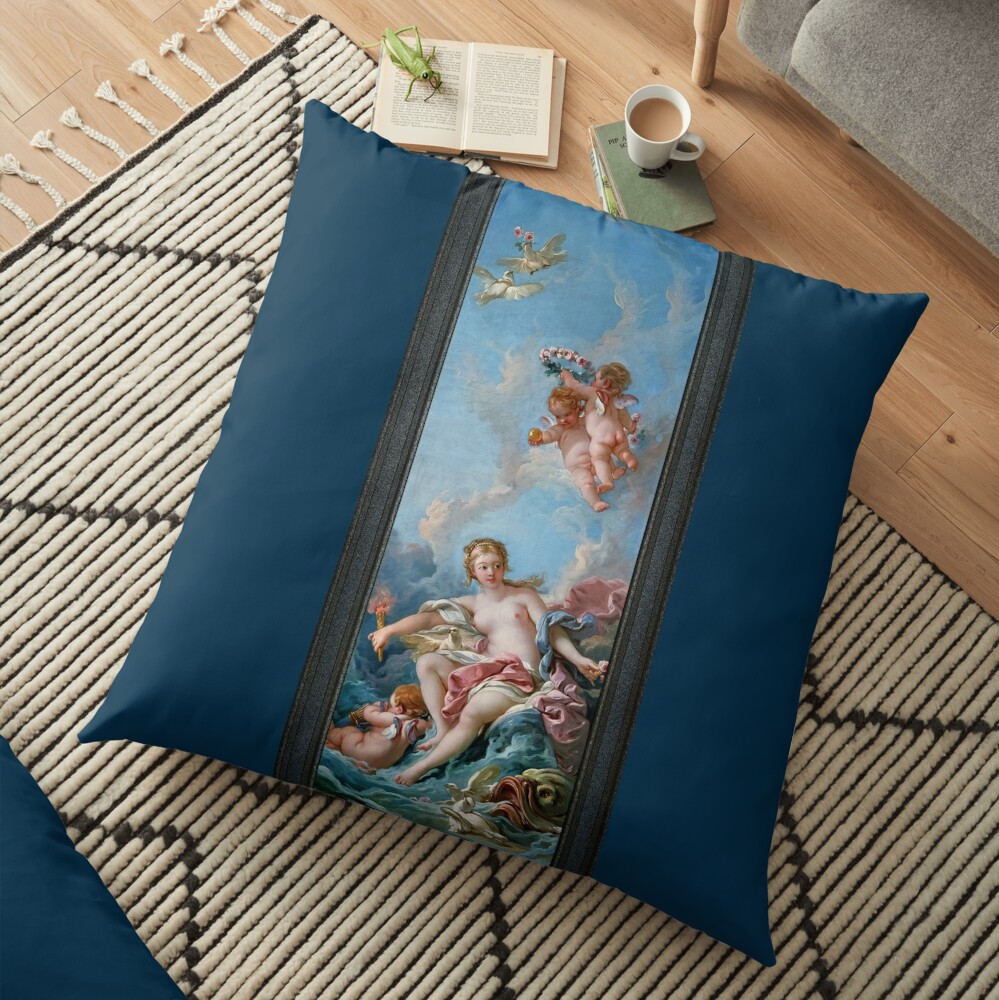
Francois Boucher’s (1703 – 1770) “Venus on the Waves,”Maalattu ympäri 1769, exemplifies the quintessential Rococo style that flourished in France during the mid-18th century. This vertical format painting, a testament to Boucher’s mastery of color and composition, depicts the Roman goddess Venus, or Aphrodite as she is known in Greek mythology, emerging from the sea amidst a swirling panorama of clouds, cherubs, and marine motifs. The work was commissioned by Madame de Pompadour, Louis XV’s influential mistress, reflecting the era’s taste for mythological subjects rendered with elegance and sensuality.
Sisällysluettelo
Koostumuselementit & Narrative Absence
The composition is vertically oriented, drawing the viewer’s eye upwards from the turbulent sea towards the celestial realm above. Venus occupies a central position, seated upon a shell-like structure that rises from the waves. She appears serene and composed, her gaze directed slightly downwards, as if acknowledging the surrounding spectacle but not actively participating in it. The lower portion of the painting is dominated by the churning ocean, rendered with a palette of blues and greens, punctuated by whitecaps suggesting movement and energy. Above Venus, a swirling sky filled with clouds provides a backdrop for several cherubic figures engaged in playful activities.
Cherubs & Symbolic Details
Several cherubs populate the scene, each contributing to the overall atmosphere of lightness and grace. One cherub floats above Venus, scattering rose petals – a traditional symbol of love and beauty associated with the goddess. Another group of cherubs is depicted weaving a garland, adding a touch of pastoral charm to the composition. A winged putto flies overhead carrying a bouquet of flowers, further reinforcing the theme of affection and celebration. The shell upon which Venus sits isn’t merely decorative; it’s a symbolic representation of her birth from the sea foam – a foundational myth in classical mythology.
Boucher’s Rococo Style: Väri & Tekniikka
Boucher’s artistic style is immediately recognizable through his use of soft, pastel colors and delicate brushstrokes. The painting lacks sharp lines or dramatic contrasts; sen sijaan, it relies on subtle gradations of color to create a sense of ethereal beauty. His technique emphasizes fluidity and movement, particularly evident in the depiction of the waves and clouds. Boucher’s mastery of light is also apparent – Venus appears bathed in a soft, diffused glow that enhances her luminous quality. The overall effect is one of dreamy tranquility, characteristic of Rococo art’s pursuit of pleasure and escapism.
Konteksti & Historiallinen merkitys
“Venus on the Waves” was created during a period when mythological subjects were highly fashionable among the French aristocracy. Boucher’s interpretation of Venus departs from earlier depictions that emphasized her power or authority; sen sijaan, he presents her as an embodiment of beauty, armo, and sensuality – qualities prized by the court of Louis XV. The painting reflects the Rococo era’s shift away from the grandeur of the Baroque towards a more intimate and decorative style. It served not only as a work of art but also as a symbol of refined taste and aristocratic patronage.
Examination of Venus’s Pose & Expression
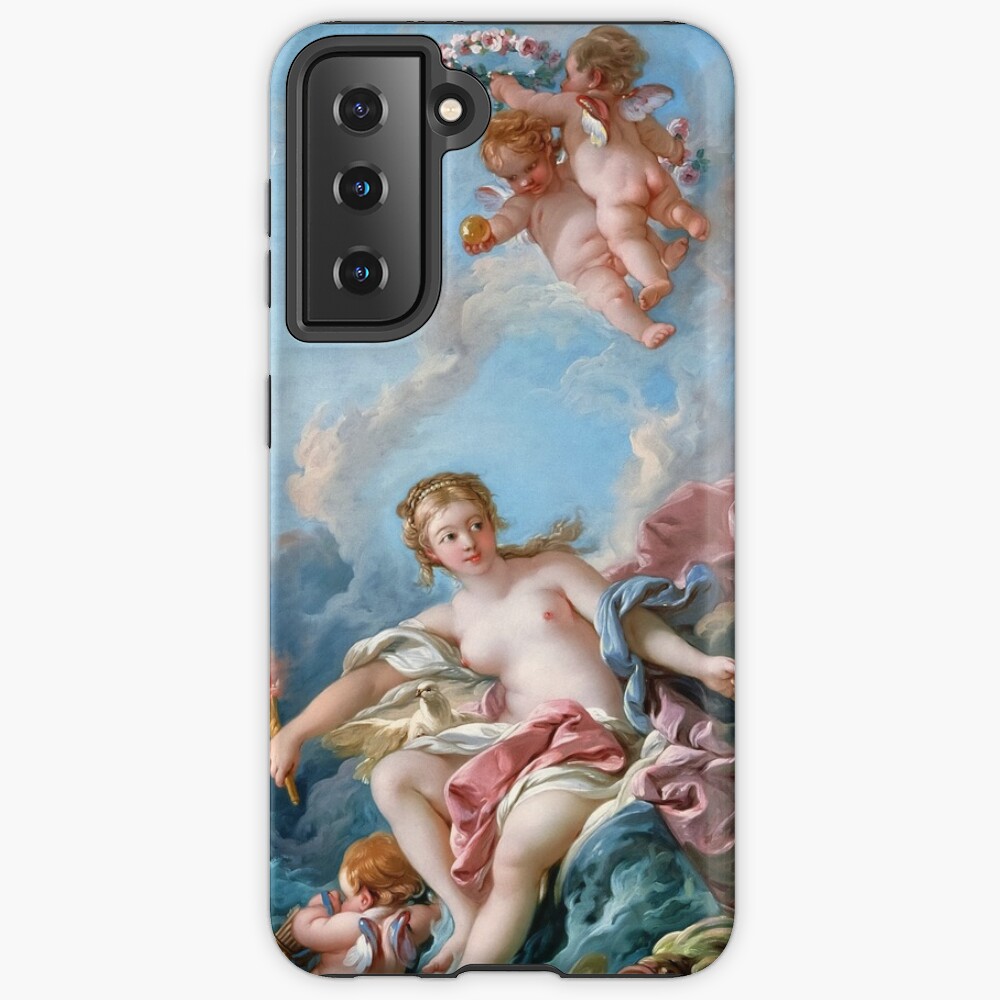
Venus is depicted in a relaxed, almost languid pose. Her body curves gently, suggesting both softness and vitality. She holds a single torch aloft, its flame casting a warm glow on her face and hands. The torch itself carries symbolic weight; it represents the divine spark of love and beauty that Venus embodies. Her expression is serene and contemplative, conveying a sense of inner peace and detachment from the surrounding activity. This lack of overt emotion contributes to the painting’s overall atmosphere of tranquility and grace.
Värivalikoima & Ilmakehän vaikutukset
The color palette in “Venus on the Waves” is dominated by soft blues, pinkit, vihreät, ja kultaa. These colors contribute to the painting’s ethereal quality and evoke a sense of warmth and light. Boucher skillfully uses atmospheric perspective – rendering distant objects with less detail and paler colors – to create a sense of depth and space within the composition. The swirling clouds and turbulent waves add dynamism to the scene, while the soft lighting enhances the overall feeling of dreamlike beauty.
Taiteellisia vaikutteita & Perintö
Boucher’s work was influenced by earlier masters such as Peter Paul Rubens and Jean-Antoine Watteau, both renowned for their depictions of mythological subjects and their mastery of color and composition. kuitenkin, Boucher developed his own unique style that became synonymous with the Rococo movement. “Venus on the Waves” is considered one of his most iconic works and has had a lasting impact on Western art, inspiring countless artists to emulate its elegance and sensuality. The painting remains an important example of Rococo aesthetics and a testament to Boucher’s artistic genius.
Taiteilija Bio on johdettu Wikipedia.org
Kotoisin Pariisista, Boucher oli vähemmän tunnettu taidemaalari Nicolas Boucherin poika, joka antoi hänelle ensimmäisen taiteellisen koulutuksen. Seitsemäntoistavuotiaana, Boucherin maalausta ihaili taidemaalari François Lemoyne. Lemoyne nimitti myöhemmin Boucherin oppipoikakseen, mutta vasta kolmen kuukauden jälkeen, hän meni töihin kaivertajalle Jean-François Carsille.
Sisään 1720, hän voitti eliitin Grand Prix de Rooman maalauksesta, mutta käytti seuraavaa tilaisuutta opiskella Italiassa vasta viisi vuotta myöhemmin, kuninkaallisten maalaus- ja kuvanveistoakatemian taloudellisten ongelmien vuoksi.[1] Palattuaan opiskelemaan Italiassa hänet hyväksyttiin uudelleen perustettuun Académie de peinture et de veistokseen 24 marraskuu 1731. Hänen vastaanottokappaleensa (vastaanottokappale) oli hänen Rinaldo ja Armida 1734.
Boucher meni naimisiin Marie-Jeanne Buzeaun kanssa vuonna 1733. Pariskunnalla oli kolme yhteistä lasta. Boucherista tuli tiedekunnan jäsen vuonna 1734 ja hänen uransa kiihtyi tästä lähtien, kun hänet ylennettiin professoriksi, sitten akatemian rehtoriksi, hänestä tuli tarkastaja Royal Gobelinsin manufaktuurissa ja lopulta pääministeri Peintre du Roi (Kuninkaan ensimmäinen maalari) sisään 1765. Muotokuva Marie-Louise O’Murphy c. 1752
Boucher kuoli 30 saattaa 1770 kotimaassaan Pariisissa. Hänen nimensä, yhdessä hänen suojelijansa Madame de Pompadourin kanssa, oli tullut synonyymi ranskalaiselle rokokoo -tyylille, johdattaa Goncourt -veljekset kirjoittamaan: “Boucher on yksi niistä miehistä, jotka edustavat vuosisadan makua, jotka ilmaisevat, personoida ja ilmentää sitä.”
Boucher on kuuluisa sanomalla, että luonto on “liian vihreä ja heikosti valaistu” (liian vihreä ja huonosti valaistu).
Boucher liittyi jalokivikaivertaja Jacques Guayhin, jonka hän opetti piirtämään. Hän opetti myös Moravian-itävaltalaisen taidemaalarin Martin Ferdinand Quadalin ja uusklassisen taidemaalarin Jacques-Louis Davidin. 1767.[4] Myöhemmin, Boucher teki sarjan piirroksia Guayn teoksista, jotka rouva de Pompadour kaiverrettiin ja jaettiin komeasti sidottuna teoksena suosituille hovimiehille
Venus On The Waves is a retouched digital art reproduction of a public domain image that is available as a rullaprintti verkossa.