

Vénus sur les vagues
Vénus sur les vagues: A Rococo Dreamscape
François Boucherc'est (1703 – 1770) “Venus on the Waves,”Peint autour 1769, exemplifies the quintessential Rococo style that flourished in France during the mid-18th century. This vertical format painting, a testament to Boucher’s mastery of color and composition, depicts the Roman goddess Venus, or Aphrodite as she is known in Greek mythology, emerging from the sea amidst a swirling panorama of clouds, chérubins, and marine motifs. The work was commissioned by Madame de Pompadour, La maîtresse influente de Louis XV, reflecting the era’s taste for mythological subjects rendered with elegance and sensuality.
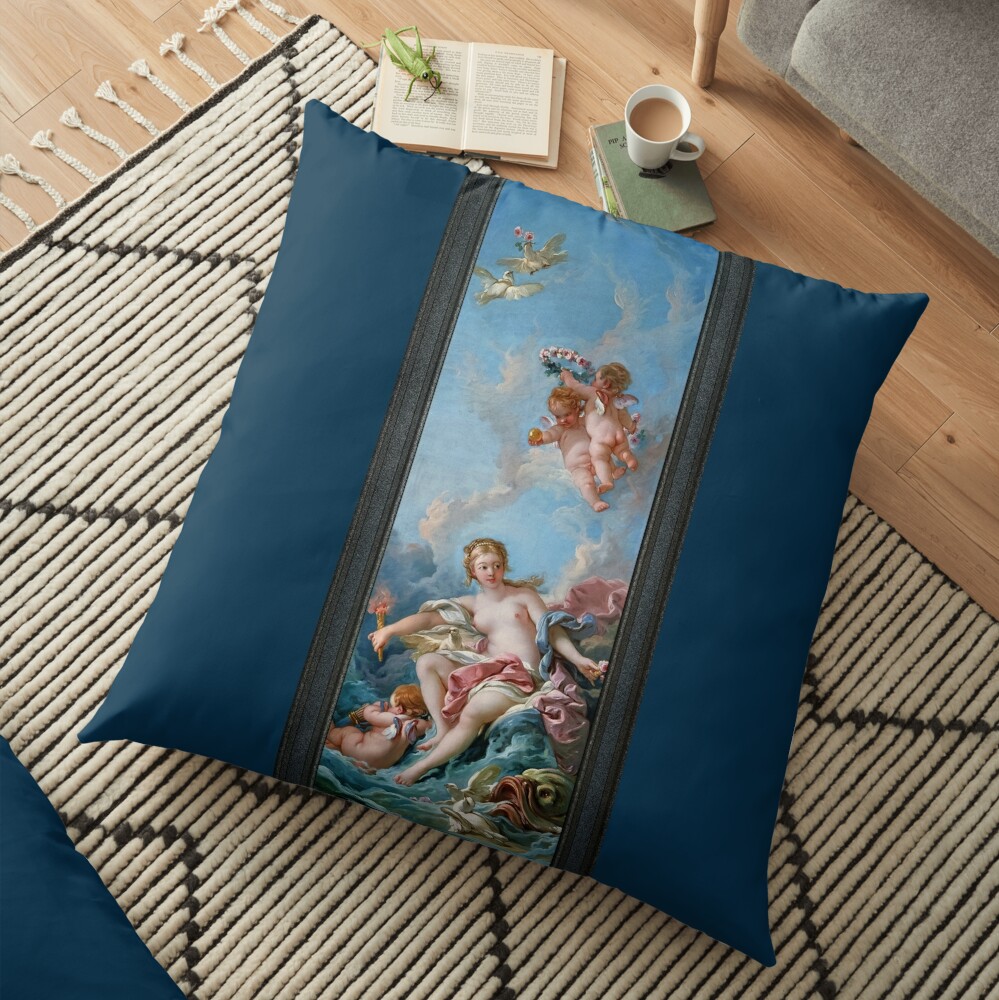
Table des matières
Éléments de composition & Narrative Absence
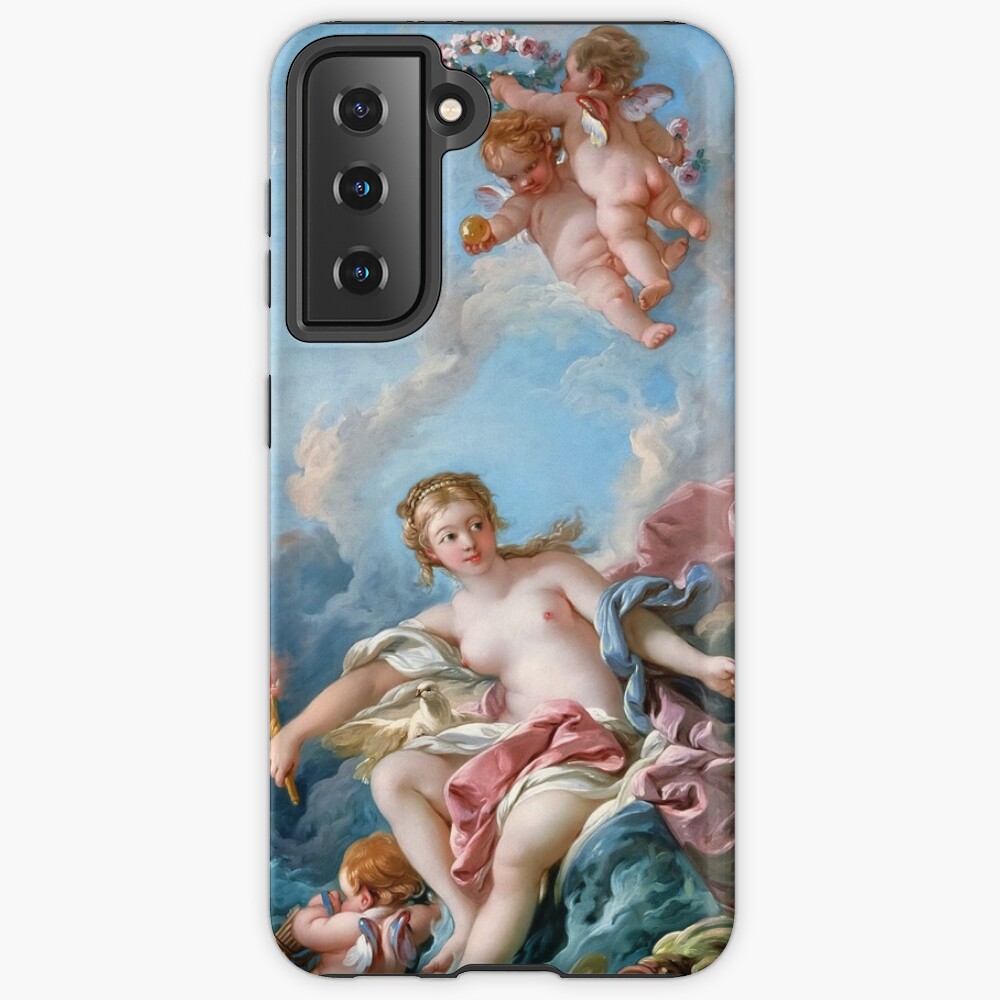
The composition is vertically oriented, drawing the viewer’s eye upwards from the turbulent sea towards the celestial realm above. Venus occupies a central position, seated upon a shell-like structure that rises from the waves. She appears serene and composed, her gaze directed slightly downwards, as if acknowledging the surrounding spectacle but not actively participating in it. The lower portion of the painting is dominated by the churning ocean, rendered with a palette of blues and greens, punctuated by whitecaps suggesting movement and energy. Above Venus, a swirling sky filled with clouds provides a backdrop for several cherubic figures engaged in playful activities.
Chérubins & Détails symboliques
Several cherubs populate the scene, each contributing to the overall atmosphere of lightness and grace. One cherub floats above Venus, scattering rose petals – a traditional symbol of love and beauty associated with the goddess. Another group of cherubs is depicted weaving a garland, adding a touch of pastoral charm to the composition. A winged putto flies overhead carrying a bouquet of flowers, further reinforcing the theme of affection and celebration. The shell upon which Venus sits isn’t merely decorative; it’s a symbolic representation of her birth from the sea foam – a foundational myth in classical mythology.
Boucher’s Rococo Style: Couleur & Technique
Boucher’s artistic style is immediately recognizable through his use of soft, pastel colors and delicate brushstrokes. The painting lacks sharp lines or dramatic contrasts; plutôt, it relies on subtle gradations of color to create a sense of ethereal beauty. His technique emphasizes fluidity and movement, particularly evident in the depiction of the waves and clouds. Boucher’s mastery of light is also apparent – Venus appears bathed in a soft, diffused glow that enhances her luminous quality. The overall effect is one of dreamy tranquility, characteristic of Rococo art’s pursuit of pleasure and escapism.
Contexte & Importance historique
“Venus on the Waves” was created during a period when mythological subjects were highly fashionable among the French aristocracy. Boucher’s interpretation of Venus departs from earlier depictions that emphasized her power or authority; plutôt, he presents her as an embodiment of beauty, grâce, and sensuality – qualities prized by the court of Louis XV. The painting reflects the Rococo era’s shift away from the grandeur of the Baroque towards a more intimate and decorative style. It served not only as a work of art but also as a symbol of refined taste and aristocratic patronage.
Examination of Venus’s Pose & Expression
Venus is depicted in a relaxed, almost languid pose. Her body curves gently, suggesting both softness and vitality. She holds a single torch aloft, its flame casting a warm glow on her face and hands. The torch itself carries symbolic weight; it represents the divine spark of love and beauty that Venus embodies. Son expression est sereine et contemplative, conveying a sense of inner peace and detachment from the surrounding activity. This lack of overt emotion contributes to the painting’s overall atmosphere of tranquility and grace.
Palette de couleurs & Effets atmosphériques
The color palette in “Venus on the Waves” is dominated by soft blues, roses, légumes verts, et or. These colors contribute to the painting’s ethereal quality and evoke a sense of warmth and light. Boucher skillfully uses atmospheric perspective – rendering distant objects with less detail and paler colors – to create a sense of depth and space within the composition. The swirling clouds and turbulent waves add dynamism to the scene, while the soft lighting enhances the overall feeling of dreamlike beauty.
Influences artistiques & Héritage
Boucher’s work was influenced by earlier masters such as Peter Paul Rubens and Jean-Antoine Watteau, both renowned for their depictions of mythological subjects and their mastery of color and composition. pourtant, Boucher developed his own unique style that became synonymous with the Rococo movement. “Venus on the Waves” is considered one of his most iconic works and has had a lasting impact on Western art, inspiring countless artists to emulate its elegance and sensuality. The painting remains an important example of Rococo aesthetics and a testament to Boucher’s artistic genius.
Biographie de l'artiste dérivée de Wikipedia.org
Originaire de Paris, Boucher était le fils d'un peintre moins connu Nicolas Boucher, qui lui a donné sa première formation artistique. À l'âge de dix-sept ans, un tableau de Boucher a été admiré par le peintre François Lemoyne. Lemoyne nomma plus tard Boucher son apprenti, mais après seulement trois mois, il est allé travailler pour le graveur Jean-François Cars.
Dans 1720, il a remporté le Grand Prix élite de Rome pour la peinture, mais n'a saisi l'occasion conséquente d'étudier en Italie que cinq ans plus tard, due to financial problems at the Académie royale de peinture et de sculpture.[1] À son retour des études en Italie, il a été admis à l'Académie de peinture et de sculpture refondée sur 24 novembre 1731. His morceau de réception (pièce de réception) était son Rinaldo et Armida de 1734.
Boucher a épousé Marie-Jeanne Buzeau en 1733. Le couple a eu trois enfants ensemble. Boucher est devenu membre du corps professoral en 1734 et sa carrière s'est accélérée à partir de ce moment, car il a été promu professeur puis recteur de l'Académie, devenir inspecteur à la Manufacture Royale des Gobelins et enfin Premier Peintre du Roi (Premier peintre du roi) dans 1765. Portrait de Marie-Louise O’Murphy c. 1752
Boucher est décédé le 30 Mai 1770 dans son Paris natal. Son nom, avec celle de sa patronne Madame de Pompadour, était devenu synonyme du style rococo français, amenant les frères Goncourt à écrire: “Boucher fait partie de ces hommes qui représentent le goût d'un siècle, qui expriment, personnifiez-le et incarnez-le.”
Boucher est célèbre pour dire que la nature est “trop verte et mal éclairée” (trop vert et mal éclairé).
Boucher était associé au graveur de pierres précieuses Jacques Guay, à qui il a appris à dessiner. Il a également encadré le peintre morave-autrichien Martin Ferdinand Quadal ainsi que le peintre néoclassique Jacques-Louis David dans 1767.[4] Plus tard, Boucher a réalisé une série de dessins d'œuvres de Guay que Madame de Pompadour a ensuite gravées et distribuées sous forme de volume joliment relié à des courtisans privilégiés.
Venus On The Waves est une reproduction d'art numérique retouchée d'une image du domaine public disponible sous forme de impression roulée en ligne.