

Venus Weighs Cupid
Venus Weighs Cupid Against A Butterfly c1894 by French Painter Henri Pierre Picou (1824 – 1895); known for his early portrait work and historical subject matter and in his later years for his Allegorical and Mythological themes
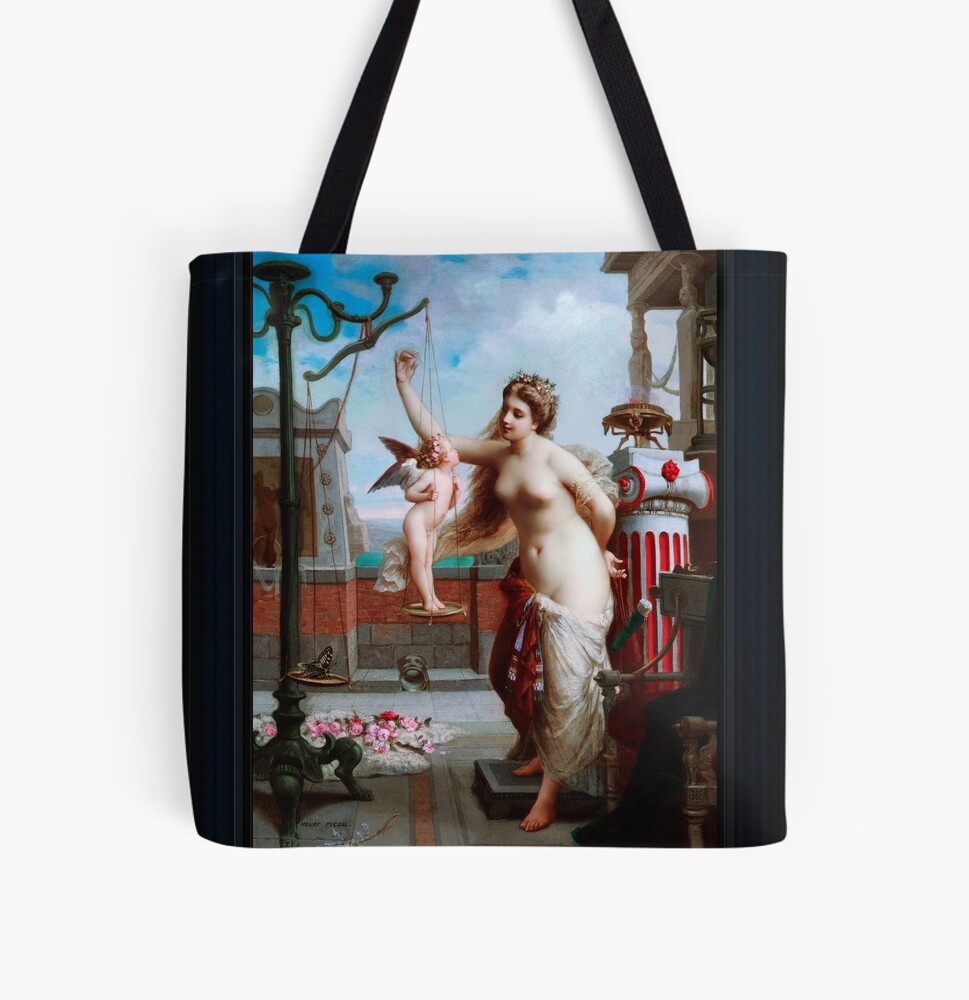
Venus Weighs Cupid Against A Butterfly is a cute and amusing painting showing a large butterfly resting on a platter on one end of a large balance scale with Cupid (adorned with flowers) on the other platter and Venus (with flowers in her hair) looking on as the butterfly out weighs Cupid.
Venus Weighs Cupid is a brightly colored image with whimsical objects, starting with the tall floor standing candelabra that Venus is using to hold the balance scale; while behind her is white and red scroll column that highlights her left hand that is behind her back holding Cupids Green Quiver filled with arrows and straight ahead a drain that looks like a face with a very large round mouth.
Venus Weighs Cupid Against A Butterfly is a retouched digital art old masters reproduction of a public domain image is available as a wall decor rolled art print.
Informoj Malsupre Derivita De Vikipedio.org
Henri-Pierre estis akademia farbisto kaj unu el la fondintoj de la Neo-Grec-lernejo, kune kun liaj proksimaj amikoj Gustave Boulanger, Jean-Leon Gerome, kaj Jean-Louis Hamon, ankaŭ akademiaj pentristoj.
All of the men studied in the workshops of both Paul Delaroche and later Charles Gleyre. Picou’s style was noticeably influenced by Gleyre; while the rest of the group generally painted classical and mythological subjects.
Picou first debuted is artistic style at the Salon in 1847; and the following year was awarded a second-class medal for his painting, Cléopâtre et Antoine sur le Cydnus. Also known as Cleopatra on the Cydnus, it is commonly regarded as Picou’s masterpiece.

The showing at the Salon in 1848 of Cléopâtre et Antoine sur le Cydnus was written about by the critic Théophile Gautier, who felt that the subject matter was too ambitious, but also said that “As it is, it gives the best hope for the future of the young artist, and ranks among the seven or eight most important paintings of the Salon.”
En 1875, the painting was exhibited in New York, and afterward found a place on the walls of a private art gallery in San Francisco.
Picou maintained a large workshop in Paris on the Boulevard de Magenta, which provided him room to work on his expansive frescoes. His popularity continued to rise and he went on to win the Second Prix de Rome in 1853 for his painting, Jésus chassant les vendeurs du Temple (The Moneylenders Chased from the Temple), and another second-class medal for his Salon painting in 1857.
De la tempo de lia debuto en 1847, li iĝis kutima kliento ĉe la Salono, montrante preskaŭ ĉiun jaron ĝis lia fina ekspoziciaĵo en 1893. Li estis nomita la plej moda farbisto direkte al la fino de la Dua Franca Imperio; kaj ricevis multajn komisionojn, inkluzive de komisionoj por grandaj religiaj freskoj de multaj preĝejoj, kiu inkludis la Église Saint-Roch.