

Viktorie, Duchess of Kent (1786 – 1861) c1935
The portrait titled “Viktorie, Duchess of Kent (1786 – 1861) c1935” was created by the British painter George Hayter (1792 – 1871) during the early 19th century, capturing the likeness of the Duchess of Kent in a dignified and regal fashion. Known for his ability to render portraits with great accuracy and lifelike quality, Hayter’s painting demonstrates his mastery in depicting not just the physical appearance of his subjects, but their character and presence as well. Painted during a pivotal time in British history, this piece serves as a historical record of the Duchess of Kent, the mother of Queen Victoria, and as an artistic reflection of the royal court’s fashion and elegance in the 19th century.
Obsah
Předmět a kompozice
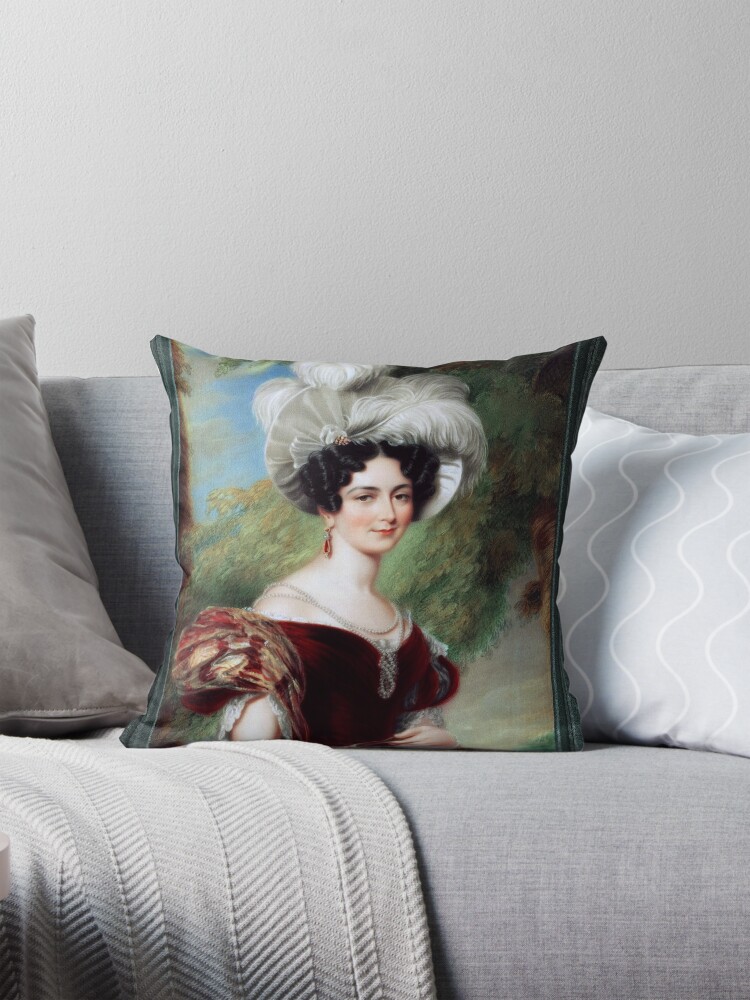
The central figure in the portrait is Victoria, Duchess of Kent, whose refined countenance and noble demeanor are captured in stunning detail. The Duchess is presented in a half-length pose, wearing an elegant gown made of luxurious velvet in a rich shade of crimson. The gown features intricate folds and delicate textures that are indicative of the high-fashion styles of the period. The neckline of the gown is cut low, revealing a soft lace trim and a double row of pearls that encircle her neck, adding a touch of opulence to the overall attire. Her shoulders are draped with a lavish shawl, which flows loosely and elegantly from her arms, accentuating the royal grace and aristocratic finesse of her presence.
The Duchess’ face, with its soft yet commanding expression, radiates both warmth and authority. Her features are finely painted with a gentle glow, accentuating her serene yet regal expression. The soft curve of her cheeks, the delicate arch of her eyebrows, and the finely detailed curls of her hair all contribute to a sense of aristocratic beauty. Její vlasy, styled in a voluminous arrangement, is crowned with a large feathered hat, which adds a touch of drama and height, symbolizing the height of fashion and elegance in the royal circles of the time.
The Duchess’ šperky, including a pair of red earrings and a multi-strand pearl necklace, further elevate her status and reflect her aristocratic background. The gleaming red of the earrings adds a striking contrast to the rich colors of her gown and the serene background, drawing the viewer’s attention to the details of her ensemble.
Background and Setting
The background of the portrait features a tranquil natural setting, with soft green foliage and hints of blue sky visible through the trees. The delicate rendering of the landscape contrasts the opulence of the Duchess’ attire and creates a serene and almost dreamlike atmosphere. The natural elements in the background seem to symbolize the Duchess’ connection to both the royal household and the British land, invoking a sense of timelessness and continuity. The balance between the opulent attire and the tranquil scenery adds a sense of harmony, reinforcing the calm yet commanding presence of the Duchess.
Umělecký styl a technika
George Hayter’s style is characterized by his meticulous attention to detail, which is evident in the rendering of fabrics, šperky, and facial expressions in the portrait. The artist’s use of light and shadow plays a significant role in bringing the Duchess to life, with soft highlights illuminating her face and gown, contrasting with deeper shadows that give the piece a sense of depth. Hayter’s technique reflects the classical approach of 19th-century portraiture, where realism was emphasized through careful observation of the human form and surroundings.
The fine details of the velvet gown, the textured shawl, and the fluidity of the Duchess’ hair are all rendered with precision, showcasing Hayter’s ability to capture the textures of fabric and the softness of the skin. The careful brushwork on the background foliage adds depth and realism, enhancing the portrait’s three-dimensionality. The inclusion of such background detail suggests a connection between the subject and her environment, further emphasizing the Duchess’ rootedness in her royal context.
Téma a nálada
The portrait captures a theme of royal elegance and dignity. The Duchess of Kent, as the mother of the future Queen Victoria, is depicted with a sense of quiet strength and grace. Her calm expression and poised posture reflect her aristocratic status and her role within the royal family. There is an air of nobility in her portrayal, conveying not only the status of her position but also the responsibilities that came with it. The mood of the artwork is one of serenity and composed elegance, with a subtle undercurrent of power conveyed through her poised expression and regal attire.
The mood is also one of reflection, as the portrait seems to capture a moment frozen in time. Měkký, luminous colors of the gown, the gentle light that falls on her face, and the peaceful background suggest an atmosphere of introspection, as though the Duchess is contemplating the future of her family and her role within the monarchy. This sense of poised reflection adds a layer of emotional depth to the work, making it more than just a visual representation of her physical appearance but also an exploration of her inner dignity and strength.
Materiály a techniky
The medium used for this portrait appears to be oil on canvas, a common medium for royal portraiture in the 19th century. The smooth texture of the canvas allows Hayter to achieve a high level of detail in both the clothing and facial features of the Duchess. The layering of oil paints is evident in the depth of the colors, particularly in the velvet gown and the subtle modeling of the Duchess’ face. The artist’s delicate use of glazes adds a sense of luminosity to the painting, enhancing the realistic portrayal of the subject.
Závěr
“Viktorie, Duchess of Kent (1786 – 1861)” by George Hayter is a magnificent example of 19th-century royal portraiture, capturing both the physical likeness and the dignified presence of one of Britain’s most prominent royal figures. The artist’s skillful use of light and shadow, attention to fabric textures, and the harmonious combination of regal attire and serene natural surroundings all contribute to the timeless quality of the portrait. The Duchess of Kent is depicted not only as a woman of beauty and grace but also as a figure of strength and influence, reflecting her role as the mother of Queen Victoria and her place within the broader narrative of British history.
Toto je retušovaná reprodukce starého umění digitálního umění obrazu veřejného díla.
Artist Bio Courtesy Wikipedia.org
George Hayter was the son of Charles Hayter (1761 – 1835), a miniature painter and popular drawing-master and teacher of perspective who was appointed Professor of Perspective and Drawing to Princess Charlotte and published a well-known introduction to perspective and other works.
Initially tutored by his father, he went to the Royal Academy Schools early in 1808, but in the same year, after a disagreement about his art studies, ran away to sea as a Midshipman in the Royal Navy. His father secured his release, and they came to an agreement that Hayter should assist him while pursuing his own studies.
At the Royal Academy Schools he studied under Fuseli, a v 1815 was appointed Painter of Miniatures and Portraits by Princess Charlotte. Hayter was awarded the British Institution’s premium for history painting for the Prophet Ezra (1815; Downton Castle), purchased by Richard Payne Knight.