

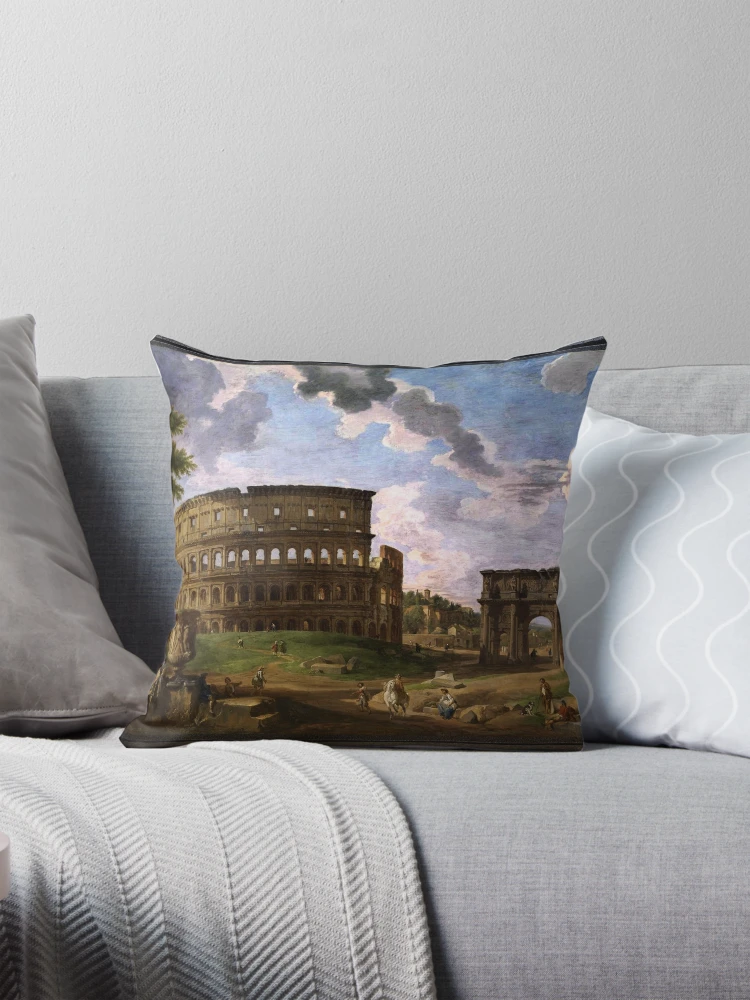
“View of the Colosseum c1747” is an artwork by Italian artist Giovanni Paolo Pannini (1691 – 1765), created during the 18th century. Pannini, a renowned artist celebrated for his works in the genre of vedute (keer bekeken), brings the grandeur of Rome’s monumental ruins to life through his exquisite rendition. This painting serves as both an architectural study and an evocative narrative of Rome’s ancient glory, capturing the vastness of the Colosseum and its surrounding environment in exceptional detail.
Inhoudsopgave
Subject of the Artwork: The Colosseum and Its Surroundings
The main subject of this artwork is the magnificent Colosseum, also known as the Flavian Amphitheatre, which stands as a symbol of Rome’s imperial past. Pannini paints the amphitheater from a slightly elevated vantage point, revealing its impressive structure from the ground level. The Colosseum is depicted in its historical ruinous state, though still retaining an air of grandeur. The arches, columns, and the exposed skeleton of the building, battered by time and weather, dominate the canvas.
Flanking the Colosseum is an archway that appears to be a representation of the Arch of Constantine, a famous triumphal arch located nearby. This feature not only enhances the composition but also provides historical context, as both structures were significant landmarks in ancient Rome, symbolizing its power and opulence. The arch’s inclusion demonstrates Pannini’s expertise in architectural perspectives, providing a sense of scale and drawing attention to the juxtaposition of ancient civilization with the modern world of the 18th century.
The Terrain and the Landscape
The terrain surrounding the Colosseum is depicted with meticulous attention to detail. The foreground is populated with a variety of human figures, some casually strolling or gathered in groups, while others are engaged in playful activities. These figures provide a sense of scale and animation to the painting, making the ancient ruins feel more integrated with contemporary life. A few children can be seen in the lower left corner, symbolizing the passage of time and perhaps the continuity of the legacy of ancient Rome through generations.
The middle ground features the Colosseum itself, surrounded by expansive green lawns and rocky remnants. The stark contrast between the lush greenery and the crumbling stone adds to the narrative of nature’s reclamation of human creations, a theme often found in depictions of ruins. Naar rechts, the distant hills and additional architectural fragments suggest that there is more to the area beyond the immediate view, hinting at the vastness of the ancient Roman city that once thrived in this space.
The sky is a radiant blend of soft blues, blanken, and swirling clouds that stretch across the entire expanse above the scene. The lighting is carefully balanced, with sunlight illuminating the Colosseum’s structure and casting long shadows across the terrain, emphasizing its grandeur. The painter’s use of light and shadow enhances the depth and drama of the scene, highlighting the ruins’ timeless beauty and the surrounding landscape.
Materialen en techniek
Pannini employs oil paint on canvas, a common medium during the Baroque and Rococo periods, to create this vivid representation. His mastery of perspective is evident in the way he captures the architectural details of the Colosseum and the arch. The subtle use of light, combined with intricate detailing of the stonework, enhances the realism and solidity of the structures, even as the buildings have suffered the ravages of time. His technique highlights the texture of the stone, the delicacy of the clouds, and the vividness of the figures’ clothing.
The human figures, though relatively small in comparison to the colossal architecture, are rendered with a great deal of attention to their movement and interaction. Their clothing is depicted in fine detail, showcasing the fashion of the 18th century, which serves as a subtle reminder that while the painting is about ancient Rome, it is also an observation of the modern world of Pannini’s time. This fusion of the old and new is a hallmark of Pannini’s style, where historical sites are placed in the context of contemporary life, creating a dialogue between past and present.
Stemming en thema
The overall mood of the painting is one of serenity and contemplation. Despite the ruins that dominate the composition, there is a certain peacefulness to the scene. The gentle blending of light and the pastoral setting create a sense of harmony between nature and history. The figures in the foreground, relaxed and enjoying the space around them, evoke a sense of everyday life that contrasts with the monumental scale of the Colosseum and the Arch of Constantine. This juxtaposition of human scale with the vastness of the ruins invites the viewer to reflect on the passage of time, the impermanence of civilizations, and the endurance of art and architecture.
The theme of ruin and the passage of time is prominent throughout the piece. Pannini does not simply depict the Colosseum as a static monument; he places it within a living landscape, reminding the viewer of the continual evolution of human civilization. Through the meticulous detail in his portrayal of the ruins, Pannini both celebrates the history of Rome and reflects on its eventual decay. The presence of people in the scene, interacting with the ruins, suggests a dialogue between past and present, where history is not forgotten but continues to influence the living.
Conclusie
“View of the Colosseum c1747” by Giovanni Paolo Pannini is a powerful visual exploration of the interplay between history, natuur, and modernity. Pannini’s ability to blend architectural grandeur with everyday life creates a narrative that is both timeless and reflective of the 18th-century context in which it was painted. Through this piece, Pannini invites viewers to contemplate the ruins of ancient Rome not just as relics of a bygone era but as ongoing symbols of the city’s undying influence.
Uitzicht op het Colosseum is een geretoucheerde digitale kunstreproductie van een afbeelding uit het publieke domein.
Bio van kunstenaar afgeleid van Wikipedia.org
Giovanni Paolo Panini of Giovanni Paolo Pannini was een schilder en architect die in Rome werkte en vooral bekend staat als een van de vedutisten (“bekijk schilders”).
Als schilder, Pannini is vooral bekend om zijn vergezichten over Rome, waarin hij een bijzondere belangstelling had voor de oudheden van de stad.
Een van zijn beroemdste werken is zijn kijk op het interieur van het Pantheon (namens Francesco Algarotti 1712 – 1764 – Een Venetiaanse Polymath), en zijn vedute-schilderijen van fotogalerijen met uitzicht op Rome.
De meeste van zijn werken, vooral die van ruïnes, een fantasievolle en onwerkelijke verfraaiing hebben die kenmerkend is voor Capriccio-thema's. Hierin lijken ze op de capricci van de Italiaanse schilder en graficus Marco Ricci (1676 – 1730).
Panini schilderde ook portretten, waaronder een van paus Benedictus XIV (geboren Prospero Lorenzo Lambertini 1675 – 1758 – Hoofd van de Katholieke Kerk van 1740 – 1758).
In Rome, Panini verwierf naam als decorateur van paleizen. Sommige van zijn werken omvatten de Villa Patrizi c1719/25, het Palazzo de Carolis c1720, en het Seminario Romano c1721/22).
In 1719, Panini werd toegelaten tot de Congregatie van de Virtuosi al Pantheon. Hij doceerde in Rome aan de Accademia di San Luca en de Académie de France, waar hij zou hebben beïnvloed Jean-Honoré Fragonard. In 1754, hij diende als de prins (regisseur) van de Accademia di San Luca.