

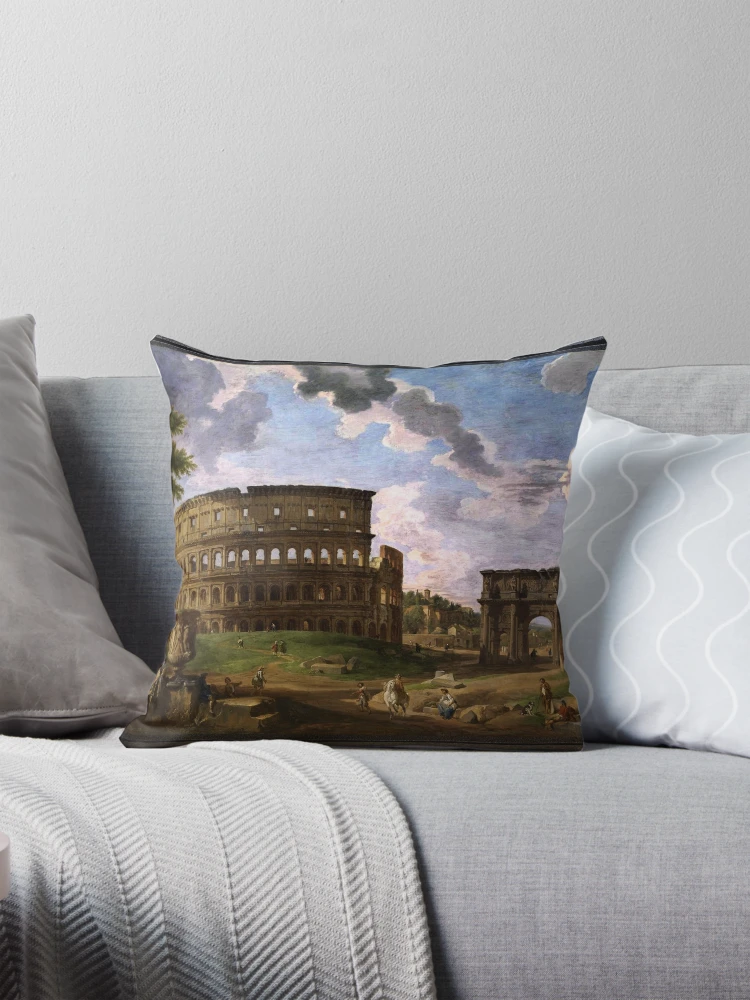
“View of the Colosseum c1747” is an artwork by Italian artist Giovanni Paolo Pannini (1691 – 1765), created during the 18th century. Pannini, a renowned artist celebrated for his works in the genre of vedute (vyer), brings the grandeur of Rome’s monumental ruins to life through his exquisite rendition. This painting serves as both an architectural study and an evocative narrative of Rome’s ancient glory, capturing the vastness of the Colosseum and its surrounding environment in exceptional detail.
Innehållsförteckning
Subject of the Artwork: The Colosseum and Its Surroundings
The main subject of this artwork is the magnificent Colosseum, also known as the Flavian Amphitheatre, which stands as a symbol of Rome’s imperial past. Pannini paints the amphitheater from a slightly elevated vantage point, revealing its impressive structure from the ground level. The Colosseum is depicted in its historical ruinous state, though still retaining an air of grandeur. The arches, kolumner, and the exposed skeleton of the building, battered by time and weather, dominate the canvas.
Flanking the Colosseum is an archway that appears to be a representation of the Arch of Constantine, a famous triumphal arch located nearby. This feature not only enhances the composition but also provides historical context, as both structures were significant landmarks in ancient Rome, symbolizing its power and opulence. The arch’s inclusion demonstrates Pannini’s expertise in architectural perspectives, providing a sense of scale and drawing attention to the juxtaposition of ancient civilization with the modern world of the 18th century.
The Terrain and the Landscape
The terrain surrounding the Colosseum is depicted with meticulous attention to detail. The foreground is populated with a variety of human figures, some casually strolling or gathered in groups, while others are engaged in playful activities. These figures provide a sense of scale and animation to the painting, making the ancient ruins feel more integrated with contemporary life. A few children can be seen in the lower left corner, symbolizing the passage of time and perhaps the continuity of the legacy of ancient Rome through generations.
The middle ground features the Colosseum itself, surrounded by expansive green lawns and rocky remnants. Den skarpa kontrasten mellan den frodiga grönskan och den smulande stenen bidrar till berättelsen om naturens återvinning av mänskliga skapelser, ett tema som ofta återfinns i skildringar av ruiner. Till höger, de avlägsna kullarna och ytterligare arkitektoniska fragment tyder på att det finns mer till området bortom den omedelbara utsikten, antyder viddheten av den antika romerska staden som en gång frodades i detta utrymme.
Himlen är en strålande blandning av mjuka blåtoner, vita, och virvlande moln som sträcker sig över hela vidden ovanför scenen. Belysningen är noggrant balanserad, med solljus som lyser upp Colosseums struktur och kastar långa skuggor över terrängen, understryker dess storhet. Målarens användning av ljus och skugga förstärker scenens djup och dramatik, highlighting the ruins’ timeless beauty and the surrounding landscape.
Material och teknik
Pannini employs oil paint on canvas, a common medium during the Baroque and Rococo periods, to create this vivid representation. His mastery of perspective is evident in the way he captures the architectural details of the Colosseum and the arch. The subtle use of light, combined with intricate detailing of the stonework, enhances the realism and solidity of the structures, even as the buildings have suffered the ravages of time. His technique highlights the texture of the stone, the delicacy of the clouds, and the vividness of the figures’ clothing.
The human figures, though relatively small in comparison to the colossal architecture, are rendered with a great deal of attention to their movement and interaction. Their clothing is depicted in fine detail, showcasing the fashion of the 18th century, which serves as a subtle reminder that while the painting is about ancient Rome, it is also an observation of the modern world of Pannini’s time. This fusion of the old and new is a hallmark of Pannini’s style, where historical sites are placed in the context of contemporary life, creating a dialogue between past and present.
Humör och tema
The overall mood of the painting is one of serenity and contemplation. Despite the ruins that dominate the composition, there is a certain peacefulness to the scene. The gentle blending of light and the pastoral setting create a sense of harmony between nature and history. The figures in the foreground, relaxed and enjoying the space around them, framkalla en känsla av vardagsliv som står i kontrast till den monumentala skalan av Colosseum och Konstantins båge. Denna sammanställning av mänsklig skala med ruinernas viddlighet inbjuder betraktaren att reflektera över tidens gång, civilisationernas förgänglighet, och konstens och arkitekturens uthållighet.
Temat ruin och tidens gång är framträdande genom hela stycket. Pannini skildrar inte bara Colosseum som ett statiskt monument; han placerar den i ett levande landskap, påminner betraktaren om den mänskliga civilisationens ständiga utveckling. Genom den noggranna detaljen i hans skildring av ruinerna, Pannini både hyllar Roms historia och reflekterar över dess eventuella förfall. Närvaron av människor på scenen, interagerar med ruinerna, föreslår en dialog mellan dåtid och nutid, där historien inte glöms bort utan fortsätter att påverka de levande.
Slutsats
“View of the Colosseum c1747” av Giovanni Paolo Pannini är en kraftfull visuell utforskning av samspelet mellan historien, natur, och moderniteten. Panninis förmåga att blanda arkitektonisk storhet med vardagen skapar en berättelse som är både tidlös och reflekterande av 1700-talskontexten där den målades. Genom detta stycke, Pannini inbjuder tittarna att betrakta ruinerna av det antika Rom, inte bara som reliker från en svunnen tid utan som pågående symboler för stadens eviga inflytande.
View of the Colosseum är en retuscherad digital konstreproduktion av en offentlig egendom avbildar.
Artist Bio härledd från Wikipedia.org
Giovanni Paolo Panini eller Giovanni Paolo Pannini var en målare och arkitekt som arbetade i Rom och är främst känd som en av vedutistierna (“visa målare”).
Som målare, Pannini är mest känd för sin utsikt över Rom, där han intresserade sig särskilt för stadens antikviteter.
Bland hans mest kända verk är hans syn på Pantheons interiör (på Francesco Algarottis vägnar 1712 – 1764 – En venetiansk polymat), och hans vedutmålningar av bildgallerier med utsikt över Rom.
De flesta av hans verk, särskilt de av ruiner, har en fantasifull och overklig utsmyckning som kännetecknar capriccio -teman. I detta liknar de capricci av den italienska målaren och grafikern Marco Ricci (1676 – 1730).
Panini målade också porträtt, inklusive en av påven Benedikt XIV (född Prospero Lorenzo Lambertini 1675 – 1758 – Chef för katolska kyrkan från 1740 – 1758).
I Rom, Panini fick ett namn för sig själv som dekoratör av palats. Några av hans verk inkluderade Villa Patrizi c1719/25, Palazzo de Carolis c1720, och Seminario Romano c1721/22).
I 1719, Panini antogs till kongressen av Virtuosi al Pantheon. Han undervisade i Rom vid Accademia di San Luca och Académie de France, där han sägs ha påverkat Jean-Honoré Fragonard. I 1754, han tjänade som prins (direktör) av Accademia di San Luca.