

Walk Through The Forest
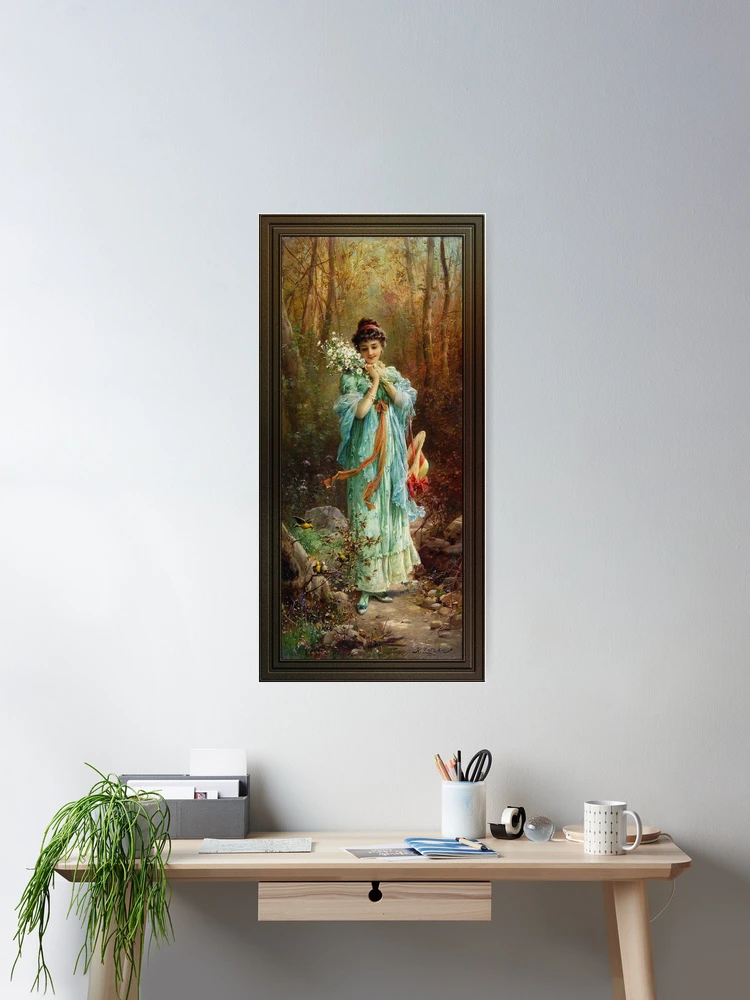
“Walk Through The Forest,” painted by Hans Zatzka (1859 – 1945), is a beautiful representation of nature and the human connection to it. Known for his romantic and idealized depictions, Zatzka was an Austrian painter who frequently signed his works with various pseudonyms, including Joseph Bernard, J. Bernard, and P. Ronsard, to navigate the constraints of his contractual obligations. Nesta peça, Zatzka presents an ethereal scene, where the subject of the painting, a young woman, walks gracefully through a serene forest landscape. The piece exudes an air of calm and tranquility, inviting the viewer into a timeless moment of contemplation.
Índice
Assunto principal e composição
At the heart of the painting is a young woman dressed in an exquisite flowing gown, adorned with soft, delicate textures that highlight the movement of the fabric. Seu traje, a pale green dress with ribbons in rich hues of orange and coral, contrasts beautifully against the earthy tones of the forest. O vestido, which moves effortlessly with the breeze, evokes a sense of ethereal elegance. Her posture is one of peaceful serenity, as she holds a bouquet of daisies tenderly in her hands, her expression soft with a hint of a smile, adding to the harmonious mood of the scene.
O escuro dela, curled hair is styled in an updo, secured with a ribbon, and framed by the soft light filtering through the trees behind her. This light adds a sense of depth to the scene, creating a warm, glowing atmosphere that encapsulates the viewer in the subject’s world. As she walks down a winding forest path, the woman is surrounded by lush greenery, which is meticulously detailed in the painting. The forest appears both inviting and mysterious, filled with tall trees that stretch upwards, their branches forming a canopy above.
On the ground, delicate flora peeks through, their colors harmonizing with the subject’s dress, adding to the overall sense of cohesion. Birds can be seen in the foreground, adding to the sense of movement and life within the piece, subtly emphasizing the connection between the figure and the natural world.
Terreno e fundo
The forest setting is rendered with great attention to detail. The trees that line the path are tall and slender, their trunks slightly curved as if bending towards the young woman. The foliage appears lush, with deep greens and touches of autumn hues suggesting a time of transition, possibly early fall or late spring. The rich colors of the leaves—ranging from olive greens to golds and rusts—convey the vibrancy of the natural world, enhanced by the soft light filtering through the canopy.
The terrain is a gentle, rocky path, where small stones and rocks add texture to the ground, leading the viewer’s eye from the foreground to the distant backdrop. The pathway, framed by clusters of wildflowers, suggests that the woman is walking along a serene forest trail, far removed from the distractions of the modern world. O macio, dappled light illuminating the scene evokes a dreamlike quality, where the boundaries between reality and fantasy blur.
Humor, Atmosfera, and Style
The mood of the painting is undeniably peaceful and serene. The combination of soft colors, iluminação suave, and the graceful figure of the woman walking through the tranquil forest creates a sense of quiet contemplation. The atmosphere is one of timelessness, as though the moment could be captured and held forever. The viewer is invited to step into the world of the painting and share in the calm beauty of nature and the woman’s peaceful journey through it.
Zatzka’s style in “Walk Through The Forest c~” reflects his mastery of romanticism and idealization. His attention to detail, particularly in the textures of the woman’s gown and the lush surroundings, is reminiscent of 19th-century academic painting. O macio, almost ethereal portrayal of the subject highlights Zatzka’s characteristic ability to evoke a sense of innocence and beauty. The color palette is gentle, dominated by pastel greens, rosa suave, and warm golden tones, which harmonize perfectly with the natural elements in the scene.
The technique of using light and shadow plays a critical role in enhancing the atmosphere. The glow of sunlight filtering through the trees creates a luminous effect, giving the scene a soft, inviting warmth. Zatzka’s brushwork is delicate and precise, allowing for subtle gradations of light and shadow to bring depth to the composition. The overall effect is one of harmony between the subject, the landscape, and the mood.
Conclusão
“Walk Through The Forest c~” by Hans Zatzka captures a fleeting moment in nature, where the subject, dressed in flowing garments, finds peace in the embrace of the natural world. O clima sereno da pintura, delicate color palette, and attention to detail evoke a sense of timeless beauty. Zatzka’s mastery of romanticism shines through in this work, as he invites the viewer into a world where nature and humanity are in perfect harmony. The piece serves as a reminder of the simple yet profound connection between people and the world around them, a timeless portrayal of beauty, serenidade, E a passagem do tempo.
Esta é uma reprodução dos antigos mestres da arte digital retocada de uma imagem de domínio público que está disponível como um impressão em tela.
BIO do artista derivado de Wikipedia.org
Hans Zatzka às vezes era conhecido como P. Ronsard, Pierre de Ronsard, ou H. Baterias, e assinou muitas de suas obras como Joseph Bernard, J. Bernard, ou Bernard Zatzka.
O objetivo da vasta gama de pseudônimos de Zatzka era evitar penalidades de quebra de contratos que limitavam a quantidade de obras de arte que ele poderia vender.
Isso fez com que alguns bancos de dados de arte combinassem o trabalho de Zatzka sob o pseudônimo de Joseph Bernard com o escultor francês com o mesmo nome.
Hans Zatzka nasceu em 8 marcha 1859 em viena. Seu pai, Bartholomaüs, era operário da construção civil, e sua mãe era Marie Karpischek Zatzka.
Entre 1877 e 1882, estudou na Academie des Beaux-Arts, sob Christian Griepenkerl, Carl Wurzinger, e Karl von Blaas.
Zatzka conseguiu ganhar a vida com a produção de afrescos para igrejas e outras instituições.
Dentro 1885, Zatzka foi contratado para criar o afresco do teto A Naiad de Baden em Kurhaus Baden.
Muitas das obras de Zatzka eram pinturas religiosas e retábulos dedicados a várias igrejas na Áustria.
Contudo, ele é mais conhecido por suas pinturas de mulheres, fadas, e outras cenas fantásticas.
Muitas vezes, ele se inspiraria nas obras de Richard Wagner e nos contos de fadas dos Irmãos Grimm.
No final do século 19 e início do século 20, várias peças de Zatzka foram fotografadas e transformadas em cartões-postais comerciais e colecionáveis.
Durante a década de 1920, O estilo de Zatzka se tornou a decoração preferida em toda a Europa. Além disso, nos trinta anos anteriores houve um ressurgimento de Zatzka.