

Seda Blanca
“Seda Blanca” is a striking artwork created by Peruvian artist Alberto Vargas a mediados del siglo XX, capturing the beauty of femininity through a vintage lens. Alberto Vargas, nació en 1896 y pasando 1982, was known for his remarkable talent in the realm of pin-up art, bringing sensual elegance to life through his illustrations. Esta pieza en particular, “Seda Blanca,” embodies his distinctive style, marrying sophistication with allure. The piece stands as a testament to Vargas’ mastery in blending the glamour of Hollywood with classical art techniques, showcasing a timeless and evocative portrayal of a woman’s elegance.
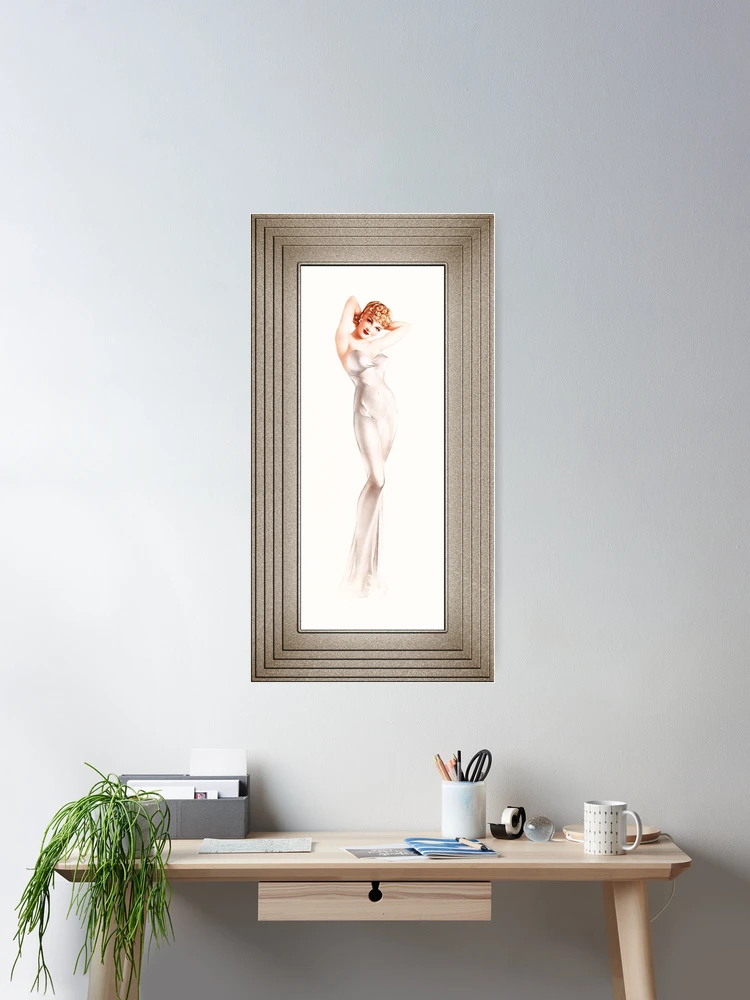
Tabla de contenido
Sujeto principal y composición
En el corazón de “Seda Blanca” is a stunning female figure, depicted with soft, graceful lines and an air of effortless allure. The subject is a woman draped in a flowing, form-fitting white silk gown, which clings to her curves, evoking a sense of elegance and sensuality. Su postura es relajada pero segura., with her arms raised above her head, suggesting a moment of grace as she adjusts her coiffed, vintage-styled hair. Her gaze is slightly off to the side, adding an element of mystery and intrigue to the image.
The figure’s delicate features, such as her flawless skin, plump lips, and expressive eyes, are highlighted by the soft lighting that bathes her face and body. The soft folds of the gown create a beautiful contrast against the smoothness of her skin, and the fabric’s subtle sheen adds a sense of luxuriousness to the overall composition. Su pelo, a cascade of curls, complements the sophistication of her look, highlighting Vargas’ skill in creating volume and texture.
Escenario y objetos
El trasfondo de “Seda Blanca” is simple yet deliberate, providing a neutral, almost ethereal space that directs the viewer’s attention entirely to the subject. The lack of extraneous objects allows the viewer to focus on the form and beauty of the woman without distraction. This minimalist approach, common in Vargas’ work, enhances the mood of elegance and glamour while maintaining an uncluttered and refined aesthetic.
The absence of a detailed background is not a mere omission but rather a calculated decision by Vargas to create a timeless, universal atmosphere. The focus on the subject’s beauty and the luxurious fabric of her gown is emphasized by the stark simplicity of the space surrounding her, evoking the glamour of the early to mid-20th century when pin-up art reached its peak popularity.
Estilo, Técnica, y materiales
Alberto Vargas is known for his iconic pin-up art, often blending realistic portraiture with a soft, romanticized approach to his subjects. En “Seda Blanca,” he employs a meticulous technique, using the soft blending of colors and detailed shading to achieve a lifelike appearance. The smooth transitions of light and shadow enhance the sensuality of the subject, especially in the way the gown hugs the curves of her body.
Vargas’ use of color is another noteworthy aspect of this piece. Lo suave, almost ethereal white of the silk gown contrasts with the warm tones of the subject’s skin, creating a delicate yet vibrant composition. The gleaming white of the gown stands out in contrast with the subtle skin tones, allowing the viewer’s eyes to be drawn to the fluidity of the figure. This is balanced by the soft background, which remains neutral and unobtrusive, permitiendo que la figura tome protagonismo en la composición.
La capacidad de Vargas para captar la textura de los materiales es otro sello distintivo de su estilo., y en “Seda Blanca,” Esto es evidente en la interpretación realista de la tela del vestido.. La forma en que la luz juega con la seda., creando reflejos y sombras sutiles, demuestra su experiencia técnica en retratar texturas con profundidad y precisión.
Tema y estado de ánimo
El estado de ánimo de “Seda Blanca” puede describirse como uno de elegancia atemporal y sensualidad discreta.. El sujeto, con su postura perfecta y su tranquila confianza, Exuda un sentido de gracia que trasciende cualquier período de tiempo específico., dando a la obra de arte un atractivo universal. Hay un aire de misterio sobre el tema., con la mirada desviada, Sugiriendo un mundo privado que no es completamente accesible para el espectador..
This theme of quiet confidence and unattainable beauty was characteristic of Vargas’ work, which often portrayed women in a manner that celebrated their sensuality while maintaining a sense of dignity and allure. Lo suave, flowing nature of the white silk gown adds to the dreamlike quality of the image, giving it a sense of ethereal beauty that is both captivating and enigmatic. The subject’s graceful posture, combined with the luxurious gown, creates an atmosphere of refined beauty and timeless allure.
Legacy and Influence
“Seda Blanca” is not just a work of art but also a reflection of the cultural and artistic climate of the time. The image of the idealized woman portrayed in this piece was emblematic of the mid-20th century’s fascination with glamour, elegancia, and the Hollywood starlet. Vargas’ contributions to the world of pin-up art have had a lasting impact on both commercial illustration and fine art, influencing not only other artists but also the way women were portrayed in popular media. His ability to combine beauty with realism made his work stand out and contributed to the enduring popularity of the pin-up genre.
De muchas maneras, “Seda Blanca” captures the spirit of an era when femininity, belleza, and elegance were celebrated in a way that was both bold and sophisticated. El uso de la luz, textura, and form in this piece highlights Vargas’ skill as a painter and his ability to capture the essence of a moment in time, making this work an iconic representation of his artistic legacy.
Esta es una reproducción de viejos maestros de arte digital retocada de una imagen de dominio público.
Biografía del artista
Información debajo de Wikipedia.org
Nacido en Arequipa, Perú, era hijo del destacado fotógrafo peruano Max T. Vargas. Alberto Vargas se mudó a los Estados Unidos en 1916 después de estudiar arte en Europa, Zúrich, y Ginebra antes de la Primera Guerra Mundial. Mientras estaba en Europa se topó con la revista francesa La Vie Parisienne, con una portada de Raphael Kirchner, que dijo fue una gran influencia en su trabajo.
Su carrera temprana en Nueva York incluyó su trabajo como artista para Ziegfeld Follies y para muchos estudios de Hollywood.. Ziegfeld colgó su pintura de Olive Thomas en el teatro, y fue considerada como una de las primeras Vargas Girls. Vargas’ obra cinematográfica más famosa fue para el cartel de la 1933 película El pecado de Nora Moran, que muestra a Zita Johann casi desnuda en una pose de desesperación. El cartel es nombrado con frecuencia como uno de los mejores carteles de películas jamás creados..
Se hizo ampliamente conocido en la década de 1940 como el creador de pin-ups icónicos de la era de la Segunda Guerra Mundial para la revista Esquire conocida como “Vargas Girls.” Entre 1940 y 1946 Vargas produjo 180 pinturas para la revista. El diseño de la nariz de muchos aviones estadounidenses y aliados de la Segunda Guerra Mundial se inspiró y adaptó de estos pin-ups de Esquire., así como los de George Petty, y otros artistas.