

Who’s On The Line
Gil Elvgren (1914 – 1980), an American illustrator renowned for his pin-up art, created the iconic piece titled “Who’s On The Line,” likely during the mid-20th century. Elvgren’s work exemplifies the essence of American pin-up art, a genre that became synonymous with youthful charm, flirtování, and a sense of playfulness. V tomto díle, we see a striking example of Elvgren’s mastery in capturing the human form, emphasizing not only physical allure but also the narrative and emotion conveyed through a seemingly simple, yet evocative, moment.
Obsah
Hlavní předmět: A Flirty Young Woman
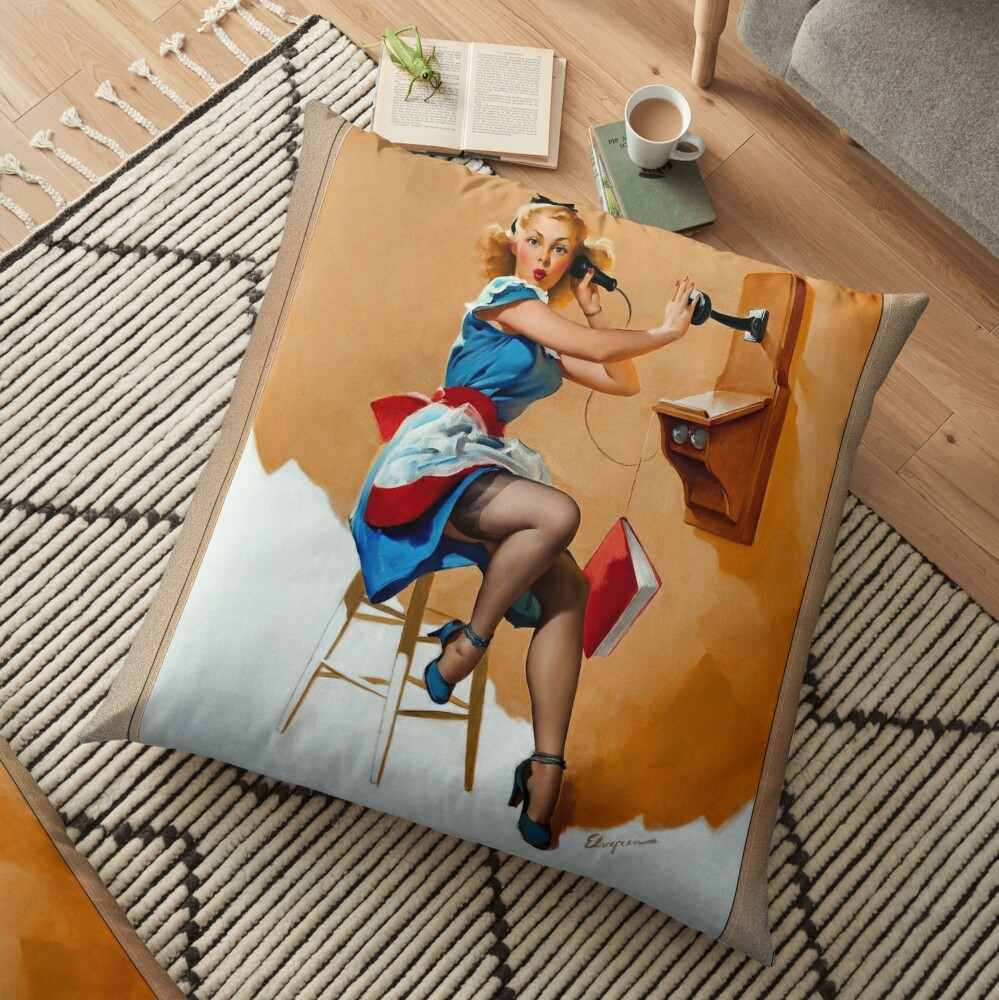
V srdci “Who’s On The Line” is a youthful and playful woman, a typical subject of Elvgren’s pin-up work. She is positioned in the center of the artwork, striking a dynamic pose that captures her both in motion and caught in a moment of surprise. The woman is dressed in a playful, slightly retro blue dress with a white apron.
The dress is belted at the waist with a bold red ribbon, which creates a lively contrast against her soft skin tone and the surrounding colors. Her pose is flirtatious and casual, yet she exudes an air of mystery, there is a sense that she is either expecting or answering an unexpected phone call. She is perched on a small wooden stool, leaning forward towards the old-fashioned telephone that seems to be a focal point of her attention.
Her expression is one of mock surprise or perhaps confusion, her mouth slightly parted as if caught in mid-conversation. One hand holds the receiver of the telephone, while her other hand rests on her hip, reinforcing the attitude of nonchalance. Její vlasy, styled in playful curls, frames her face, adding to the sense of whimsy that defines the artwork. The playful nature of her expression, coupled with the classic pin-up style, imbues the painting with a sense of fun and light-heartedness.
The Telephone: A Symbol of Connection
The telephone itself is an integral part of the narrative in “Who’s On The Line.” Positioned prominently on the wall beside the woman, it serves as the bridge between the subject and the unseen world outside the frame. The old-fashioned telephone, with its rotary dial and hand receiver, is a relic of a time before modern communication, evoking a sense of nostalgia and a longing for a simpler era. The object is painted with great care, with attention to texture and detail, suggesting its importance not only in the scene but also in the broader context of the woman’s life and experience.
While the woman’s playful pose and attire suggest the work is lighthearted, the telephone adds an element of suspense. It seems to be almost symbolic—perhaps representing a connection to someone distant or a long-awaited conversation. The lack of clarity about the person on the other end of the line enhances the intrigue, allowing the viewer to project their own narrative onto the scene.
The Terrain and Background: Simplicity and Focus
The background of “Who’s On The Line” is rather minimalistic, yet it serves to highlight the subject without distraction. Měkký, beige wall creates a neutral backdrop that emphasizes the vibrant colors of the woman’s dress and the telephone.
There is no intricate furniture or scenic landscape that pulls attention away from the central figures; spíše, the focus is entirely on the woman and the immediate objects around her. The floor appears to be a simple, light-colored surface, with no prominent details other than the stool she sits on, which adds to the sense of modesty and simplicity in the scene.
The lack of ornate surroundings allows the viewer to focus on the interaction between the woman and the phone. The scene could be taking place in a humble domestic setting, reinforcing the narrative of everyday life, but with a touch of glamour, an artifice that pin-up art often aimed to depict. Hladký, clean background provides a canvas for the character to shine, both physically and emotionally.
The Style: Classic Pin-Up Art
Gil Elvgren’s style is immediately recognizable and widely regarded as the epitome of the mid-20th-century American pin-up genre. His works often feature women in moments of playful flirtation or light-hearted mischief, captured with smooth lines and rich colors. “Who’s On The Line” follows this tradition with its clean, vyleštěná estetika, characterized by an almost idealized depiction of the female form. The curves of the subject are accentuated by the contours of the dress and the way the light interacts with her skin. Elvgren’s careful rendering of the woman’s face, her playful expression, and the softness of her figure demonstrates his skill at capturing both sensuality and innocence in equal measure.
Nálada: Playful and Teasing
Celková nálada “Who’s On The Line” is playful and teasing. There is a flirtatious energy to the piece, enhanced by the woman’s cheeky pose and curious expression. The painting’s light-hearted nature invites the viewer into a narrative where the subject may be engaging in a flirtatious conversation or perhaps caught off guard by a phone call. The interaction with the telephone suggests an intriguing tension, with the viewer left to wonder about the identity of the person on the other end of the line.
The mood is further emphasized by the color choices in the painting. The combination of the vibrant red ribbon, the soft blues of her dress, and the muted tones of the background creates a balance between warmth and coolness. This harmony adds to the sense of relaxed charm, allowing the viewer to enjoy the scene without feeling overwhelmed by any intense emotions. The subject’s charm and innocent allure are conveyed through her body language and facial expression, inviting the viewer to share in the moment.
Závěr: A Timeless Snapshot of Playful Femininity
“Who’s On The Line” by Gil Elvgren captures a moment of playful femininity in a beautifully crafted image that balances sensuality with innocence. The painting’s timeless appeal lies in its ability to transport the viewer to a moment of flirtation and curiosity, evoking a nostalgic sense of charm and youth. Přes pečlivou pozornost k detailu, Elvgren brings to life a character who is both whimsical and grounded, caught between an era gone by and the timeless nature of the human experience. This piece is a perfect example of Elvgren’s ability to merge art with narrative, capturing the essence of his era with both humor and grace.
Toto je remasterovaná reprodukce starých mistrů digitálního umění obrázku ve veřejné doméně, který je dostupný jako a tisk na plátno online.
Umělec bio Wikipedia.org
Gillette A. Elvgren se narodil v St. Pavel, Minnesota, a navštěvoval univerzitní střední školu. Po promoci, začal studovat umění na Minneapolis Institute of Arts.
Později se přestěhoval do Chicaga studovat Americkou akademii umění, a absolvoval Akademii během velké deprese, ve dvaadvaceti letech.
Po promoci se Elvgren připojil ke stáji umělců ve Stevens and Gross, Nejprestižnější reklamní agentura v Chicagu, a stal se chráněncem umělce Haddona Sundbloma.
v 1937, Gil začal malovat pin-upy kalendáře pro Louisa F.. Dow, jedna z předních amerických vydavatelských společností, za tu dobu vytvořil asi 60 pin-up girl pracuje na plátně 22 ″ × 28 ″ a odlišuje je tištěným podpisem.
Mnoho z jeho pin-upů bylo během druhé světové války reprodukováno jako umění nosu na vojenských letadlech; a bylo to asi tentokrát v 1944, že Elvgrena oslovila společnost Brown and Bigelow Publishing Company; firma, která stále dominuje oboru při výrobě kalendářů, reklamní speciality a reklamní zboží.
Příští rok od 1945 až do 1972, Elvgren byl spojován s Brownem & Vydavatelská společnost Bigelow, a začal pracovat s 24 palec o 30 palcová plátna, formát, který by použil pro další 30 let, a podepsal svou práci kurzívou.
Elvgren byl komerční úspěch. Bydlel na různých místech, a byl aktivní od třicátých do sedmdesátých let minulého století. v 1951 začal malovat v ateliéru ve svém domě, pak ve Winnetce, Illinois, pomocí asistenta nastavit osvětlení, stavět rekvizity a scény, sady fotografií, a připravit mu barvy.
Mezi jeho klienty patřily známé společnosti jako Brown a Bigelow, Kola, General Electric a Sealy Matrace Company, abychom jmenovali alespoň některé. Navíc, během čtyřicátých a padesátých let ilustroval příběhy pro řadu časopisů, jako například The Saturday Evening Post a Good Housekeeping.
Mezi modelky a hollywoodské legendy, které Elvgren namaloval během své kariéry, byla Myrna Hansen, Donna Reedová, Barbara Haleová, Arlene Dahl, Lola Albright a Kim Novak.