

Will It Be Fine c1896
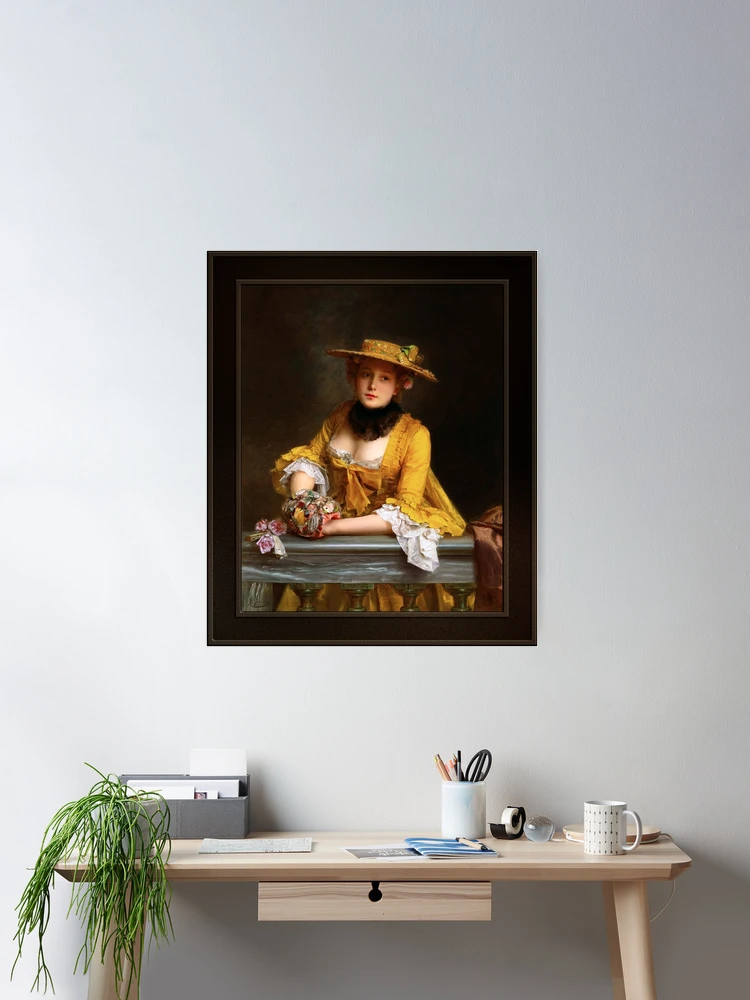
“Will It Be Fine,” creat a 1896 by French painter Gustave Jean Jacquet (1846 – 1909), is a portrait that captures a moment of contemplation and grace, reflecting the aesthetic trends of the late 19th century. El quadre representa una dona jove, dressed in an elegant yellow gown, leaning against a table as she holds a bouquet of flowers.
Her delicate pose and thoughtful expression invite the viewer into her world, perhaps pondering a future decision or the course of her life. La vestimenta del subjecte, hairstyle, and surroundings embody the refined atmosphere of the period, blending naturalism with a touch of Romanticism. The attention to detail and the soft, warm tones of the painting evoke a sense of timeless beauty and a tranquil moment of introspection.
Taula de continguts
El subjecte: A Portrait of Elegance
Al cor de “Will It Be Fine” is the retrat d’una dona jove, likely a representation of femininity in its most delicate form. Està asseguda d'una manera relaxada però equilibrada, with one arm resting on a table, and her gaze directed slightly off to the side, giving the impression that she is lost in thought. La seva expressió facial, serè i compost, speaks to the psychological depth that Jacquet was able to achieve through his meticulous brushwork.
The woman’s features are finely detailed, amb suau, pale skin that contrasts subtly against the deeper tones of her clothing. The artist’s precision in capturing the texture and structure of her face is noteworthy, amb cada detall, from her soft cheeks to her slightly parted lips, contributing to a sense of realism that was characteristic of Jacquet’s work.
El vestit de la dona, a yellow gown with intricate ruffles, is a statement of high fashion typical of the late 19th century. El vestit, with its vibrant yellow color, is composed of fine fabrics that catch the light, enhancing the richness of the scene. The wide-brimmed hat atop her head, adorned with floral embellishments, completes her ensemble.
The rich textures of the fabric and the carefully painted details of her accessories, such as the ribbon tied at the neckline and the delicate bouquet she holds, all contribute to the luxurious feel of the portrait. The ensemble exudes elegance, signifying her high social status or noble birth. The bouquet of flowers, també, is a key detail, simbolitzant la bellesa, vostès mateixos, and perhaps the fleeting nature of time.
El marc i els materials
The background of the portrait is subtle, proporcionant un contrast apagat amb la vitalitat de la indumentària del subjecte. L'artista utilitza una foscor, teló de fons gairebé eteri que afegeix una sensació de profunditat i enfocament al tema alhora que millora l'estat d'ànim íntim de la peça. La taula davant d'ella, sobre el qual recolza el braç, es presenta amb un sentit de realisme, encara que queda en un segon pla, servir com a suport més que com a punt focal. L'ús de la llum i l'ombra a la cara i el vestit ajuda a crear un efecte tridimensional, posant èmfasi en l'enfocament naturalista pel qual era conegut Jacquet.
Els materials de la pintura en si són oli sobre tela, que permet les transicions suaus de color i llum, contribuint a la qualitat real del treball. L'aplicació de llum i ombra està especialment ben executada, amb Jacquet utilitzant reflexos delicats per donar a la tela del vestit una sensació de textura. La llum sembla acariciar la cara i les mans del subjecte, cridant l'atenció sobre la bellesa subtil de la seva pell i la suavitat de la seva expressió.
Estil, Tema, i l'estat d'ànim
“Will It Be Fine” és una obra exemplar del retrat francès del segle XIX, amb influències tant de la tradició acadèmica com de la més íntima, exploracions psicològiques que anaven sorgint en aquell moment. L'estil de Jacquet combina el realisme amb una interpretació romàntica del seu tema, capturant la semblança física de la dona alhora que la impregna d'una sensació de profunditat emocional. The painting’s realism is evident in the precise rendering of the fabrics, the textures, and the light, while the soft treatment of the woman’s face and the mood created by her distant gaze lend the piece an air of introspection and contemplation.
The theme of the painting seems to explore a moment of quiet anticipation, perhaps asking the question of whether the future will bring joy or sorrow—symbolized by the title “Will It Be Fine.” El títol, in conjunction with the contemplative mood of the figure, suggests a sense of uncertainty or hopefulness, evoking a time in the subject’s life when decisions or events may alter her course.
The overall mood of the painting is one of calm introspection. Els colors, especially the warm yellow of the gown and the softness of the background, contribute to a sense of peace. No obstant això, there is also an undercurrent of uncertainty, as the subject’s expression is not one of absolute confidence, but rather one of quiet contemplation.
Conclusió
En “Will It Be Fine,” Gustave Jean Jacquet succeeds in capturing a moment that is both timeless and evocative. The painting speaks to the viewer not just through its technical mastery but also through its emotional resonance. The young woman in her opulent attire, holding her bouquet and gazing into the distance, seems to embody a silent narrative of waiting, of pondering the future. Jacquet’s deft handling of light, his careful rendering of fabrics, and his ability to evoke a range of emotions through the subject’s expression all come together to create a portrait that is not just a depiction of a woman, but a meditation on beauty, vostès mateixos, i el pas del temps.
Es tracta d’una reproducció de vells mestres d’art digital retocada d’una imatge de domini públic.
Artsit Bio Is Derived From 19thcenturypaintings.com
Gustave va néixer a París, França en marxa 1846 i va ser deixeble del pintor francès William-Adolphe Bouguereau (1825 – 1905) del Neoclassicisme, Realisme, Acadèmic, Simbolisme, Era de l'Art Modern; i mai va ser mentor amb cap altre artista i va ser molt influenciat per ell durant la primera part de la seva carrera.
L'obra d'art de debut de Gustave va ser La Rêverie, una peça d'al·legoria presentada al Saló de 1865; després a 1866 va presentar pintures de petites dimensions que representaven la vida del segle XVI, 17vida dels segles i XVIII, així com pintar retrats de subjectes amb vestits d'època del segle XVI.
En 1875 Gustave va rebre una medalla d'excel·lència i 4 anys més tard va ser nomenat Cavaller de la Legió d'Honor (Legió d'Honor, antigament Reial Orde de la Legió d'Honor); és el màxim ordre de mèrit francès, tant militars com civils. Establert a 1802 de Napoleó Bonaparte.