

Winter Landscape With Travelers
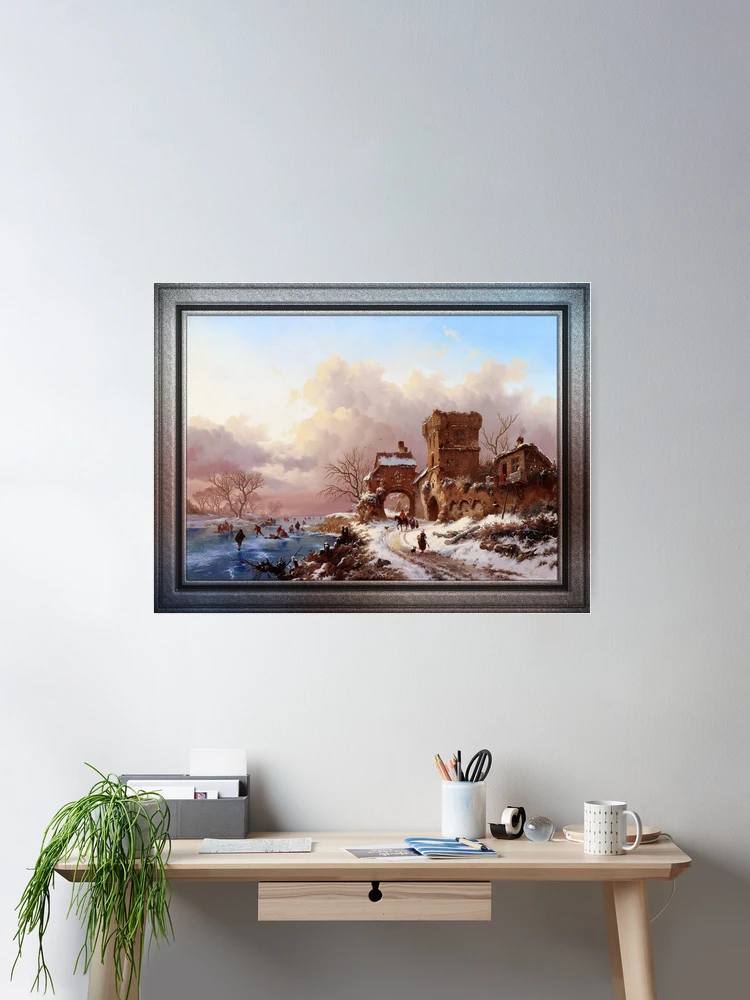
Yn Winter Landscape With Travelers Near The Town Gate, painted by Frederik Marinus Kruseman (1816 – 1882), the viewer is transported to a serene winter’s day in the 19th century, where the tranquility of the frozen landscape is punctuated by the movements of travelers. This stunning piece, dating from around 1857, exemplifies the Dutch Romanticism style, characterized by its detailed naturalistic approach, its emphasis on the landscape as both a subject of beauty and contemplation, and its carefully composed atmosphere. The artist presents a rich narrative of rural life in the cold months, capturing both the splendor and harshness of winter in a northern European town.
Ynhâldsopjefte
Haadûnderwerp en komposysje
At the heart of the painting is a town gate, acting as the focal point of the composition. This structure, grand and imposing, stands against the backdrop of a serene but somewhat desolate winter scene. The gate leads into a quaint village or town, which is implied but not directly shown in the artwork. On either side of the entrance, towering bare trees stretch their limbs into the cold air, their gnarled branches reaching out toward the sky, their starkness enhanced by the absence of leaves. These trees, mostly without foliage, evoke a sense of dormancy, signifying the depth of winter’s grip.
Just outside the town gate, the ground is blanketed in a layer of snow, its purity highlighted by the faint tinge of sunset light that reflects off its surface. The snow is soft and undisturbed near the gate, but as it stretches farther into the scene, the untouched white is interrupted by travelers on foot, creating dynamic movement within the otherwise still landscape.
Dizze sifers, bundled in winter coats and cloaks, traverse the icy terrain, their heads lowered against the cold wind, adding a sense of realism and humanity to the scene. The scene thus tells a story of daily life during winter, where travel and movement persist despite the frozen conditions.
Objekten en materialen
The painting’s attention to detail is evident in its depiction of materials. The stone structure of the town gate is textured and weathered, with intricate architectural features that reflect the period’s craftsmanship. The gate itself serves as a symbolic barrier between the bustling life of the town and the expansive, icy wilderness outside. The faint glow from the window of the building atop the gate hints at warmth within, contrasting the harsh cold of the outside world.
The snow is not just a passive element in the scene; Kruseman skillfully uses it to highlight the light effects of the setting sun. De snie, with its delicate, powdery texture, reflects the amber and pale colors of the sky, which gently fade into a soft pinkish hue near the horizon.
It wetter, visible in the foreground, has a frozen sheen to it, allowing travelers and skaters to glide across its surface. There are figures visible on the ice, engaged in the sport of skating—a pastime synonymous with cold winters in the Low Countries during the 19th century. De sifers’ motion contrasts with the stillness of the trees and the looming town gate.
Terrain and Surroundings
The surrounding terrain consists of a variety of textures and layers, from the soft snow that covers the ground to the frozen river in the foreground, which adds depth and intrigue to the scene. De rivier, partially frozen, reflects the cloudy sky above, while thin cracks in the ice hint at the fragile nature of the winter landscape. Yn 'e fierte, the horizon is dominated by the fading light of the sunset, casting a warm glow across the scene that contrasts with the cool tones of the snow and ice.
The snow-covered path that leads to the town gate is marked by the footprints of the travelers, whose dark forms stand out against the pale ground. This path draws the viewer’s eye toward the gate, enhancing the sense of movement within the otherwise quiet scene. Kruseman vangt de sekuere aard fan de winter op it Nederlânske plattelân, gebrûk fan natuerlike eleminten lykas de izige rivier en blêdleaze beammen om de stille iensumens fan it momint oer te bringen.
Styl en technyk
Kruseman syn behearsking fan ljocht en skaad is te sjen yn dit skilderij, om't hy de waarme toanen fan 'e sinneûndergong effektyf kontrasteart tsjin 'e koelere skaden fan it winterlânskip. It boarstelwurk is delikaat, mei Kruseman syn oandacht foar detail yn de ôfbylding fan beammen, snie, en arsjitektuer meitsje in harmonieuze lykwicht tusken realisme en artistike ekspresje.
De keunstner syn gebrûk fan ljocht spilet in wichtige rol by it ynstellen fan de stimming fan it skilderij. De sêfte, diffuus ljocht suggerearret it ein fan in dei, in rêstige en kontemplative sfear oproppe. The viewer is invited to imagine the quiet of the countryside as the sun sets, with the only sounds being the crunch of snow underfoot and the distant voices of the travelers.
The figures in the painting are rendered with a great deal of realism, with Kruseman capturing the naturalistic details of their clothing and movements. The traveler’s cloaks and hats evoke the practical fashion of the time, as they were meant to shield the wearer from the biting cold of winter. The posture of the travelers also adds a sense of realism—heads lowered against the wind, bodies slightly bent as they move through the snow.
Tema en stimming
The predominant mood in Winter Landscape With Travelers Near The Town Gate is one of quiet solitude, tempered by the presence of life and motion. The scene captures the interplay between nature and humanity, showing how the people in the painting are subject to the forces of nature, yet continue to move forward despite the harsh winter conditions. There is a sense of resilience in the travelers’ purposeful strides, contrasting with the stillness of the frozen landscape.
This is a portrayal of a community enduring the winter season, yet finding a certain peacefulness within it. The town gate acts as both a literal and symbolic threshold, representing the boundary between the warmth and security of the town and the harshness of the world outside. The traveler’s presence suggests a world beyond the gate, one of movement and passage, yet still part of the larger natural landscape.
Yn wêzen, Kruseman’s work reflects a deep reverence for the natural world, capturing the stark beauty of winter while also suggesting the enduring spirit of those who live within it. The painting invokes themes of endurance, it ferrin fan de tiid, and the quiet beauty found in the often-overlooked details of daily life.
Winter Landscape With Travelers is a retouched digital art old masters reproduction of a public domain image.
Dizze digitale keunst skepping, lykas mei al it keunstwurk dat te finen is op 'e Xzendor7-webside is online te keap yn in ferskaat oan materiaalformaten, ynklusyf canvasprints, acryl prints, metalen prints, hout prints, framed prints, posters, en as rôlde canvasprints yn in ferskaat oan grutte fan 12 inches oan 72 inch ôfhinklik fan de grutte fan it eigentlike keunstwurk en de print-on-demand winkel wêrfan jo kieze om de keunst te keapjen.
It keunstwurk is ek te krijen op in breed oanbod fan klean foar manlju en froulju, mokken, totes, sjaals, notebooks en tydskriften en in protte home decor produkten.
Oer The Artist
Info hjirûnder ôflaat fan Wikipedia.org
Frederik received his first drawing lessons from still life painter Jan Reekers (1790 – 1858), who at the time was Director of the Royal Acadamy of Fine Arts in Amsterdam; and who had also tutored his cousin Jan Adam[ while attending a vocational school in Haarlem from 1832 nei 1833.
Yn 1833 he then began to study painting with Dutch Painter, Graveur, Lithographer, Watercolorist and Illustrator Nicolaas Johannes Roosenboom (1805 – 1880).
Dan yn 1835 he moved to Het Gooi in the center of the Nertherlands, where he took advanced studies with Dutch Landscape Painter Jan van Ravenswaay (1789 – 1869); as well as studying for a brief period of time with Dutch Landscape Painter and Lithographer Barend Cornelis Koekkoek (1803 – 1862).
He later returned to Haarlem and from there to Kleve in northwestern Germany where he painted landscapes, before returning home in 1839.
Yn 1841 he moved to Brussels and stayed there until 1852, except for a brief period of a few months when he went to Paris. Yn 1852 he went back home to Haarlem and stayed there for four years, after which he went to Belgium, where he remained until his death in 1882.