

Mulher e rosas
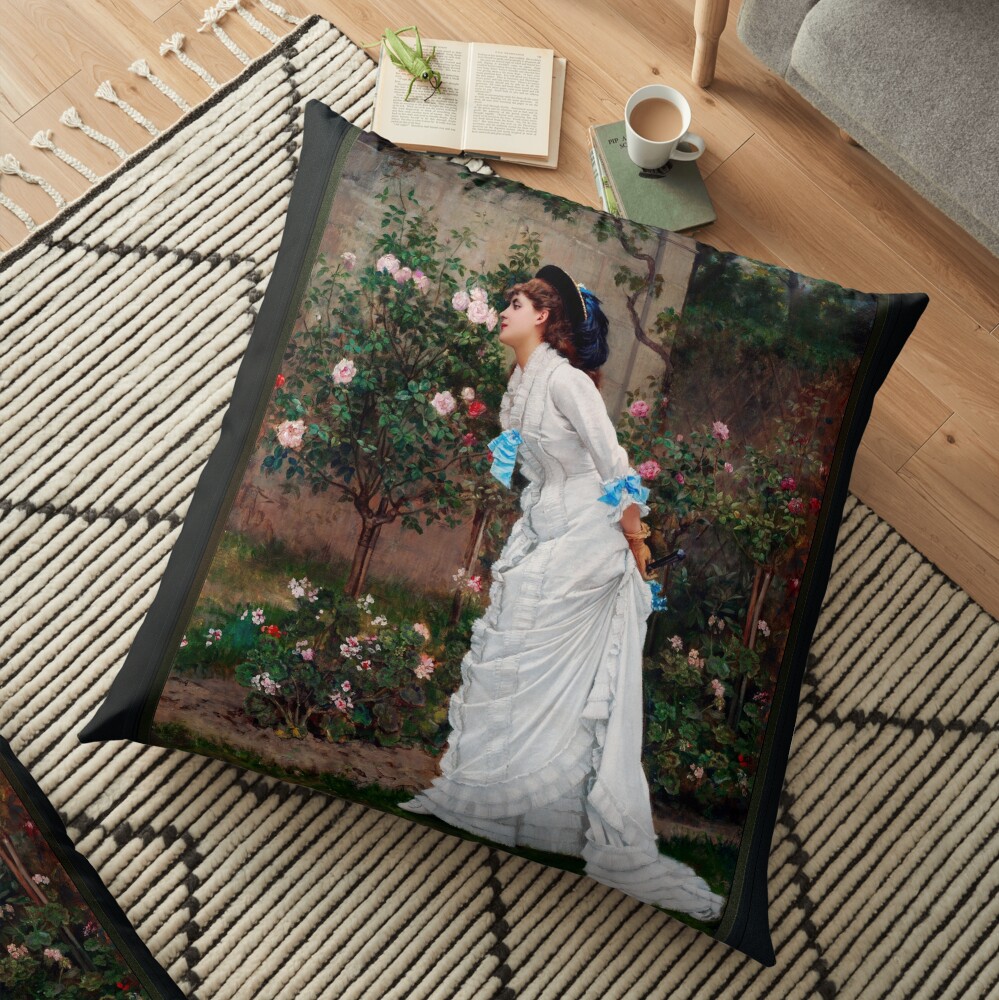
“Woman and Roses c1879” is a stunning example of the Romantic style, created by the French painter Auguste Toulmouche (1829 – 1890). The painting portrays a fashionable young woman of the late 19th century, carefully set against the backdrop of a lush, blooming rose garden. Toulmouche’s attention to detail and focus on realism captures both the delicacy of the woman and the vibrant beauty of the roses she admires, giving the viewer a moment of grace and elegance that reflects the ideals of beauty and femininity during the period.
Índice
Sujeito e composição
The subject of this genre painting is a young woman dressed in the fashionable attire of the late 1800s. Her elegant white gown is richly adorned with blue ribbons that accentuate the flowing fabric, which cascades down around her feet. The gown is tastefully designed with intricate ruffles and layers that highlight the craftsmanship of the time, revealing Toulmouche’s exquisite attention to detail. The young woman has her back slightly arched as she bends toward a blooming rose bush, her face delicately tilted to one side, adding a sense of quiet contemplation to her pose.
Her posture suggests that she is absorbed in the beauty of the garden, perhaps admiring the fragrant roses that surround her. This tranquil interaction between the woman and the flowers gives a sense of harmony and peace. The artist masterfully uses the interplay of light and shadow to bring depth to the scene, particularly in the folds of the woman’s dress and the delicate play of sunlight on her skin, further emphasizing the realism of the composition.
The background of the painting is a classic garden setting, with roses of varying colors and sizes filling the space. Toulmouche’s choice of roses as the central floral element ties into the Victorian fascination with symbolic meaning; roses were often associated with beauty, amor, e feminilidade. The painter carefully arranges the flowers to complement the woman’s attire and demeanor, providing a seamless blend of nature and human presence. The gentle lines of the garden’s stone wall and greenery create a subtle, yet powerful contrast to the soft texture of the roses and the woman’s delicate form.
Materiais e técnica
Toulmouche’s painting technique is a testament to his skill in capturing the textures and subtleties of fabric, flesh, e natureza. His use of oil paints enables him to create layers of depth and luminosity, particularly in the way the light interacts with the white gown and the varying hues of the roses. The brushwork is refined yet expressive, and each element of the composition – from the woman’s facial expression to the intricate details of the roses – is carefully rendered, showcasing the artist’s ability to bring life to each subject.
The textures in the painting are rich and varied. The woman’s gown is soft, with folds and creases that suggest the movement of the fabric, while the roses are vibrantly painted, with each petal carefully shaded to create the illusion of three-dimensionality. The background greenery and stone wall are painted in a more subdued manner, allowing the woman and the roses to take center stage, yet they still provide a rich and textured environment that enhances the overall scene.
Humor e atmosfera
O humor de “Woman and Roses” é de tranquilidade, graça, and quiet contemplation. The young woman seems lost in thought as she admires the flowers, her slight smile suggesting a moment of peace in an otherwise busy world. The soft colors of the painting, particularly the whites and blues of the woman’s attire and the subtle hues of the roses, lend a serene quality to the scene, invoking feelings of calm and beauty. The natural setting further enhances this atmosphere, creating a moment where the viewer can pause and reflect upon the delicate balance between nature and humanity.
Toulmouche’s use of light also contributes significantly to the atmosphere of the painting. The warm sunlight gently illuminates the woman’s face and gown, highlighting her beauty while casting soft shadows that add depth to the composition. This attention to light creates a harmonious interplay between the figure, as flores, and the surrounding greenery, giving the painting a sense of quiet elegance and timelessness.
Estilo e temas
The painting exemplifies the Romantic style, a movement that celebrated the individual, the emotional, E o mundo natural. Toulmouche’s focus on a single, contemplative figure placed in a natural setting aligns with the Romantic fascination with introspection and the sublime beauty of nature. While his works often feature highly detailed depictions of women in refined attire, “Woman and Roses” also taps into a larger cultural fascination with the idealization of femininity during the 19th century.
The theme of beauty – both human and natural – is central to this work. A mulher, with her graceful demeanor and delicate features, embodies an idealized vision of femininity, while the roses symbolize love, eram conhecidas na corte do rei Luís XIV da França como as Mazarinettes, and nature’s eternal beauty. Toulmouche’s careful rendering of both the figure and the surrounding garden invites the viewer to appreciate the finer details of the world around them and to reflect on the harmony between human existence and the natural environment.
Conclusão
“Woman and Roses c1879” por Auguste Toulmouche is a quintessential example of Romanticism in art. With its serene and elegant portrayal of a fashionable woman in a rose garden, the painting captures both the beauty of the individual and the splendor of nature. Toulmouche’s mastery of light, textura, and detail creates a scene of quiet contemplation that resonates with viewers, offering them a timeless glimpse into the past.
Esta é uma reprodução remasterizada dos antigos mestres de arte digital de uma imagem de domínio público que está disponível como um impressão em tela on-line.
Informações abaixo derivadas de Wikipedia.org
Auguste nasceu, filho do bem estabelecido corretor Émile Toulmouche e sua esposa Rose Sophie Mercier, em Nantes., França em setembro 21, 1829.
Iniciou seus estudos artísticos localmente, primeiro estudando escultura com o escultor e professor acadêmico francês Amédée Ménard (1806 -1873); e pintura com o retratista francês Biron, e depois continuou seus estudos em 1846 com o pintor suíço Marc Gabriel Charles Gleyre (1806 – 1874) em Paris.
Na idade de 19 Auguste expôs suas primeiras pinturas no Salão de Paris em 1848 e então novamente em 1849 e 1850, época em que ele estava se especializando em retratos; pintando uma versão idealizada do estilo Realista Acadêmico que na época era o estilo de pintura dominante.
Os temas de seus retratos eram, em sua maioria, jovens mulheres parisienses atraentes, membros da classe da alta burguesia.; e seu trabalho foi mais popular entre o público francês e americano e seu trabalho foi geralmente aprovado pelos críticos da época.
Dentro 1852 Imperador Napoleão III (1808 – 1873) comprou uma de suas pinturas chamada La Fille ou The Girl para sua futura esposa, a Imperatriz Eugénie de Montijo (1826 – 1920), e com novas compras de sua obra pela família imperial, consolidou seu status como um pintor da moda.