

Femme avec Lys
Femme avec Lily par le lithographe américain Louis Prang (1824 – 1909)
L'œuvre intitulée “Femme avec Lys” a été créé par le lithographe américain Louis Prang, né dans 1824 et passant 1909. La lithographie, produit à la fin du 19ème siècle, illustre la maîtrise de Prang dans la représentation détaillée et vibrante de personnages dans le style délicat typique de l'époque. ère victorienne. L'image représente une jeune femme tenant un lys, et cette pièce faisait partie du genre populaire de lithographie d'art dans lequel Prang s'est spécialisé.. Connu pour son habileté dans le domaine de la chromolithographie, Le travail de Prang cherchait à combiner le naturalisme avec une forme idéalisée de beauté, créer des images qui plaisaient à un large public à l'époque.
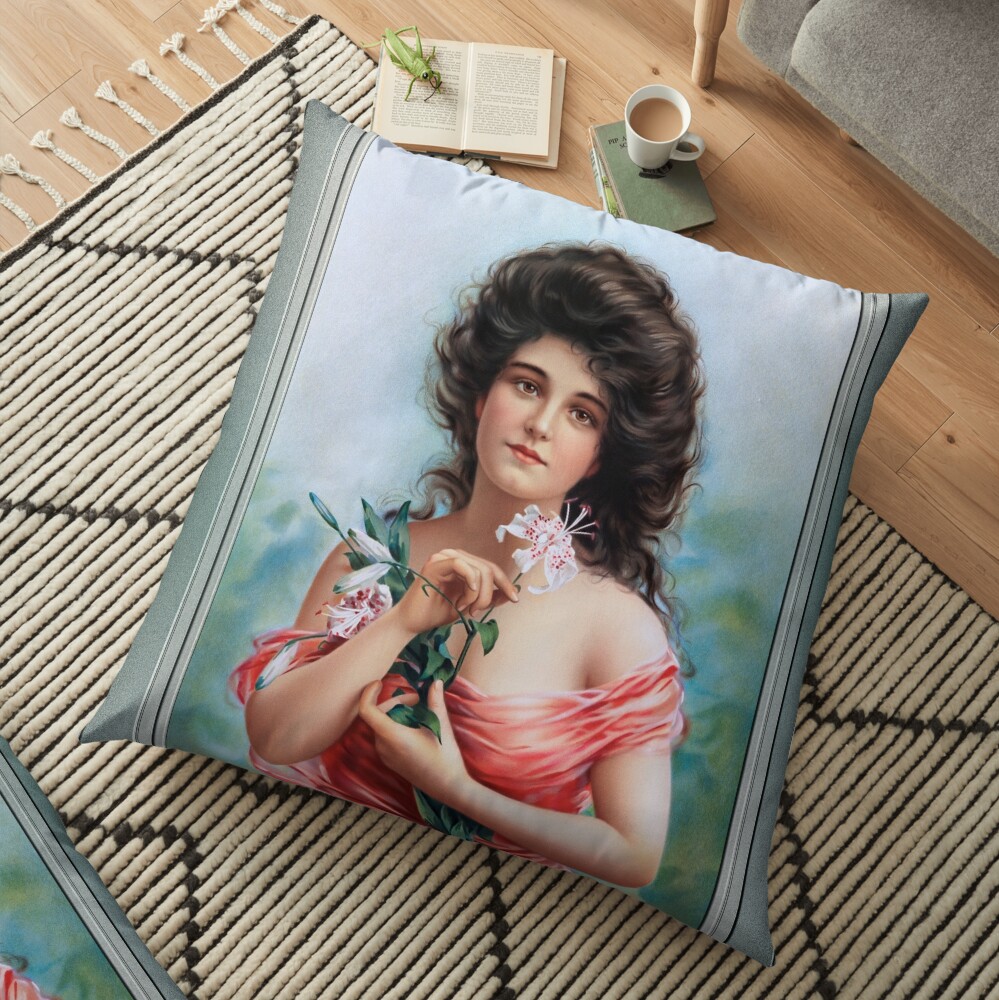
Table des matières
Sujet principal et composition
Le sujet central de l'œuvre est une jeune femme, portrayed with a serene and gentle expression. She is depicted in a soft, flowing pink dress, which contrasts beautifully with the green foliage surrounding her. The woman gazes softly at the viewer, her brown eyes exuding a sense of quiet grace and elegance. Her flowing dark hair is styled in a natural yet polished manner, with soft curls framing her face. Sa posture est équilibrée et élégante, as she gently holds a large lily in her right hand. The lily is a key feature of the composition, symbolizing purity and innocence, and its delicate white petals contrast with the soft hues of the woman’s dress and the surrounding background.
The background of the lithograph is a soft blend of light greens and blues, suggesting a tranquil outdoor scene. While the terrain is not explicitly detailed, the hazy green tones give the impression of a lush, cadre naturel. La composition globale est équilibrée et harmonieuse, with the woman’s figure positioned centrally within the frame, making her the undeniable focal point. The arrangement emphasizes her graceful demeanor, with her slightly tilted head and gentle hands reinforcing a sense of delicacy and refinement.
Style et technique
Prang’s lithographic technique is evident in the fine detail and vibrant color palette used throughout the piece. The subtle gradients in the woman’s dress, from light pink to deeper rose tones, highlight Prang’s skill in creating depth and dimension. The artist uses delicate shading to suggest the volume and texture of the fabric, adding to the realism of the portrait. The folds in her dress are softly rendered, mimicking the natural flow of the material.
La représentation de la lumière et de l'ombre est un autre élément notable de l'œuvre d'art.. La source de lumière semble provenir du coin supérieur gauche, projetant une douce lueur sur le visage et les bras de la femme. Cela met en valeur la douceur de sa peau, qualité proche de la porcelaine et contraste avec les tons plus sombres du fond et de sa robe. La lumière touche aussi le lys, soulignant ses pétales blancs sur le rose tendre de la tenue vestimentaire de la femme.
L'utilisation habile de la couleur par Prang ajoute également à l'ambiance générale de la pièce.. La douceur de la robe rose, combiné avec la verdure luxuriante et les tons bleus du fond, crée une atmosphère de tranquillité et de calme. Les couleurs, bien que brillant, conserver une sensation de douceur naturelle, éviter les contrastes trop durs qui pourraient perturber la douceur de l'atmosphère. Les verts et bleus atténués de l'arrière-plan renforcent encore le sentiment de sérénité., as if the viewer is being transported into a peaceful, idyllic world.
Thème et humeur
Le thème de “Femme avec Lys” is one of innocence, pureté, et la beauté naturelle. La jeune femme, with her delicate features and graceful posture, embodies the ideals of femininity that were highly regarded in the late 19th century. The lily, a symbol of purity and virtue, reinforces this theme, creating a sense of harmony between the figure and the natural world around her. There is a subtle suggestion of timelessness in the artwork, as the woman is not bound by a particular time period or setting, but instead represents a universal symbol of feminine grace and beauty.
The mood of the artwork is one of calm and serenity. Les couleurs douces, the woman’s gentle expression, and the delicate floral element all contribute to a peaceful, ambiance presque onirique. The viewer is drawn into the image not by a dramatic narrative, but by the quiet elegance of the figure and the serene environment in which she is placed. The woman’s subtle expression, with no discernible emotion other than a soft, tranquil gaze, invites the viewer to engage with her in a contemplative way, suggesting that the true beauty of the piece lies not in grand gestures or action, but in the quiet, graceful presence of the subject.
Matériaux et exécution
The lithograph was executed with great attention to detail, a hallmark of Louis Prang’s work. Lithography involves drawing on a stone or metal surface with a greasy substance and then transferring the image onto paper. The artist’s precise line work and careful application of color demonstrate his mastery of this technique. In Prang’s era, chromolithography was a popular method for producing vibrant, colored prints, and his ability to use color to enhance the mood and emotion of his pieces was highly regarded.
The quality of the lithograph suggests that it was printed on high-quality paper, a medium that allows for rich, couleurs vibrantes. The paper’s texture is likely smooth, providing an ideal surface for the fine details of the woman’s features and the delicate rendering of the lily. The framing of the piece in the image adds to its overall effect, with the ornate border reinforcing the sense of refinement and beauty that the artwork conveys.
Conclusion
“Femme avec Lys” by Louis Prang is a beautiful example of 19th-century lithographic art, showcasing the artist’s mastery of color and detail. The piece presents a serene and timeless portrait of feminine beauty, capturing the delicate grace of a young woman amidst a soft, idyllic background. Through the use of vibrant yet gentle colors, subtle shading, and a careful composition, Prang creates an image that evokes feelings of calm, pureté, et une élégance tranquille. The work is not only a testament to Prang’s technical skill but also an embodiment of the ideals of femininity and beauty that were celebrated in the Victorian era.
Woman with Lily is a remastered digital art old masters reproduction of a public domain image that is available as a impression sur toile.
À propos de l'artiste
Informations ci-dessous dérivées de Wikipedia.org
Louis was the son of a textile manufacturer was born in Breslau in Prussian Silesia (now Southwestern Poland) dans 1824 to Jonas Louis Prang of French Huguenot origin, and Rosina Silverman, who was German.
As a boy Louis became an apprentice to his father and learned the skills of engraving and calico dyeing and printing, et par 1840 traveled to Bohemia, in the Czech Republic working with companies that produced prints and textiles.
He also traveled throughout Europe and in 1848 found himself in a bit of trouble getting involved in the March Revolutions ot the German Revolutions of 1848-49; which resulted in the establishment of the German State and the introduction of a Liberal Constitution.
With the Prussian government hot on his heels he traveled to Switzerland in 1850 and then emigrated to the United States; settling in Boston, Massachusetts.
Dans 1856 Louis along with a partner created a press company called Prang and Mayer, that produced lithographs; with a specialty in producing prints of building and towns in Massachusetts; and four years later brought out Mayer and changed the name of the company to L. Prang & Company.
The new company began work in color printing, producing advertisements and other forms of business material; and became quite successful, being known for the war maps that were distributed by newspapers during the American Civil War (1861 – 1865).
Dans 1864, Louis decided to leave America and travel back to Europe to learn what was then the cutting edge of German lithography printing; and upon returning home the following year, he began to produce high quality reproduction of major works of art.
He also began producing a series of album card which became quite popular, that were advertised as collectibles for scrapbooks, that depicted natural scenes and patriotic symbols; puis dans 1873 il a commencé à produire des cartes de vœux pour le marché populaire en Grande-Bretagne et un an plus tard, Carte de Noël en Amérique.
Louis Prang est également connu pour ses efforts visant à améliorer l'éducation artistique aux États-Unis et pour la création et la publication de livres d'art pédagogiques.; ainsi que la création d'une fondation pour former des professeurs d'art.