

Niña recogiendo agua en la fuente
“Young Girl Gathering Water at the Fountain” is a captivating painting created by American artist Elizabeth Jane Gardner Bouguereau in the late 19th century. Gardner, nació en 1837 y falleciendo en 1922, was a prominent figure in academic realism, and this piece reflects her mastery of the human form, luz natural, and delicate expression. Set in an idyllic outdoor environment, this artwork captures the moment of a young girl interacting with a fountain, a common subject in 19th-century art that evokes themes of youth, inocencia, y naturaleza.
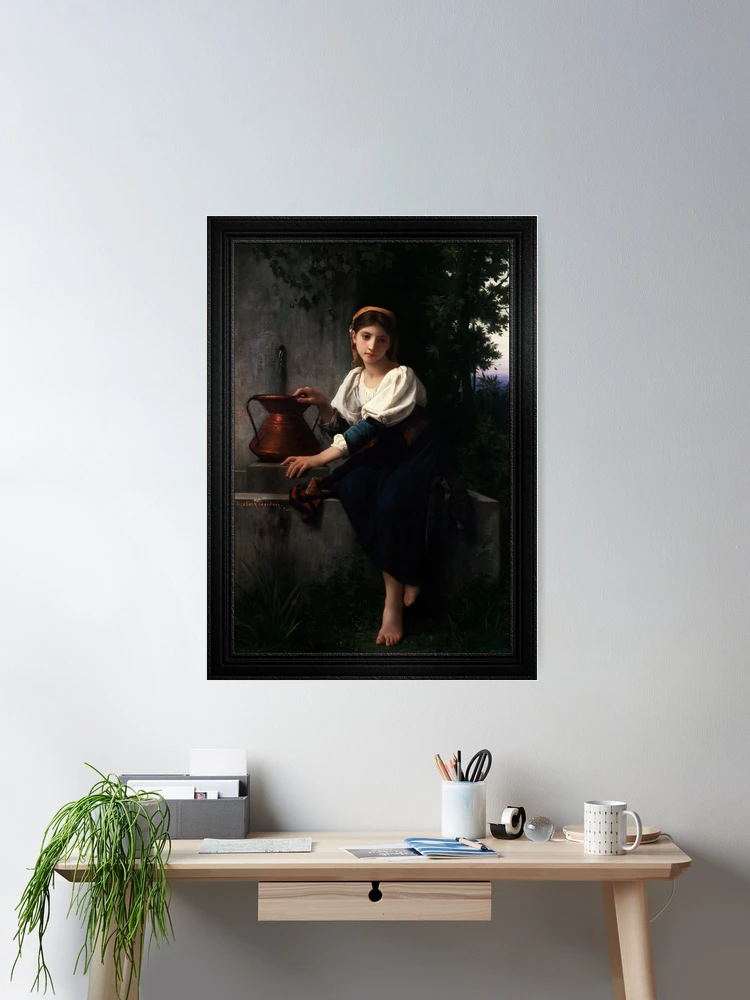
Tabla de contenido
Tema y composición
The central subject of this painting is a joven seated next to a fountain. She is delicately positioned on the edge of a stone basin, with one hand resting on the surface of the fountain while the other gently holds a copper water jug. Her posture is relaxed, pero decidido, as if she is caught in the moment between tasks. The girl’s face is tender and serene, conveying an expression of quiet contemplation as she gazes off into the distance. The viewer is drawn to her gentle beauty, which is enhanced by her delicate features, including soft, smooth skin and deep, reflective eyes.
Her attire is typical of the period, featuring a loose white blouse with billowing sleeves, paired with a rich blue skirt. This simple but elegant outfit contrasts with the more intricate details of her accessories. A reddish-brown sash is tied around her waist, and a headscarf, worn in a loose knot, frames her face and adds a touch of rustic charm to her appearance. The fabric of her clothing is painted with exquisite attention to detail, capturing the soft texture of linen and wool. The artist’s precision in rendering the clothing emphasizes her technical skill, a hallmark of Gardner’s realist approach.
The girl’s bare feet are casually positioned on the stone surface, further emphasizing the natural setting and the simplicity of rural life. This focus on unadorned, natural beauty is consistent with Bouguereau’s style, which often celebrated the purity and grace of youth in rural settings.
Objetos y Simbolismo
The objects within the scene play an important role in reinforcing the themes of domestic life, naturaleza, and labor. The fountain itself is a key element of the composition, and its presence suggests the cycle of everyday tasks that the young girl partakes in. Water, an essential resource in rural life, symbolizes life itself. The copper jug she holds is another significant object in the painting. Copper was a common material used for domestic utensils during the time, and the reflection of light on its surface adds depth to the artwork. The jug acts as a subtle metaphor for the girl’s role in the home, as well as her connection to nature and the land.
The fountain is a simple stone structure, with water flowing gently from the spout. The sound of water cascading into the basin could almost be heard from the stillness of the painting. The use of flowing water adds an element of movement to the otherwise peaceful scene. The surrounding environment features lush greenery, with ivy climbing the stone backdrop. The foliage and the light, dappled through the trees, lend the setting a serene and natural feel. The artist’s careful rendering of the plant life in the background conveys a sense of harmony between the young girl and the landscape.
Terreno y fondo
el terreno en “Young Girl Gathering Water at the Fountain” is a picturesque and tranquil rural setting. The backdrop features a stone wall with trailing ivy that suggests a weathered, natural environment. The foliage surrounding the fountain includes rich greens and subtle earth tones, with the detailed rendering of each leaf and vine enhancing the depth of the scene.
A lo lejos, the landscape fades into a soft horizon where the sky meets a distant body of water or a continuation of lush countryside, creating a sense of vastness beyond the scene. The artist uses soft gradients of color in the background to evoke the warmth of sunlight filtering through the trees, casting a gentle glow across the girl’s face and surroundings.
Gardner Bouguereau’s choice of landscape highlights a sense of peace and simplicity, reflecting a rural life untouched by the noise of urban society. The calm, natural setting reinforces the mood of tranquility and timelessness, making the scene feel both intimate and universal. The detailed texture of the stone and the foliage contrasts beautifully with the smoothness of the girl’s skin and the flowing nature of her attire, creating a balance of solidity and fluidity within the painting.
Estilo y técnica artística
As with many of her works, Elizabeth Jane Gardner Bouguereau employed a highly refined and meticulous style in “Young Girl Gathering Water at the Fountain.” Her use of light and shadow is particularly noteworthy, as it serves to model the forms of the figures and create a sense of depth within the composition. The gentle diffusion of light across the girl’s face and clothing enhances the realism of the scene and brings an almost photographic quality to the work.
Gardner Bouguereau was influenced by the academic tradition of French realism, which emphasized the accurate and detailed portrayal of human figures, particularly in outdoor settings. Her mastery of flesh tones and the representation of the human form is on full display in this painting. The careful attention to anatomical detail, such as the subtle play of light across the girl’s face and body, reveals the artist’s technical prowess. Her ability to capture the texture of fabrics and the reflective quality of light on surfaces is one of the defining aspects of her work, and it is especially evident in this painting.
Estado de ánimo y tema
The mood of the painting is one of peaceful contemplation, with an undercurrent of nostalgia for a simpler time. The scene evokes a sense of harmony between the figure and the natural world, reinforcing the connection between youth, inocencia, y naturaleza. The girl, seated at the fountain, represents an archetype of rural life, embodying the purity and grace that were highly regarded in academic realism. The simplicity of her task – gathering water – reflects the importance of domestic chores and the relationship between humans and the land.
The overall theme of the painting is one of timelessness. The young girl and her actions transcend any specific era or place, representing universal values of youth, sencillez, and the connection to nature. The painting invites the viewer to reflect on the past and on the enduring beauty of rural life.
Conclusión
“Young Girl Gathering Water at the Fountain” by Elizabeth Jane Gardner Bouguereau is a masterful example of 19th-century academic realism. Through her technical expertise and her delicate portrayal of the human form, Gardner Bouguereau captures a serene moment in the life of a young girl. La atención al detalle, the balance of light and shadow, and the harmonious composition all contribute to the timeless beauty of this piece. It serves as both a celebration of youth and nature, as well as a poignant reminder of the simplicity and grace that can be found in the everyday tasks of life.
Esta es una reproducción de viejos maestros de arte digital retocada de una imagen de dominio público.
Biografía del artista derivada de Wikipedia.org
Elizabeth Gardner nació en Exeter, New Hampshire, y asistió a la YOung Ladies Female Academy en Exeter; y luego asistió al Seminario Femenino Lasell en Auburndale, Massachusetts; estudiar arte e idiomas con especialización en inglés, francés, Italiano y alemán.
En 1856 se graduó del Lasell Female Seminary y pasó los siguientes años enseñando francés en una escuela recién abierta en Worcester, Massachusetts.
También enseñó arte en el Lasell Female Seminary., y en 1864 junto con su amiga y colega Imogene Robinson (1828 – 1908); un pintor histórico y de retratos estadounidense se fue a Francia, que se convertiría en su nuevo hogar en los años venideros.
Durante sus primeros años en Francia estudió con el pintor figurativo Hugues Merle. (1823 – 1881), Pintor de salón Jules Joseph Lefebvre (1836 – 1911) y William-Adolphe Bouguereau (1825 – 1905); con quien más tarde se casaría en 1896.
En este momento, para llegar a fin de mes y pagar el alquiler, pasó gran parte de su tiempo copiando pinturas de artistas contemporáneos y las obras de arte de los viejos maestros en varias galerías prestigiosas..
Más tarde en el otoño de 1864 Elizabeth decidió postularse a la escuela Ecole des Beaus-Art; pero su solicitud fue rechazada ya que las escuelas en este momento eran solo para hombres y la prohibición contra las mujeres eroling no se levantaría hasta que 1897.
Sin embargo, esto no disuadió a Elizabeth y continuó estudiando en clases privadas., desacelerando la construcción de un excelente portafolio de su trabajo.
La obra más conocida de Gardner puede ser The Shepherd David Triumphant c1895, que muestra al joven pastor con el cordero que ha rescatado.
Entre sus otras obras se encuentran Cenicienta, Cornelia y sus joyas, Corinne, Adivino, Maud Muller, Daphne y Chloe, Rut y Noemí, La hija del granjero, La boda bretona, y algunos retratos.