

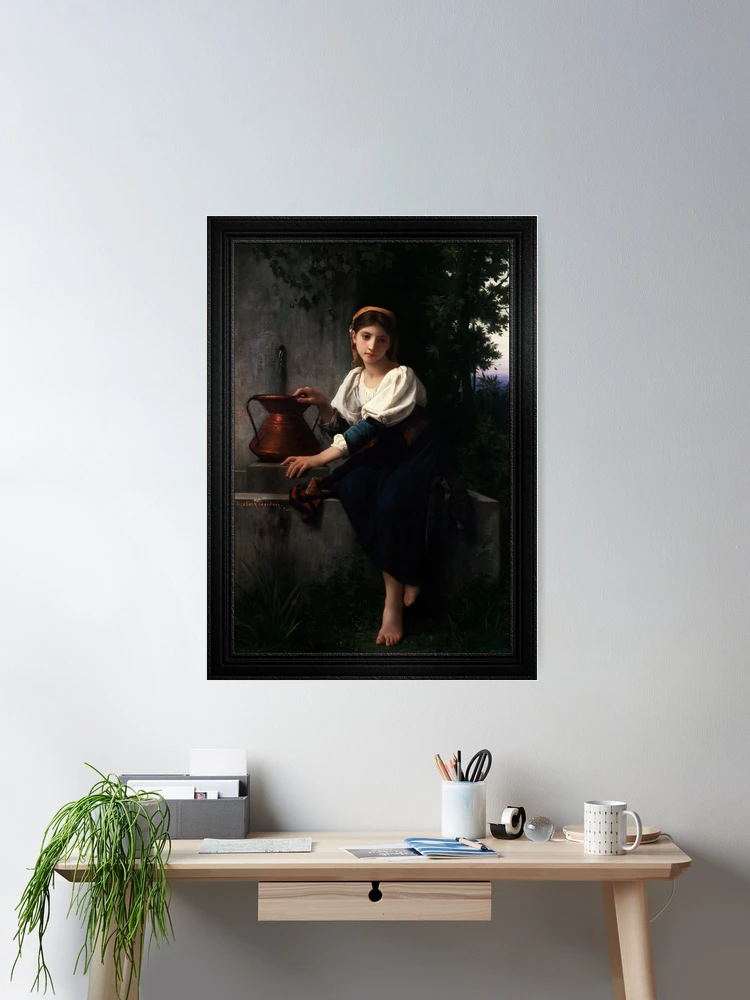
Молодая девушка набирает воду у фонтана
“Young Girl Gathering Water at the Fountain” is a captivating painting created by American artist Elizabeth Jane Gardner Bouguereau in the late 19th century. Gardner, родился в 1837 и скончался в 1922, was a prominent figure in academic realism, and this piece reflects her mastery of the human form, естественный свет, and delicate expression. Set in an idyllic outdoor environment, this artwork captures the moment of a young girl interacting with a fountain, a common subject in 19th-century art that evokes themes of youth, невиновность, и природа.
Оглавление
Тема и состав
The central subject of this painting is a молодая девушка seated next to a fountain. She is delicately positioned on the edge of a stone basin, with one hand resting on the surface of the fountain while the other gently holds a copper water jug. Her posture is relaxed, еще целенаправленно, as if she is caught in the moment between tasks. The girl’s face is tender and serene, conveying an expression of quiet contemplation as she gazes off into the distance. The viewer is drawn to her gentle beauty, which is enhanced by her delicate features, including soft, smooth skin and deep, reflective eyes.
Her attire is typical of the period, featuring a loose white blouse with billowing sleeves, paired with a rich blue skirt. This simple but elegant outfit contrasts with the more intricate details of her accessories. A reddish-brown sash is tied around her waist, and a headscarf, worn in a loose knot, frames her face and adds a touch of rustic charm to her appearance. The fabric of her clothing is painted with exquisite attention to detail, capturing the soft texture of linen and wool. The artist’s precision in rendering the clothing emphasizes her technical skill, a hallmark of Gardner’s realist approach.
The girl’s bare feet are casually positioned on the stone surface, further emphasizing the natural setting and the simplicity of rural life. This focus on unadorned, natural beauty is consistent with Bouguereau’s style, which often celebrated the purity and grace of youth in rural settings.
Объекты и символизм
The objects within the scene play an important role in reinforcing the themes of domestic life, природа, and labor. The fountain itself is a key element of the composition, and its presence suggests the cycle of everyday tasks that the young girl partakes in. Water, an essential resource in rural life, symbolizes life itself. The copper jug she holds is another significant object in the painting. Copper was a common material used for domestic utensils during the time, and the reflection of light on its surface adds depth to the artwork. The jug acts as a subtle metaphor for the girl’s role in the home, as well as her connection to nature and the land.
The fountain is a simple stone structure, with water flowing gently from the spout. The sound of water cascading into the basin could almost be heard from the stillness of the painting. The use of flowing water adds an element of movement to the otherwise peaceful scene. The surrounding environment features lush greenery, with ivy climbing the stone backdrop. The foliage and the light, dappled through the trees, lend the setting a serene and natural feel. The artist’s careful rendering of the plant life in the background conveys a sense of harmony between the young girl and the landscape.
Местность и фон
Местность в “Young Girl Gathering Water at the Fountain” is a picturesque and tranquil rural setting. The backdrop features a stone wall with trailing ivy that suggests a weathered, natural environment. The foliage surrounding the fountain includes rich greens and subtle earth tones, with the detailed rendering of each leaf and vine enhancing the depth of the scene.
На расстоянии, the landscape fades into a soft horizon where the sky meets a distant body of water or a continuation of lush countryside, creating a sense of vastness beyond the scene. The artist uses soft gradients of color in the background to evoke the warmth of sunlight filtering through the trees, casting a gentle glow across the girl’s face and surroundings.
Gardner Bouguereau’s choice of landscape highlights a sense of peace and simplicity, reflecting a rural life untouched by the noise of urban society. Спокойствие, natural setting reinforces the mood of tranquility and timelessness, making the scene feel both intimate and universal. The detailed texture of the stone and the foliage contrasts beautifully with the smoothness of the girl’s skin and the flowing nature of her attire, creating a balance of solidity and fluidity within the painting.
Художественный стиль и техника
As with many of her works, Elizabeth Jane Gardner Bouguereau employed a highly refined and meticulous style in “Young Girl Gathering Water at the Fountain.” Her use of light and shadow is particularly noteworthy, as it serves to model the forms of the figures and create a sense of depth within the composition. The gentle diffusion of light across the girl’s face and clothing enhances the realism of the scene and brings an almost photographic quality to the work.
Gardner Bouguereau was influenced by the academic tradition of French realism, which emphasized the accurate and detailed portrayal of human figures, particularly in outdoor settings. Her mastery of flesh tones and the representation of the human form is on full display in this painting. The careful attention to anatomical detail, such as the subtle play of light across the girl’s face and body, reveals the artist’s technical prowess. Her ability to capture the texture of fabrics and the reflective quality of light on surfaces is one of the defining aspects of her work, and it is especially evident in this painting.
Настроение и тема
The mood of the painting is one of peaceful contemplation, with an undercurrent of nostalgia for a simpler time. The scene evokes a sense of harmony between the figure and the natural world, reinforcing the connection between youth, невиновность, и природа. Девушка, seated at the fountain, represents an archetype of rural life, embodying the purity and grace that were highly regarded in academic realism. The simplicity of her task – gathering water – reflects the importance of domestic chores and the relationship between humans and the land.
The overall theme of the painting is one of timelessness. The young girl and her actions transcend any specific era or place, representing universal values of youth, простота, and the connection to nature. The painting invites the viewer to reflect on the past and on the enduring beauty of rural life.
Заключение
“Young Girl Gathering Water at the Fountain” by Elizabeth Jane Gardner Bouguereau is a masterful example of 19th-century academic realism. Through her technical expertise and her delicate portrayal of the human form, Gardner Bouguereau captures a serene moment in the life of a young girl. Внимание к деталям, the balance of light and shadow, and the harmonious composition all contribute to the timeless beauty of this piece. It serves as both a celebration of youth and nature, as well as a poignant reminder of the simplicity and grace that can be found in the everyday tasks of life.
Это ретушированная цифровая художественная репродукция старых мастеров изображения из общественного достояния..
Биография художника получена из Wikipedia.org
Элизабет Гарднер родилась в Эксетере., Нью-Гемпшир, и посещала женскую академию молодых леди в Эксетере.; а позже посещала женскую семинарию Ласелла в Оберндейле., Массачусетс; изучение искусства и языков по специальности английский язык, французский язык, итальянский и немецкий.
В 1856 она окончила женскую семинарию Ласелла и следующие несколько лет преподавала французский язык в недавно открывшейся школе в Вустере., Массачусетс.
Она также преподавала искусство в женской семинарии Ласелла., И в 1864 вместе со своей подругой и коллегой Имоджен Робинсон (1828 – 1908); американский художник-портретист и исторический художник уехал во Францию., который станет ее новым домом в ближайшие годы.
В первые годы своего пребывания во Франции она училась у художника-фигуратора Хьюга Мерля. (1823 – 1881), Художник салона Жюль Жозеф Лефевр (1836 – 1911) и Вильям-Адольф Бугро (1825 – 1905); за кого она позже выйдет замуж 1896.
В это время, чтобы сводить концы с концами и платить за квартиру, большую часть своего времени она копировала картины современных художников и работы старых мастеров в различных престижных галереях..
Позднее осенью г. 1864 Елизавета решила поступить в школу Ecole des Beaus-Art; но ее заявление было отклонено, поскольку в то время школы были только для мужчин, и запрет на обучение женщин не был снят до тех пор, пока 1897.
Однако это не остановило Элизабет, и она продолжала ходить на частные уроки., замедление создания выдающегося портфолио ее работ.
Самой известной работой Гарднера может быть «Пастух Дэвид-победитель» 1895 года., где изображен молодой пастух с ягненком, которого он спас.
Среди других ее работ были Золушка., Корнелия и ее драгоценности, Коринн, Гадалка, Мод Мюллер, Дафна и Хлоя, Руфь и Наоми, Дочь фермера, Бретонская свадьба, и несколько портретов.