

Young Mother Nursing Her Baby
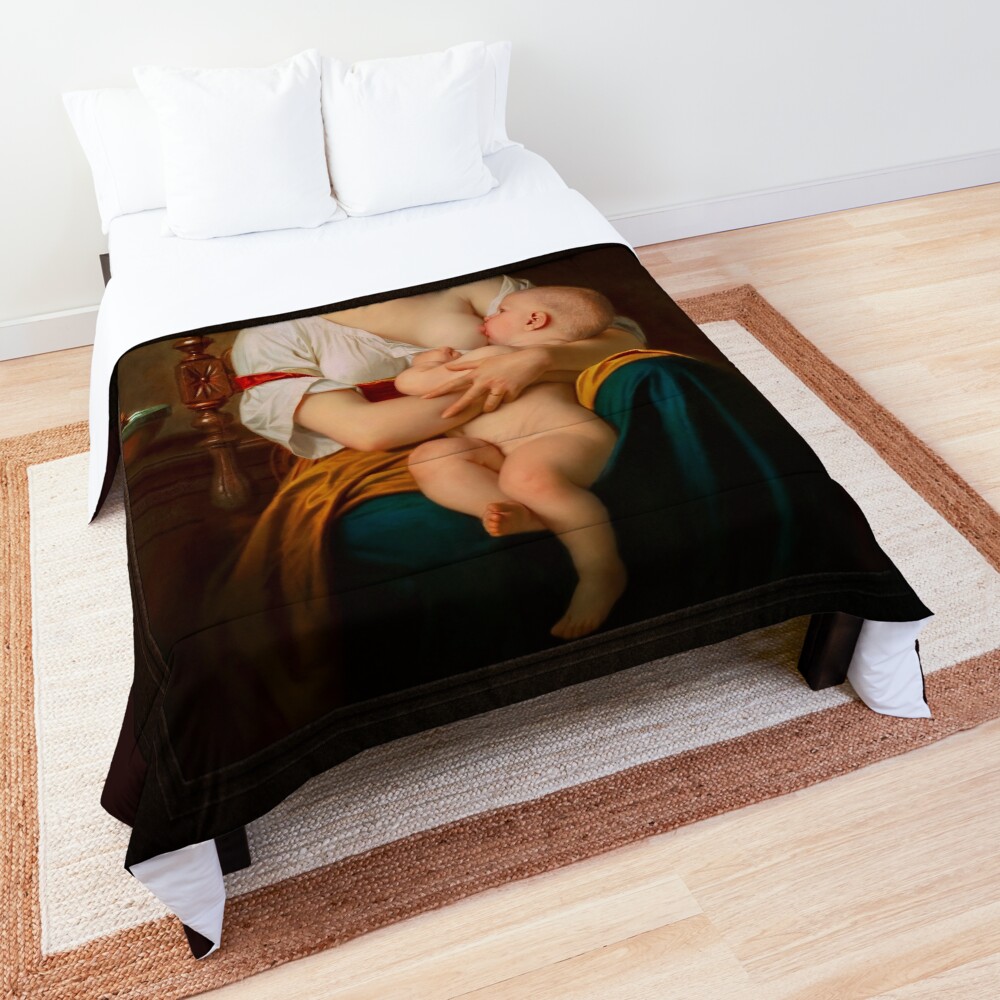
“Young Mother Nursing Her Baby,” pintat a 1865 de l'artista francès Hugues Merle (1822 – 1881), is an exemplary work of genre painting that portrays a deeply intimate and tender moment between a mother and her child. Merle, who was well-regarded for his sensitive and realistic portrayals of human subjects, employs his characteristic naturalism in this painting, capturing both the physical and emotional intimacy of motherhood. L'escena, focused entirely on the mother and child, exemplifies the artist’s ability to evoke a quiet, yet poignant narrative through a simple domestic moment.
Taula de continguts
Tema principal: The Mother and Child
At the heart of this composition is the mother, depicted as a youthful, serene woman, tenderly nursing her infant. Her expression is one of deep affection, marked by a gentle smile as she gazes lovingly at her child, whose eyes remain closed in the bliss of nourishment.
The bond between the two is palpable, captured in the delicate way her hands cradle the child and guide it to her breast. Her slightly bowed head and the softness in her facial expression emphasize the maternal devotion that defines this moment. The child, en fort contrast, is a symbol of vulnerability and innocence, its plump form fully exposed in the close embrace of the mother. This contrast between the mother’s mature serenity and the baby’s trusting vulnerability highlights the theme of motherhood and its sacred, natural role in human life.
The composition exudes tenderness, and Merle’s careful attention to the details of their interaction serves to amplify the emotional resonance of the scene. The warm and harmonious connection between the figures is reinforced by their subtle poses and gestures. The mother’s soft, yet purposeful, embrace of her child suggests both strength and care, while the child, nestled in her arms, radiates a sense of peace and security. The quiet moment depicted here speaks volumes about the human condition—about the timeless and universal bond between mother and child.
La configuració: Fons i Entorn
El fons de la pintura, though not as elaborate as the primary subjects, provides an atmospheric context to the intimate scene. A muted, soft-hued room creates a sense of domestic tranquility, with elements like the faint outlines of furniture and a distant, soft light that suggests the presence of a window, possibly offering a glimpse of natural light. The simplicity of the setting directs the viewer’s attention to the emotional weight of the moment between mother and child, highlighting the universal nature of the act of nursing in any time or place. The soft tones of the room contrast with the rich, more vibrant colors worn by the mother, particularly the luxurious red and green of her attire.
The scene is not bound by any grand historical or geographical reference but instead focuses on an intimate domestic world. The space is not filled with distractions; una mica, it is subdued, allowing the figures of the mother and child to dominate the composition. The sparse but intimate nature of the environment enhances the warmth and the closeness between the subjects.
Materials i Tècnica
Merle’s technique in this painting is indicative of the academic style prevalent in mid-19th-century French art, particularly within the tradition of French realism. His approach to the handling of light and shadow is one of his defining features. The soft but rich lighting in this painting creates a glow around the figures, emphasizing the contours of the mother’s face, the softness of her skin, and the fleshy innocence of the baby’s form. The artist’s use of light not only creates depth but also adds an ethereal quality to the scene, almost as if the figures are glowing with maternal love and warmth.
Les textures de la pintura estan representades amb una atenció notable als detalls. Els plecs de la roba de la mare, la suavitat de la pell del nadó, i el lluentor de llum als seus cabells estan tots pintats amb cura, toc realista. La pinzellada de Merle crea una sensació gairebé tàctil dels materials, des de la suavitat del pit de la mare fins al suau, forma de nadó del nen. Els detalls fins a les cares d'ambdues figures afegeixen el realisme realista de la pintura, fonamentant-lo en el món tangible alhora que transmet la profunditat emocional del moment.
Estil, Tema, i l'estat d'ànim
L'estil de la pintura està arrelat a la tradició naturalista que va dominar l'escena artística acadèmica durant l'època de Merle.. L'artista empra una tècnica molt refinada que reflecteix la precisió i l'atenció acurada a la precisió anatòmica que eren els distintius de la formació acadèmica.. Els temes estan representats de manera realista, amb èmfasi en la bellesa natural i l'autenticitat física. La suavitat i la calidesa de la paleta de colors, amb els seus delicats tons de carn i els seus teixits rics, serveixen per emfatitzar la humanitat i la tendresa de l'escena.
El tema de la pintura se centra al voltant de l'acte íntim i sagrat de la maternitat. Infermeria, tal com es mostra a la pintura, no és només un acte físic sinó també un intercanvi emocional entre mare i fill. La pintura capta no només l'alimentació física que es proporciona, sinó també el vincle emocional i psicològic que es fomenta durant aquest moment.. L'escena encarna temes de cura, vulnerabilitat, nodrir, i la profunda connexió entre una mare i el seu nadó, que transcendeix el temps i les fronteres culturals.
L'estat d'ànim evocat per “Young Mother Nursing Her Baby” és un de pau, tendresa, i devoció. L'espectador està convidat a compartir el moment privat de la maternitat, i a través d'aquest silenci, acte íntim, l'artista parla de l'experiència universal d'amor i cura que defineix la condició humana. Les expressions serenes tant de la mare com del nen, combinat amb la composició suau, transmetre una sensació de calidesa i tranquil·litat, fent que l'espectador se senti com si estigués mirant cap a un sagrat, moment atemporal.
Conclusió
“Young Mother Nursing Her Baby” és un poderós retrat de l'amor matern, capturat a través de les pinzellades refinades i la profunditat emocional característiques de l'obra d'Hugues Merle. El quadre no només serveix com a exemple del realisme acadèmic del segle XIX, sinó que també ofereix una reflexió atemporal sobre l'experiència universal de la maternitat.. A través de la representació d'aquest moment íntim, Merle convida l'espectador a presenciar la profunda connexió entre mare i fill, emfatitzant la bellesa i la puresa d'aquest vincle humà.
Darrere de la parella hi ha una taula de fusta que té un bol de ceràmica verda i marró que descansa a sobre, amb alguna cosa dins.
Young Mother Nursing Her Baby és una reproducció de mestres antics d'art digital retocada d'una imatge de domini públic que està disponible com a Impressió de tela en línia.
Aquesta creació d'art digital, com amb totes les obres d'art que es poden trobar al lloc web de Xzendor7, es poden comprar en línia en una varietat de formats de material, incloses impressions de llenç, impressions acríliques, estampes de metall, estampes de fusta, impressions emmarcades, cartells, i com impressions de llenços enrotllats en una varietat de mides de 12 polzades a 72 polzades depenent de la mida de l'obra d'art real i de la botiga d'impressió sota demanda on trieu comprar l'art.
L'obra d'art també està disponible en una àmplia gamma de roba d'home i dona, tasses, bosses, mocadors, quaderns i revistes i molts productes de decoració de la llar.
Artista Bio
La informació següent es deriva Wikipedia.org i Rehs.com
Hugues Merle va néixer a 1822 a La Zona, França i cap a l'edat de 21 va arribar a París, França, on va estudiar pintura amb el pintor històric i retratista francès Léon Cogniet (1794 – 1880).
Encara que se sap poc dels primers anys d'Hugues, se suposa que va rebre algun grau d'educació artística abans d'arribar a París el 1843; perquè va començar a exposar al Saló de París a 1847 amb la seva peça Retrat de l'autor i en 1848 va exposar la peça Légende des Willis.
Amb el pas del temps, la reputació de Hugues com a retratista va créixer substancialment durant la dècada de 1850; i com a pintor reeixit i destacat va ser capaç d'atreure seriosos amants de l'art que buscaven construir les seves col·leccions d'art..
Un d'aquests primers col·leccionistes d'art va ser el quart marquès de Hertford, Richard Seymour-Conway (1800-1870); que va comprar la seva presentació al saló Reading the Bible in 1859.
Durant la dècada de 1860, La llista de col·leccionistes de clients de Hugues incloïa no només persones del continent europeu, però també col·leccionistes americans, com William Walters de Baltimore que va encarregar The Scarlet Letter.