

Young Woman with Flowers in Her Hair c1734
L'opera d'arte Young Woman with Flowers in Her Hair was created in 1734 by the renowned French painter François Boucher (1703 – 1770). Boucher, celebrated for his role in the Rococo movement, presents in this painting a portrait of youthful beauty and elegance, characteristic of his ability to capture both the grace and sensuality of his subjects. This work is a delicate and refined depiction of a young woman, bathed in soft light and surrounded by elements that evoke a sense of opulence and ease, typical of the Rococo era. The artist’s brushwork, combined with the vivid detail of the subject’s attire and facial features, places the painting firmly within the context of 18th-century French aristocracy and fashion.
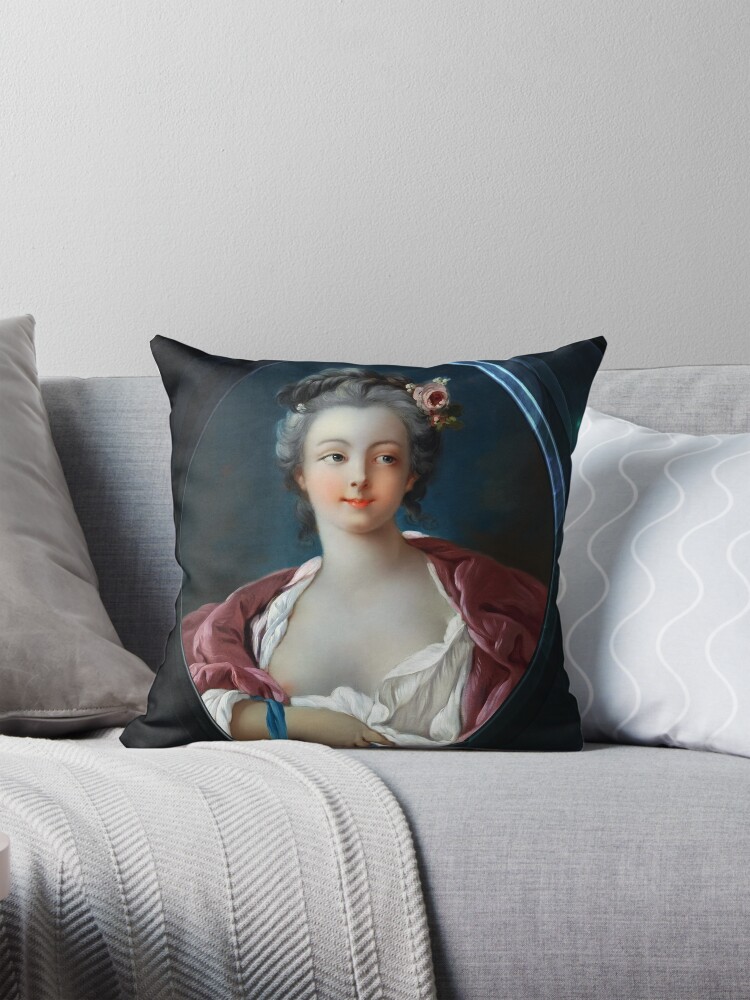
Table of Contents
U sughjettu è a cumpusizioni
In questu ritrattu, Boucher expertly showcases a young woman dressed in a luxurious ensemble of flowing fabrics, with her face framed by soft curls and adorned with flowers. The woman is depicted in an intimate and almost wistful pose, her soft gaze directed slightly off-center, as if lost in contemplation. The simplicity of her pose, with one hand resting gently at her chest, invites the viewer to focus on her delicate features and the grace of her attire. The subtle contrast between the intricate folds of her luxurious robe and the softness of her skin enhances the natural elegance of the subject.
I so capelli, styled in an elaborate updo, is adorned with vibrant roses and delicate blossoms, a signature detail of Boucher’s work that celebrates both the natural world and the beauty of femininity. The arrangement of flowers in her hair, combined with the gentle expression on her face, speaks to the Rococo theme of idealized beauty and sensuality, set within a world of nature and grace.
L'usu di u culore è a luce
Boucher’s use of color in this portrait is notable for its subtlety and richness. The soft pastel hues of her gown, composed of muted pinks, bianchi, and creams, contrast beautifully with the deeper, darker tones of the background. These color choices serve to enhance the subject’s youthful beauty, as her face and attire seem to almost glow against the dark, blurred backdrop. The gentle play of light on her skin and fabric adds depth to the composition, highlighting the textures of her clothing and the soft contours of her face. The muted tones of the background also create a sense of ethereal space, focusing all attention on the subject’s figure and face.
The Rococo Style and Mood
François Boucher’s Young Woman with Flowers in Her Hair encapsulates the defining characteristics of the Rococo style, which flourished in France during the early 18th century. Rococo, marked by its ornate, playful, and often sensual aesthetic, sought to evoke lightness and pleasure, moving away from the more somber tones of the Baroque period. In questa pittura, the delicate treatment of the subject’s features, the flowing, almost billowy fabrics, and the soft color palette all exemplify Rococo’s emphasis on grace and beauty.
The mood of the portrait is one of calm and serenity, with a hint of coquettish charm. The subject’s gentle smile and distant gaze suggest an inner world of thoughtfulness, while her elegant pose exudes both confidence and femininity. The flowers in her hair act as a metaphor for youth and beauty, reinforcing the Rococo fascination with fleeting moments of pleasure and the cultivation of beauty.
Symbolism and Materiality
The young woman’s attire and the surrounding elements in the painting are not only a reflection of her social status but also a symbol of the prevailing tastes of the time. U so vestitu, made of luxurious fabrics such as silk or velvet, is depicted with great attention to texture, emphasizing the wealth and refinement of the subject. The folds and draping of the fabric are painted with precision, showcasing Boucher’s skill in rendering the material as though it were tangible.
The flowers in her hair carry additional meaning, often seen as symbols of youth, bellezza, and transience in 18th-century art. Roses, in particular, have long been associated with love and passion, and their inclusion here suggests a connection between the subject’s outward beauty and the emotions she may evoke. A cumpusizioni generale, with its focus on beauty and sensuality, aligns with the themes of ephemeral pleasure and the celebration of youth that were central to the Rococo movement.
Cunclusione
François Boucher’s Young Woman with Flowers in Her Hair is an exemplary work of Rococo portraiture, capturing the essence of the period through its delicate portrayal of feminine beauty and sensuality. The artist’s ability to blend texture, luce, and color creates an image that not only reflects the fashion and ideals of 18th-century French aristocracy but also invites the viewer into a world of serene grace and elegant charm. Through this painting, Boucher immortalizes the subject’s youth, bellezza, and femininity, while also showcasing the opulent tastes and refined aesthetics of the time.
Young Woman with Flowers in Her Hair is a retouched digital art reproduction of a public domain image.
Biografia di l'artista
Info sottu Derivatu da Wikipedia.org
Nativu di Parigi, Boucher era u figliolu di un pittore pocu cunnisciutu Nicolas Boucher, chì li dete a so prima furmazione artistica. À l'età di diciassette anni, un dipintu di Boucher era ammiratu da u pittore François Lemoyne. Lemoyne dopu hà numinatu Boucher cum'è u so apprendista, ma dopu solu trè mesi, andò à travaglià pè l'incisore Jean-François Cars.
In 1720, vincìu l'élite Grand Prix de Rome per a pittura, ma ùn hà pigliatu l'oppurtunità di studià in Italia finu à cinque anni dopu, per via di prublemi finanziarii à l'Accademia Reale di Pittura è Scultura.[1] Al suo ritorno dai suoi studi in Italia fu ammesso alla rifondata Académie de peinture et de sculpture on 24 Nuvembre 1731. U so pezzu di ricezione (pezza di ricezione) era u so Rinaldu è Armida di 1734.
Boucher sposò Marie-Jeanne Buzeau in 1733. A coppia avia trè figlioli inseme. Boucher hè diventatu un membru di a facultà in 1734 è a so carriera s'accelerà da questu puntu chì hè statu prumuvutu Prufessore dopu Rettore di l'Accademia, diventendu ispettore à a Royal Gobelins Manufactory è infine Premier Peintre du Roi (Primu Pittore di u Re) in 1765. Ritrattu di Marie-Louise O'Murphy c. 1752
Boucher hè mortu 30 Maghju 1770 in a so Parigi natale. U so nome, cù quellu di a so patrona Madame de Pompadour, era diventatu sinonimu di u stilu rococò francese, guidà i fratelli Goncourt à scrive: “Boucher hè unu di quelli omi chì rapprisentanu u gustu di un seculu, qui s'expriment, personificà è incarna.”
Boucher hè famosu per dì chì a natura hè “troppu verde è pocu illuminatu” (troppu verde è mal illuminatu).
Boucher era assuciatu cù l'incisore di pietre preziose Jacques Guay, à qui il a enseigné à dessiner. Il a également encadré le peintre moravo-austriaque Martin Ferdinand Quadal ainsi que le peintre néoclassique Jacques-Louis David en 1767.[4] Più tardi, Boucher hà fattu una serie di disegni di l'opere di Guay chì Madame de Pompadour hà poi incisu è distribuitu cum'è un voluminu bellu rilegatu à i cortigiani favuriti.