

Young Woman with Flowers in Her Hair c1734
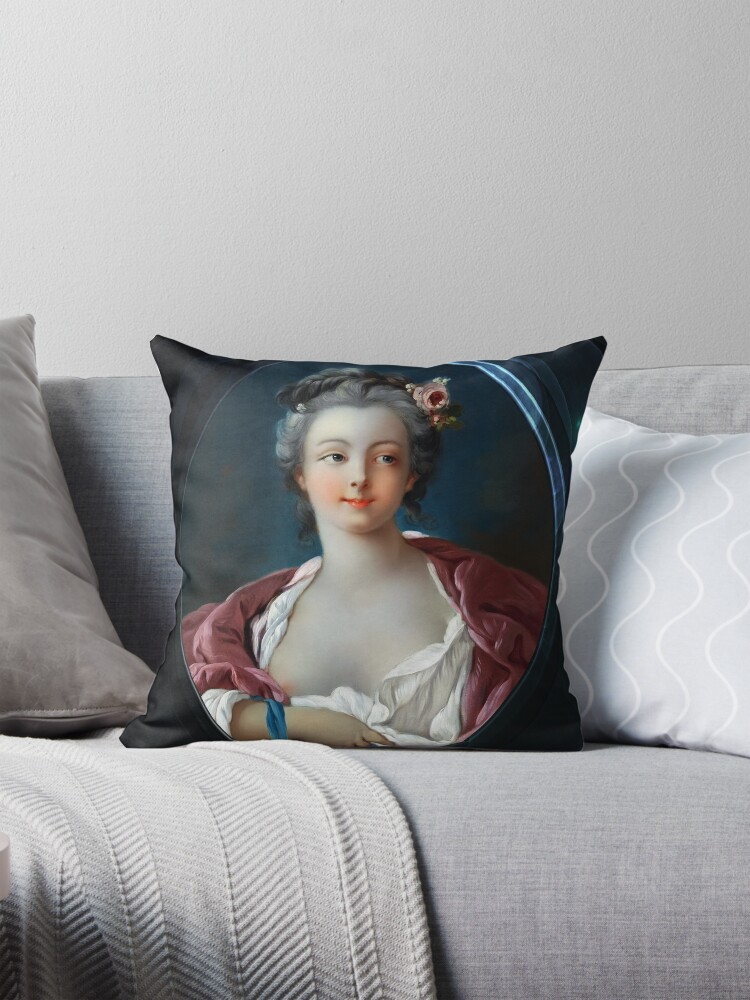
Y gwaith celf Young Woman with Flowers in Her Hair ei greu yn 1734 gan yr arlunydd Ffrengig enwog Francois Boucher (1703 – 1770). Boucher, celebrated for his role in the Rococo movement, presents in this painting a portrait of youthful beauty and elegance, characteristic of his ability to capture both the grace and sensuality of his subjects. This work is a delicate and refined depiction of a young woman, bathed in soft light and surrounded by elements that evoke a sense of opulence and ease, typical of the Rococo era. The artist’s brushwork, combined with the vivid detail of the subject’s attire and facial features, places the painting firmly within the context of 18th-century French aristocracy and fashion.
Tabl Cynnwys
Y Testun a'r Cyfansoddiad
Yn y portread hwn, Boucher expertly showcases a young woman dressed in a luxurious ensemble of flowing fabrics, with her face framed by soft curls and adorned with flowers. The woman is depicted in an intimate and almost wistful pose, her soft gaze directed slightly off-center, as if lost in contemplation. The simplicity of her pose, with one hand resting gently at her chest, invites the viewer to focus on her delicate features and the grace of her attire. The subtle contrast between the intricate folds of her luxurious robe and the softness of her skin enhances the natural elegance of the subject.
Ei gwallt, styled in an elaborate updo, is adorned with vibrant roses and delicate blossoms, a signature detail of Boucher’s work that celebrates both the natural world and the beauty of femininity. The arrangement of flowers in her hair, combined with the gentle expression on her face, speaks to the Rococo theme of idealized beauty and sensuality, set within a world of nature and grace.
The Use of Color and Light
Boucher’s use of color in this portrait is notable for its subtlety and richness. The soft pastel hues of her gown, composed of muted pinks, gwynn, a hufenau, contrast beautifully with the deeper, darker tones of the background. These color choices serve to enhance the subject’s youthful beauty, as her face and attire seem to almost glow against the dark, blurred backdrop. The gentle play of light on her skin and fabric adds depth to the composition, highlighting the textures of her clothing and the soft contours of her face. The muted tones of the background also create a sense of ethereal space, focusing all attention on the subject’s figure and face.
The Rococo Style and Mood
François Boucher’s Young Woman with Flowers in Her Hair encapsulates the defining characteristics of the Rococo style, which flourished in France during the early 18th century. Rococo, marked by its ornate, playful, and often sensual aesthetic, sought to evoke lightness and pleasure, moving away from the more somber tones of the Baroque period. Yn y paentiad hwn, the delicate treatment of the subject’s features, the flowing, almost billowy fabrics, and the soft color palette all exemplify Rococo’s emphasis on grace and beauty.
The mood of the portrait is one of calm and serenity, with a hint of coquettish charm. The subject’s gentle smile and distant gaze suggest an inner world of thoughtfulness, while her elegant pose exudes both confidence and femininity. The flowers in her hair act as a metaphor for youth and beauty, reinforcing the Rococo fascination with fleeting moments of pleasure and the cultivation of beauty.
Symbolism and Materiality
The young woman’s attire and the surrounding elements in the painting are not only a reflection of her social status but also a symbol of the prevailing tastes of the time. Ei gŵn, made of luxurious fabrics such as silk or velvet, is depicted with great attention to texture, emphasizing the wealth and refinement of the subject. The folds and draping of the fabric are painted with precision, showcasing Boucher’s skill in rendering the material as though it were tangible.
The flowers in her hair carry additional meaning, often seen as symbols of youth, harddwch, and transience in 18th-century art. Rhosod, yn arbennig, have long been associated with love and passion, and their inclusion here suggests a connection between the subject’s outward beauty and the emotions she may evoke. The overall composition, with its focus on beauty and sensuality, aligns with the themes of ephemeral pleasure and the celebration of youth that were central to the Rococo movement.
Nghasgliad
François Boucher’s Young Woman with Flowers in Her Hair is an exemplary work of Rococo portraiture, capturing the essence of the period through its delicate portrayal of feminine beauty and sensuality. The artist’s ability to blend texture, golau, and color creates an image that not only reflects the fashion and ideals of 18th-century French aristocracy but also invites the viewer into a world of serene grace and elegant charm. Trwy'r paentiad hwn, Boucher immortalizes the subject’s youth, harddwch, a benyweidd-dra, while also showcasing the opulent tastes and refined aesthetics of the time.
Young Woman with Flowers in Her Hair is a retouched digital art reproduction of a public domain image.
Bio artist
Gwybodaeth Islaw sy'n Deillio o Wikipedia.org
Brodor o Baris, Roedd Boucher yn fab i arlunydd llai adnabyddus Nicolas Boucher, a roddodd ei hyfforddiant artistig cyntaf iddo. Yn ddwy ar bymtheg oed, edmygwyd paentiad gan Boucher gan yr arlunydd François Lemoyne. Yn ddiweddarach, penododd Lemoyne Boucher yn brentis iddo, ond ar ôl dim ond tri mis, aeth i weithio i'r engrafwr Jean-François Cars.
Yn 1720, enillodd y Grand Prix de Rome elitaidd am baentio, ond ni fanteisiodd ar y cyfle canlyniadol i astudio yn yr Eidal tan bum mlynedd yn ddiweddarach, oherwydd problemau ariannol yn yr Academi Frenhinol Peintio a Cherflunio.[1] Ar ôl dychwelyd o astudio yn yr Eidal derbyniwyd ef i'r cerflun Académie de peinture et de newydd ei addurno 24 Tachwedd 1731. Ei ddarn derbyn (darn derbynfa) oedd ei Rinaldo ac Armida o 1734.
Priododd Boucher â Marie-Jeanne Buzeau yn 1733. Roedd gan y cwpl dri o blant gyda'i gilydd. Daeth Boucher yn aelod cyfadran yn 1734 a chyflymodd ei yrfa o'r pwynt hwn wrth iddo gael ei ddyrchafu'n Athro ar y pryd yn Rheithor yr Academi, dod yn arolygydd yn y Royal Gobelins Manufactory ac yn olaf Premier Peintre du Roi (Peintiwr Cyntaf y Brenin) yn 1765. Portread o Marie-Louise O’Murphy c. 1752
Bu farw Boucher ymlaen 30 Mai 1770 yn ei wlad enedigol Paris. Ei enw, ynghyd â rhywun ei noddwr Madame de Pompadour, wedi dod yn gyfystyr ag arddull Rococo Ffrainc, arwain y brodyr Goncourt i ysgrifennu: “Mae Boucher yn un o'r dynion hynny sy'n cynrychioli blas canrif, sy'n mynegi, personoli a'i ymgorffori.”
Mae Boucher yn enwog am ddweud bod natur yn “rhy wyrdd a goleuo'n wael” (rhy wyrdd a goleuo'n wael).
Roedd Boucher yn gysylltiedig â'r engrafwr gemstone Jacques Guay, y dysgodd ei dynnu. Bu hefyd yn mentora'r arlunydd Morafaidd-Awstria Martin Ferdinand Quadal yn ogystal â'r arlunydd neoglasurol Jacques-Louis David yn 1767.[4] Yn ddiweddarach, Gwnaeth Boucher gyfres o luniau o weithiau gan Guay y gwnaeth Madame de Pompadour eu hysgythru a'u dosbarthu fel cyfrol wedi'i rhwymo'n golygus i lyswyr a ffefrir