

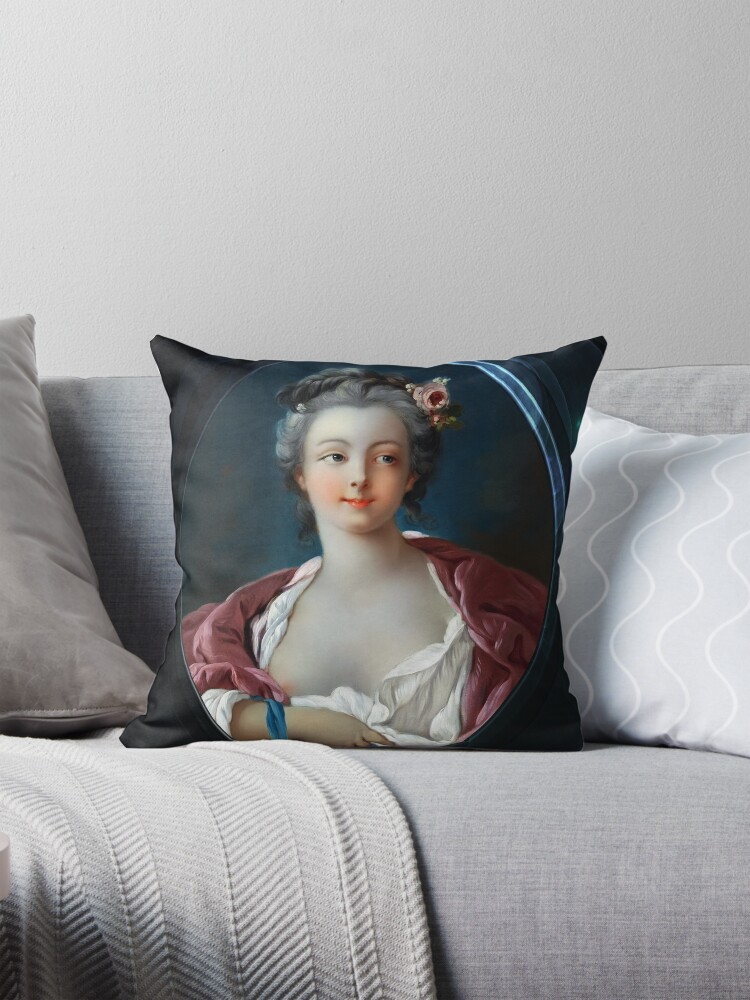
Young Woman with Flowers in Her Hair c1734
Het kunstwerk Jonge vrouw met bloemen in haar haar is ontstaan in 1734 van de bekende Franse schilder Francois Boucher (1703 – 1770). Boucher, celebrated for his role in the Rococo movement, presents in this painting a portrait of youthful beauty and elegance, characteristic of his ability to capture both the grace and sensuality of his subjects. This work is a delicate and refined depiction of a young woman, bathed in soft light and surrounded by elements that evoke a sense of opulence and ease, typical of the Rococo era. The artist’s brushwork, combined with the vivid detail of the subject’s attire and facial features, places the painting firmly within the context of 18th-century French aristocracy and fashion.
Inhoudsopgave
Het onderwerp en de compositie
Op dit portret, Boucher expertly showcases a young woman dressed in a luxurious ensemble of flowing fabrics, with her face framed by soft curls and adorned with flowers. The woman is depicted in an intimate and almost wistful pose, her soft gaze directed slightly off-center, as if lost in contemplation. The simplicity of her pose, with one hand resting gently at her chest, invites the viewer to focus on her delicate features and the grace of her attire. The subtle contrast between the intricate folds of her luxurious robe and the softness of her skin enhances the natural elegance of the subject.
Haar haar, styled in an elaborate updo, is adorned with vibrant roses and delicate blossoms, a signature detail of Boucher’s work that celebrates both the natural world and the beauty of femininity. The arrangement of flowers in her hair, combined with the gentle expression on her face, speaks to the Rococo theme of idealized beauty and sensuality, set within a world of nature and grace.
The Use of Color and Light
Boucher’s use of color in this portrait is notable for its subtlety and richness. The soft pastel hues of her gown, composed of muted pinks, blanken, en crèmes, contrast beautifully with the deeper, darker tones of the background. These color choices serve to enhance the subject’s youthful beauty, as her face and attire seem to almost glow against the dark, blurred backdrop. The gentle play of light on her skin and fabric adds depth to the composition, highlighting the textures of her clothing and the soft contours of her face. The muted tones of the background also create a sense of ethereal space, focusing all attention on the subject’s figure and face.
The Rococo Style and Mood
François Boucher Jonge vrouw met bloemen in haar haar encapsulates the defining characteristics of the Rococo style, which flourished in France during the early 18th century. Rococo, marked by its ornate, playful, and often sensual aesthetic, sought to evoke lightness and pleasure, moving away from the more somber tones of the Baroque period. Op dit schilderij, the delicate treatment of the subject’s features, het stromen, almost billowy fabrics, and the soft color palette all exemplify Rococo’s emphasis on grace and beauty.
The mood of the portrait is one of calm and serenity, with a hint of coquettish charm. The subject’s gentle smile and distant gaze suggest an inner world of thoughtfulness, while her elegant pose exudes both confidence and femininity. The flowers in her hair act as a metaphor for youth and beauty, reinforcing the Rococo fascination with fleeting moments of pleasure and the cultivation of beauty.
Symbolism and Materiality
The young woman’s attire and the surrounding elements in the painting are not only a reflection of her social status but also a symbol of the prevailing tastes of the time. Haar jurk, made of luxurious fabrics such as silk or velvet, is depicted with great attention to texture, emphasizing the wealth and refinement of the subject. The folds and draping of the fabric are painted with precision, showcasing Boucher’s skill in rendering the material as though it were tangible.
The flowers in her hair carry additional meaning, often seen as symbols of youth, schoonheid, and transience in 18th-century art. Rozen, in het bijzonder, have long been associated with love and passion, and their inclusion here suggests a connection between the subject’s outward beauty and the emotions she may evoke. The overall composition, with its focus on beauty and sensuality, aligns with the themes of ephemeral pleasure and the celebration of youth that were central to the Rococo movement.
Conclusie
François Boucher Jonge vrouw met bloemen in haar haar is an exemplary work of Rococo portraiture, capturing the essence of the period through its delicate portrayal of feminine beauty and sensuality. The artist’s ability to blend texture, licht, and color creates an image that not only reflects the fashion and ideals of 18th-century French aristocracy but also invites the viewer into a world of serene grace and elegant charm. Through this painting, Boucher immortalizes the subject’s youth, schoonheid, and femininity, while also showcasing the opulent tastes and refined aesthetics of the time.
Jonge vrouw met bloemen in haar haar is een geretoucheerde digitale kunstreproductie van een afbeelding uit het publieke domein.
Bio -kunstenaar
Info hieronder afgeleid van Wikipedia.org
Een inwoner van Parijs, Boucher was de zoon van een minder bekende schilder Nicolas Boucher, die hem zijn eerste artistieke opleiding gaf. Op de leeftijd van zeventien, een schilderij van Boucher werd bewonderd door de schilder François Lemoyne. Lemoyne benoemde later Boucher als zijn leerling, maar na slechts drie maanden, hij ging werken voor de graveur Jean-François Cars.
In 1720, hij won de elite Grand Prix de Rome voor schilderen, maar maakte pas vijf jaar later gebruik van de daaruit voortvloeiende kans om in Italië te studeren, vanwege financiële problemen bij de Koninklijke Academie voor Schilderkunst en Beeldhouwkunst.[1] Bij zijn terugkeer van zijn studie in Italië werd hij toegelaten tot de opnieuw opgerichte Académie de peinture et de sculpture on 24 november 1731. Zijn receptie stuk (receptie stuk) was zijn Rinaldo en Armida van 1734.
Boucher huwde Marie-Jeanne Buzeau in 1733. Het echtpaar kreeg samen drie kinderen. Boucher werd een faculteitslid in 1734 en zijn carrière versnelde vanaf dit punt toen hij werd gepromoveerd tot hoogleraar en vervolgens tot rector van de Academie, inspecteur worden bij de Royal Gobelins Manufactory en uiteindelijk Premier Peintre du Roi (Eerste schilder van de koning) in 1765. Portret van Marie-Louise O'Murphy c. 1752
Boucher stierf op 30 Kunnen 1770 in zijn geboorteland Parijs. Zijn naam, samen met die van zijn beschermheer Madame de Pompadour, synoniem was geworden met de Franse Rococo-stijl, de gebroeders Goncourt ertoe brengen te schrijven: “Boucher is een van die mannen die de smaak van een eeuw vertegenwoordigen, wie uiten, personifiëren en belichamen.”
Boucher staat erom bekend dat de natuur dat is “te groen en slecht verlicht” (te groen en slecht verlicht).
Boucher werd geassocieerd met de edelsteengraveur Jacques Guay, wie hij leerde tekenen. Hij begeleidde ook de Moravisch-Oostenrijkse schilder Martin Ferdinand Quadal en de neoklassieke schilder Jacques-Louis David in 1767.[4] Later, Boucher maakte een reeks tekeningen van werken van Guay, die Madame de Pompadour vervolgens graveerde en als een mooi gebonden boekdeel verspreidde onder bevoorrechte hovelingen