

Dona jove amb hortènsies
Dona jove amb hortènsies (Dona jove amb hortènsies) de la pintora francesa Élisabeth Sonrel (1874 – 1953); i il·lustrador de l'estil Art Nouveau; les obres de qui inclouen temes al·legòrics, misticisme i simbolisme, retrats i paisatges.
The painting Young Woman with Hydrangeas (c. 1900) by the French artist Elisabeth Sonrel presents a delicate and contemplative scene, one that radiates the essence of late 19th-century European sensibilities and aesthetic charm. Through her thoughtful use of soft, natural tones, gentle lighting, and classical themes, Sonrel offers a portrayal of beauty that captures the spirit of the Belle Époque era, a period marked by its appreciation for nature, feminitat, and delicate elegance.
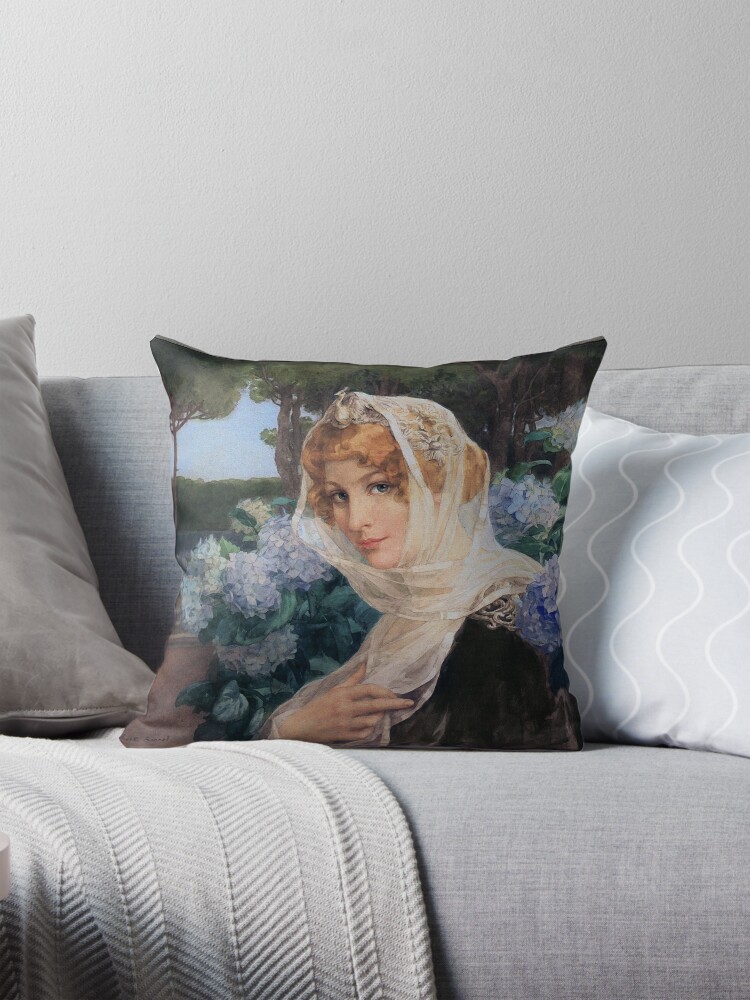
At the heart of this artwork is a dona jove, poised with grace and serenity. She occupies the foreground of the composition, the viewer’s gaze immediately drawn to her as the central figure. The woman’s face is framed by soft, wavy hair that spills gently down her shoulders, with subtle hints of warmth in the light brown and auburn hues.
La seva mirada, though not directed outward, carries an air of introspection, as if she is lost in a private, peaceful reverie. Her eyes are soft and her expression serene, conveying a deep sense of tranquility. This sense of calm is enhanced by her posture; she is seated with one hand delicately holding a cluster of hydrangeas, their intricate, multi-toned petals painted with precision and grace.
The hydrangeas, a symbol of beauty, gràcia, and abundance, are not merely decorative in this piece but rather serve as a reflection of the subject’s character and the mood of the composition. They are rendered with exquisite detail, each flower appearing to bloom under a soft, ambient light.
The colors range from rich, deep purples to soft pinks and blues, creating a vivid contrast with the more muted tones of the young woman’s attire. These flowers seem to breathe life into the portrait, making them an essential component in conveying the overall theme of natural beauty and the fleeting, ephemeral nature of youth and femininity.
The woman’s clothing also plays a key role in the narrative of the painting. El seu vestit, adorned with subtle lace and floral patterns, evokes the restrained elegance typical of the late 19th century. The soft hues of her dress—pale creams and whites—complement the colors of the hydrangeas, creating a harmonious relationship between the figure and her floral surroundings. The fabric of her gown is portrayed with remarkable texture, conveying its delicacy and fine quality.
The drapery falls in soft folds around her body, further enhancing the sense of grace that pervades the entire composition. Her dress, with its refined cut and high collar, suggests a degree of modesty, in keeping with the values of the time, yet the soft detailing allows for an undercurrent of sensuality and softness to emerge.
Darrere del tema, the background provides a serene, natural landscape that enhances the intimate, estat d'ànim pacífic de la pintura. The artist has opted for a slightly blurred and ethereal rendering of the surrounding foliage, with the soft light filtering through the trees and casting a warm, diffused glow over the figure.
The background is not overpowering but serves to frame the young woman in a gentle embrace of nature, suggesting a deep connection between the subject and her environment. The interplay of light and shadow on the leaves and flowers subtly echoes the light touch and serenity that pervades the figure, creating a seamless balance between subject and surroundings.
The artist’s choice to depict the woman against this natural backdrop also suggests a celebration of the harmony between human life and nature. The quietude of the landscape complements the figure’s pensive demeanor, evoking themes of renewal, creixement, and cyclical beauty. El suau, muted greens of the foliage, together with the delicate tones of the hydrangeas, contribute to the painting’s overall sense of stillness and calm.
The palette used in Young Woman with Hydrangeas is another important feature of the artwork. Sonrel’s use of light, pastel tones—pale blues, pinks, verd, and soft yellows—creates an atmosphere of ethereal elegance, lending the scene a dreamlike quality. The composition is bathed in a soft, llum gairebé daurada, lending a sense of timelessness to the scene.
The colors are not bold or jarring but rather gentle and soothing, contributing to a sense of peace and refinement. These soft hues are paired with more subdued, natural colors, creating a perfect balance between warmth and coolness, light and shadow.
Pel que fa a l'estil, Sonrel’s painting reflects the highly refined academic tradition that was popular in France during the late 19th century. Her work demonstrates technical mastery, especially in the detailed rendering of the hydrangeas and the folds of the woman’s gown. El suau, almost luminous quality of the work, achieved through the artist’s nuanced application of paint, demonstrates an intimate knowledge of how to capture light and texture.
There is an emphasis on fine detail, particularly in the treatment of the flowers and the fabric of the woman’s dress, which invites the viewer to appreciate the careful craftsmanship behind the scene. Al mateix temps, the soft blending of colors and the gentle modeling of light create an almost impressionistic atmosphere, with an emphasis on mood rather than strict realism.
The theme of the painting is one of natural beauty, innocència, i la introspecció. The hydrangeas, symbolizing both abundance and the transience of life, are paired with the figure of the young woman, who seems to embody the fleeting nature of youth and beauty. El suau, glowing light and gentle colors emphasize the theme of fragility, reminding the viewer of the ephemeral nature of time and the beauty it bestows. The mood of the painting is calm and contemplative, suggesting a moment of stillness in which the subject is lost in thought or quietly appreciating the beauty of her surroundings.
En conclusió, Young Woman with Hydrangeas by Elisabeth Sonrel is a work that captures the delicate interplay between beauty, natura, and the passage of time. Through her meticulous attention to detail, the artist has created a piece that speaks to the viewer on both an emotional and aesthetic level, evoking a sense of serenity and timelessness that transcends the boundaries of the canvas.
Dona jove amb hortènsies és una reproducció retratada d'art digital de vells mestres d'una imatge de domini públic.
Informació a continuació de Wikipedia.org
Elisabeth Sonrel (1874 Tours - 1953 Segells) va ser un pintor i il·lustrador francès d’estil Art Nouveau. Les seves obres incloïen temes al·legòrics, misticisme i simbolisme, retrats i paisatges.
Era filla de Nicolas Stéphane Sonrel, un pintor de Tours, i va rebre la seva formació primerenca d’ell. Per continuar estudis, va anar a París com a estudiant de Jules Lefebvre a l’Escola de Belles Arts.
En 1892 va pintar el seu treball de diploma, "Pax et Labor", una obra que es podrà veure al Musée des Beaux-Arts de Tours. A partir de llavors va exposar al Salon des Artistes Français entre 1893 i 1941, les seves peces d’autor eren grans aquarel·les de manera prerafaelita, que va adoptar després d'un viatge a Florència i Roma, descobrint els pintors renaixentistes – alguns dels seus treballs tenen clares notes de Botticelli. Les seves pintures sovint s’inspiraven en el romanç artúric, La divina comèdia de Dante Alighieri’ i "La nova vida", temes bíblics, i llegendes medievals. Entre les seves obres místiques destaquen ‘Ames errantes’ (Saló de 1894) i ‘Esperits de l’abisme’ (Saló de 1899) i "Dona jove amb el tapís".
A l 'Exposició Universal de Barcelona 1900, el tema principal del qual era el Modernisme, ella 1895 pintura ‘El son de la Mare de Déu’ (Son de la Verge), va rebre una medalla de bronze, i el premi Henri Lehmann de 3000 francs per l'Acadèmia de Belles Arts.[3] Des de 1900 en endavant, va limitar la seva pintura als retrats, paisatges escènics de Bretanya, i algun que altre estudi de les flors.
Va fer viatges regulars de pintura a Bretanya, inspirat en el bosc de Brocéliande, i de 1910 a diversos llocs de la costa com Concarneau, Plougastel, Pont-l'Abbé i Loctudy, sovint allotjats a fondes i acompanyats d’un o dos estudiants. Va pintar diverses obres a Le Faouët abans de construir una vil·la a La Baule als anys trenta. Treballant principalment en aquarel·la i guaix, va descobrir un subministrament de models entre noies joves de la zona, i va trobar que els bretons eren generalment amistosos, honest i segur de si mateix.
La seva última exposició al saló va ser a 1941 a l'edat de 67. També hi ha constància d’haver exposat a Liverpool. En els seus primers anys, Sonrel va produir pòsters, postals i il·lustracions, d’estil Art Nouveau.