

En Flicka Med Blommor
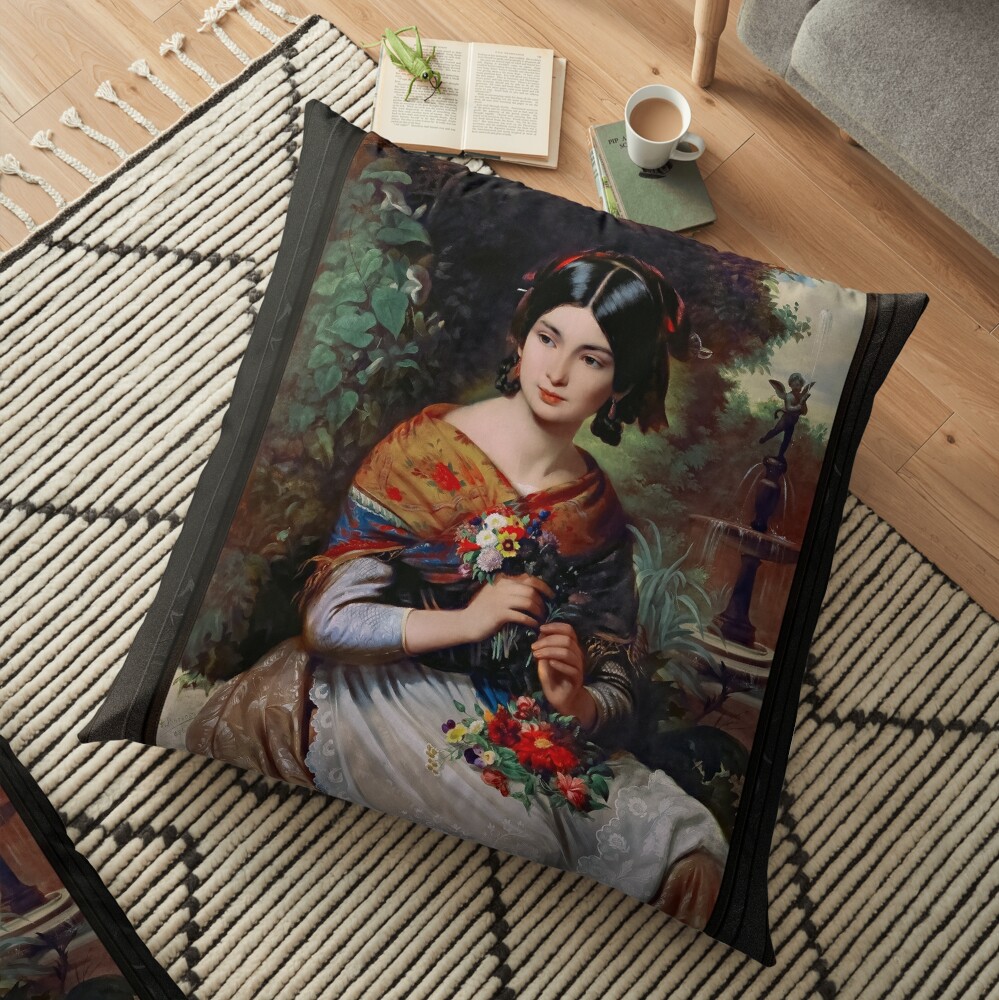
Ungersk målare József Borsos (1821 – 1883) fångar ett tidlöst ögonblick i hans konstverk med titeln “En Flicka Med Blommor,” skapad i mitten av 1800-talet. Målningen, kännetecknande för den tidens romantiska och realistiska rörelser, förkroppsligar en utsökt skildring av kvinnlighet, ungdom, och naturlig skönhet, kännetecknande för Borsos’ arbete. Konstnären balanserar skickligt detaljerad realism med en känslomässigt suggestiv komposition, med hjälp av sin behärskning av oljefärger för att skildra både den känsliga naturen hos hans motiv och den frodiga omgivande miljön. Atmosfären i stycket drar betraktaren in i en lugn, nästan idyllisk värld där motivets stilla grace dominerar scenen.
Innehållsförteckning
Huvudämne: Flickan
The focal point of the composition is a ung flicka, whose poised and graceful demeanor evokes a sense of calmness and natural beauty. She is seated amidst a vibrant garden, her posture elegant yet relaxed, as she gazes gently off to the side. Hennes mörka, smooth hair is styled in a traditional manner with soft curls at the back, highlighting her delicate features. A red ribbon is tied in a bow at the back of her head, further accentuating her youth and femininity.
She holds a small bouquet of colorful wildflowers in her hands, which serves as both a literal and symbolic representation of her connection to nature. Blommorna, carefully arranged in her hands, are a symbol of purity and the fleeting nature of youth. Deras känsliga utseende kontrasterar vackert med de mjuka vecken av flickans klänning och hennes fridfulla uttryck, vilket antyder en känsla av inre frid eller kontemplation. Betraktaren kan nästan känna den subtila brisen som försiktigt kan röra om trädgården runt henne.
Kläder och material
Flickans kläder är renderade med exceptionella detaljer, som speglar modet från det tidiga 1800-talet. Hon bär en vit klänning med spetsöverdrag, som ger en taktil känsla av textur och fint hantverk. Det delikata broderiet på spetsen är särskilt slående, visar upp Borsos noggranna uppmärksamhet på detaljer.
Över hennes klänning, hon bär en färgglad sjal, dess rika apelsintoner, röd, och lila kontrasterar med mjukheten i hennes klänning. Sjalen är prydd med blommönster, som återspeglar trädgårdens naturliga skönhet och förstärker den tematiska enheten i verket. Kombinationen av sjalen och klänningen är både elegant och enkel, en perfekt återspegling av flickans tysta men ändå sofistikerade personlighet.
Konstnären har valt att avbilda tyget i hennes klädsel på ett sätt som framhäver den delikata texturen, med varje veck och draperi noggrant målade. Denna uppmärksamhet på tyg och textur är ett kännetecken för Borsos’ arbete och är ett tecken på hans förmåga att omvandla materialet till en berättande anordning, förhöjer den övergripande stämningen i stycket.
Omgivande miljö: Trädgården
Konstverkets miljö spelar en avgörande roll för stämningen och temat för verket. Bakgrunden är fylld med frodig grönska, depicting a well-maintained garden that speaks to both the prosperity of the subject’s environment and the artist’s detailed rendering of nature. Lång, leafy trees provide the backdrop, medan en liten, distant fountain adds a touch of elegance and tranquility to the scene. The fountain’s gentle flow of water, although subtle in the painting, introduces an element of movement that contrasts with the stillness of the girl, perhaps symbolizing the passage of time or the cyclical nature of life.
I fjärran, a small statue of an angel or cherub stands atop the fountain, adding a classical touch to the composition. This element further enriches the work, linking the natural world to a more idealized, almost mythological realm. The fountain, along with the greenery and flowers in the foreground, creates a harmonious balance between the human and natural worlds, reinforcing the central theme of beauty and grace in its purest form.
Konstnärlig stil: Romantik och realism
Borsos’ style merges elements of both Romanticism and Realism, with a focus on idealized beauty and meticulous attention to detail. His brushwork is soft yet defined, with fine details that bring the scene to life, such as the delicate petals of the flowers and the texture of the fabric. The romantic elements are evident in the serene expression of the girl and the dreamlike quality of the surrounding garden. There is an almost timeless aspect to the painting, as though it could belong to any era of history, yet it firmly captures the spirit of the 19th century.
The use of light and shadow is also notable in this piece. Borsos employs a gentle, diffused light that highlights the girl’s features and creates soft, ambient shadows that add depth to the composition. The painting’s color palette is warm, dominated by earthy tones of green, brun, and gold, which give the work a grounded, naturalistic feel, while still maintaining an air of elegance.
Humör och känslomässig ton
The emotional tone of the painting is one of calm introspection. The girl’s serene expression and poised posture invite the viewer to share in a quiet moment of contemplation. The lush surroundings, coupled with the subtle, natural details, evoke a feeling of peace and harmony. Det finns en känsla av tidlöshet i scenen, as though the girl’s moment of stillness is not bound by any specific era but instead exists in a timeless, idealized world.
The theme of beauty—both human and natural—is central to the emotional impact of the piece. The artist’s careful rendering of both the girl’s delicate features and the vibrant flowers speaks to a deep appreciation of nature’s grace and the fleeting, ephemeral quality of life. There is a sense that this moment of beauty, while fleeting, is meant to be savored and admired.
Slutsats
“En Flicka Med Blommor” by József Borsos is a beautiful example of 19th-century Hungarian painting that blends the romance of nature with the realism of everyday life. Genom sin noggranna uppmärksamhet på detaljer, the artist creates a scene that is both grounded in reality and elevated by idealized beauty. The girl’s serene presence, combined with the lush garden and the subtle symbolism of the flowers, invites the viewer to contemplate the quiet beauty of life and the natural world.
Detta är en remastrad digital konst-gamla mästare-reproduktion av en offentlig egendomsbild som är tillgänglig som en canvastryck uppkopplad.
Artist Bio härledd från Wikipedia.org
József came from a well to do family as his father was Márton Borsos an editor, lawyer and publisher and at the age of 16 he became a student of Hungarian Painter József Károly Schöfft (1776 – 1851); in Budapest Hungary.
Sedan i 1840 he moved to Vienna to study at the Academy of Fine Arts under Austrian Painter Leopold Kupelwieser (1796 – 1862) who was often associated with the Nazarene movement.
Sedan tre år senare 1843 he entered a private academy that was operated by Austrian Painter and Writer Ferdinand Georg Waldmüller (1793 – 1865), considered to be one of the most important painters of the Biedermeier period which lasted from 1815 till 1848.
Though his artistic talent made him financially successful, he lost most of his money in stock market speculation; varefter han slutade måla och öppnade en fotostudio med en målare och fotograf känd som doktor Albert; och även om han gjorde en övervägande förmögenhet i strävan, han gav upp verksamheten och öppnade en restaurang Szép Juhászné; som han drev resten av sitt liv.