

A Storm on a Mediterranean Coast
A Storm on a Mediterranean Coast c1767 by French Painter Claude Joseph Vernet (1714 – 1789); kendt for at male, tegning og gravering i neoklassisk stil.
In this dramatic scene of a Mediterranean storm, Vernet has captured the harrowing moments of a group of shipwreck survivors who have managed to pull themselves onto the shore as their life boat is being pulled apart by the rough seas; and while a few watch on from a cliff as their ship is listing to the left and ready to go into a watery grave.
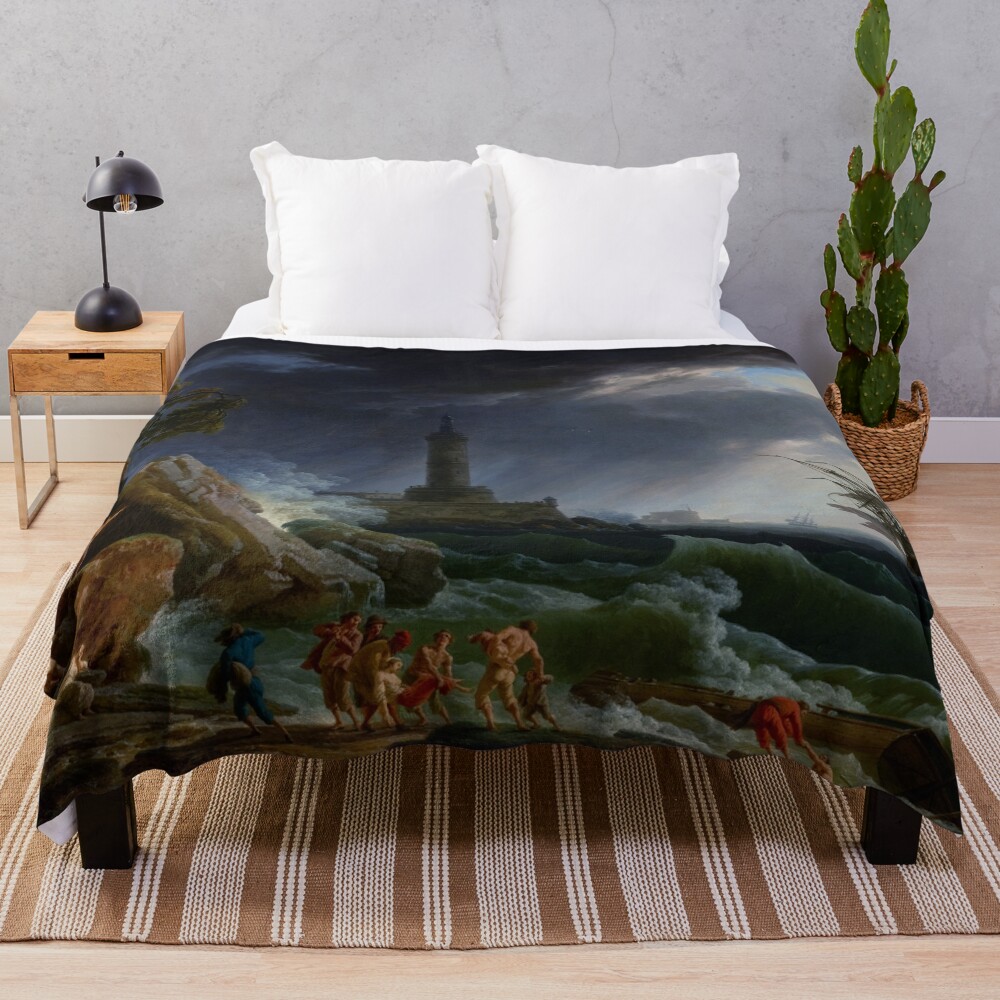
A Storm on a Mediterranean Coast is a retouched digital art reproduction of a public domain image that is available online as a lærred print online.
Info nedenfor stammer fra Wikipedia.org
Vernet was born in Avignon, and at the age of fourteen helped his father, Antoine Vernet (1689 – 1753), who was a skilled decorative painter, in the most important parts of his work.
I 1734, Vernet rejste til Rom for at studere landskabsdesignere og maritime malere, som fransk barokmaler, Tegner og etser Claude Gellee også kendt som Claude Lorrain (1600 – 1682); hvor mange af Vernets stykker minder om Lorrains arbejde.
I tyve år boede Vernet i Rom, og produceret udsigt over havne, storme, beroliger, måneskin, og store hvaler; bliver især populær blandt engelske aristokrater, hvoraf mange var på Grand Tour (en skik fra det 17. og 18. århundrede af en traditionel rejse gennem Europa, which was undertaken by upper-class young European men (about 21 års alder) of sufficient means and rank usually accompanied by a chaperone).
I 1753 Vernet was recalled to Paris; Og mens der er, by royal command, he executed the series of the seaports of France by which he is best known. I 1757, he painted a series of four paintings titled Four Times of the Day depicting, not surprisingly, four times of the day.
With a certain conventionality in design, proper to his day, Vernet allied the results of constant and honest observation of natural effects of atmosphere, which he rendered with unusual pictorial artistry.
Perhaps no painter of landscapes or sea-pieces has ever made the human figure so completely a part of the scene depicted or so important a factor in his design. In this respect he was heavily influenced by Giovanni Paolo Panini, whom he probably met and worked with in Rome.
Vernet’s work draws on natural themes, but in a way that is neither sentimental or emotive; as the overall effect of his style is wholly decorative. “Others may know better”, he said, with just pride, “how to paint the sky, the earth, the ocean; ingen ved bedre end jeg, hvordan man tegner et billede”.