

Allegorical Figure of Music
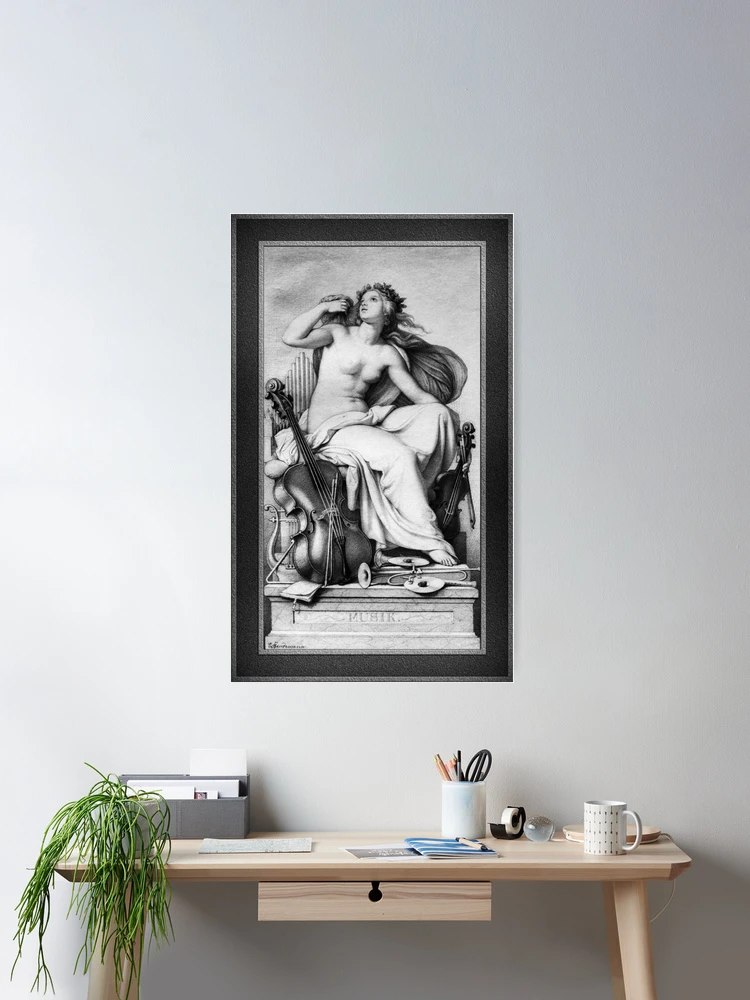
Eduard Julius Friedrich Bendemann’s 19th-century klassisch Meisterwerk, “Allegorical Figure of Music,” serves as a striking visual representation of music’s transcendent and powerful nature. Created by the German artist Eduard Julius Friedrich Bendemann, geboren in 1811 und vorbei 1889, this artwork conveys the allegorical relationship between music and human expression through meticulous craftsmanship and symbolism. In this powerful rendering, Bendemann intertwines elements of classical beauty, the human form, and musical instruments to bring forth an emotive and awe-inspiring depiction of music’s divine essence.
Inhaltsverzeichnis
Gegenstand des Kunstwerks
Die zentrale Figur in “Allegorical Figure of Music” is a graceful female figure, seated in a position that suggests both contemplative repose and quiet strength. The figure is portrayed in a semi-reclined posture, leaning slightly to one side, which draws the viewer’s attention to her commanding yet serene presence. She is captured without clothing from the waist up, which emphasizes the purity and universality of the allegorical theme. The delicate yet confident expression on her face, coupled with her gentle yet deliberate hand gesture, invites the viewer to contemplate the intangible force of music she personifies. Her facial features are rendered with great sensitivity, reflecting the classical ideals of beauty that were so highly regarded during the 19th century.
The figure’s crown of laurel leaves further reinforces her role as a symbol of divine inspiration, ähnlich wie in der Antike traditionell Musiker und Dichter geehrt wurden. Das fließende Haar, mitten in der Bewegung gefangen, erinnert an die dynamische Natur der Musik selbst, Dies deutet darauf hin, dass es sich sowohl um eine stille als auch um eine aktive Kraft handelt, die wie der Wind frei fließen kann.
Objects and Instruments
Die auffälligsten Objekte rund um die allegorische Figur sind die verschiedenen Musikinstrumente, die um sie herum verstreut sind. Die zentralen Instrumente, eine Geige und eine Flöte, sind in der Nähe ihrer Füße positioniert, während zusätzliche musikalische Elemente, wie Becken, ein Horn, und eine Oboe, werden subtil in die Komposition eingefügt. Diese Instrumente sind nicht nur Nebensache, aber sorgfältig ausgewählt, um die Vielfalt und Breite der Musik als Kunstform darzustellen. Sie sind Teil einer visuellen Symphonie, die die überlebensgroße Symbolik der Figur ergänzt.
Die Geige, insbesondere, ist ein herausragendes Instrument im Gemälde, lying close to the figure’s form and perhaps symbolizing the emotional depth and complexity of music. The flute, known for its ethereal and delicate sound, reinforces the more sublime and transcendent nature of music. In der Zwischenzeit, the scattered cymbals, horn, and oboe add a sense of balance to the scene, suggesting that music encompasses a wide range of emotional tones, from the delicate to the powerful, and from the introspective to the grandiose.
The strategic placement of these instruments around the figure highlights their connection to her, implying that she is not merely a passive representation of music but rather an active force that channels and gives shape to these instruments. Through this thoughtful arrangement, Bendemann porträtiert Musik als eine Einheit, die in einer harmonischen Beziehung sowohl zum Künstler als auch zum Publikum steht.
Gelände und Hintergrund
Der Hintergrund des Kunstwerks ist spärlich detailliert, Dies dient dazu, die Aufmerksamkeit auf die Figur und die Instrumente zu lenken. In der oberen linken Ecke, Schwache architektonische Elemente deuten auf eine klassische oder tempelartige Struktur hin, erinnert an das antike Griechenland und Rom, die historisch als Ursprung sowohl der Musik als auch der Künste angesehen wurden. Die Säulen, die den Körper der Figur zu umrahmen scheinen, verstärken das klassische Motiv noch weiter und verweisen auf die Zeitlosigkeit der Musik. Diese Wahl des Minimalismus in der Umgebung unterstreicht die Vorstellung, dass die Essenz der Musik irdische Grenzen überschreitet und ohne einen bestimmten geografischen Kontext existieren kann.
Bendemann’s use of shading and contrast brings depth to the scene, with light falling softly across the figure’s body and the surrounding objects. This creates a chiaroscuro effect that enhances the overall sense of depth and dimensionality. The careful attention to light and shadow also contributes to the mood of the piece, imbuing the figure with a sense of divine otherworldliness. Her form is bathed in a soft glow, highlighting her as an exalted, almost ethereal figure who embodies the very spirit of music.
Stil und Stimmung
Bendemann’s work is deeply rooted in the classical tradition, both in its reverence for ancient ideals and in its technical execution. Die sorgfältige Wiedergabe der menschlichen Form und die sanfte Mischung von Licht und Schatten spiegeln die akademische Ausbildung des Künstlers und sein Engagement für den klassischen Realismus wider. Der emotionale Ton des Stückes, jedoch, geht über die bloße technische Kompetenz hinaus. Die allegorische Figur, umgeben von Musikinstrumenten, vermittelt ein tiefes Gefühl von Harmonie und Ausgeglichenheit, sowohl in der Komposition selbst als auch in der umfassenderen Botschaft, die sie über die Rolle der Musik in der menschlichen Erfahrung vermittelt.
Die Stimmung des Gemäldes ist von Ehrfurcht und Selbstbeobachtung geprägt. Haltung und Ausdruck der Figur suggerieren eine innere Ruhe, dennoch ist ihre Präsenz beeindruckend, als wäre sie nicht nur eine Muse, sondern auch eine aktive Kraft. This sense of calm is counterbalanced by the dynamic quality of the flowing hair and the positioning of the musical instruments, which imbue the scene with energy and motion. Zusammen, these elements create a mood of divine tranquility fused with creative potential.
The work’s classical composition and serene tone encourage viewers to reflect on the timeless role of music in culture and the arts. The artist’s use of symbolism invites an exploration of music as both a divine gift and a human expression of emotion, Wissen, und Transzendenz.
Abschluss
“Allegorical Figure of Music” by Eduard Julius Friedrich Bendemann captures the essence of music as a timeless, transcendent force. Through its careful depiction of a central allegorical figure, surrounded by musical instruments and framed by architectural elements, Das Gemälde vermittelt sowohl die emotionale Tiefe als auch die göttliche Inspiration, die Musik verkörpert. Die Beherrschung klassischer Techniken durch den Künstler, kombiniert mit der durchdachten Komposition, ruft eine Stimmung gelassener Kontemplation und Ehrfurcht vor der Kunstform hervor. Dieses Meisterwerk, Sinnbild der romantischen und klassischen Traditionen, kommt beim Publikum weiterhin gut an, Erinnert uns an die anhaltende Kraft und Schönheit der Musik.
Die allegorische Figur der Musik ist eine retuschierte digitale Kunstreproduktion alter Meister eines gemeinfreien Bildes.
Info unten abgeleitet von Wikipedia.org
Eduard wurde in Berlin geboren, Deutschland im Dezember 3, 1811 an Anton Heinrich Bendemann, einen jüdischen Bankier, und Fanny Eleonore Bendemann, geborene von Halle; Tochter des jüdischen Bankiers Joel Samuel von Halle.
Schon in jungen Jahren zeigte Eduard eine Begabung für die Kunst, and even though at the time sons generally pursued studies and occupations similar or related to their fathers, he was allowed to study art and was enrolled in the art school of German Painter Wilhelm von Schadow (1789 – 1862), located in Düsseldorf, Deutschland.
Im 1828 im Alter von 17, he attracted some attention with a painting he did of his grandmother; und in 1830 went on a school trip to Italy, where he would remain for a year and would work in a series of paintings jobs; with people taking notice of his 1832 painting The Jews Mourning in Exile; which was featured in the Berlin art exhibition.
In that same year he also created The Two Girls at the Well and followed that up with Jeremiah amid the Ruins of Jerusalem; and for this piece received a medal in Paris, Frankreich in 1837, with his best known work being The Harvest.
Im 1838 Eduard was appointed professor of the Dresden Academy of Fine Arts (gegründet in 1764); and was commissioned to decorate the three halls of the Dresden Royal Palace with wall paintings; which included the throne room, the tower room, and the tower hall.
This massive undertaking would occupy most of his time for the next 15 year; dann von 1859 zu 1867 he was the director of the Düsseldorf Academy.