

Ariadne Engraving
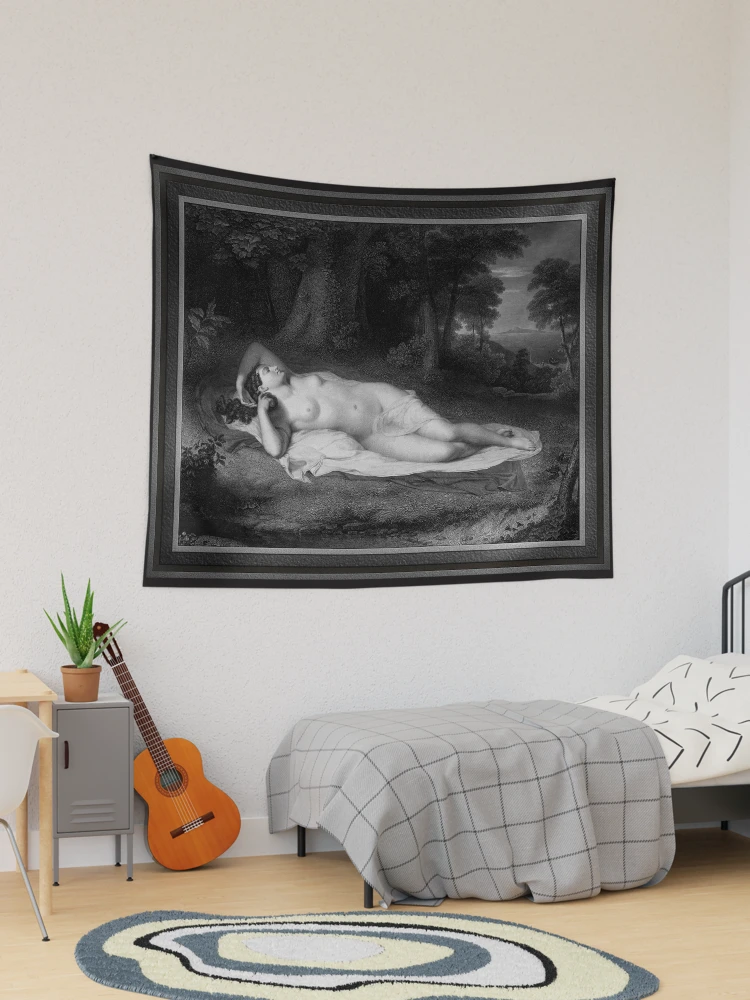
Ariadne Engraving c1835 by American Painter & Graveur Asher Brown Durand (1796 – 1886) war Teil der Romanticism Art Movement und war Absolvent der Hudson River School. Ashers Hauptaugenmerk lag auf Landschaftsbildern.
Überblick
The Ariadne engraving by Asher is from a copy of a painting he made from an original painting by John Vanderlyn (1776 – 1852). Ariadne is the Cretan Princess who was briefly loved by Theseus (der mythische König und Gründerheld von Athen), who abandoned her on the island of Naxos.
“Ariadne” is an exquisite engraving created by Asher Brown Durand, one of the prominent American artists and engravers of the 19th century. Dieses Kunstwerk, completed circa 1835, is a masterful interpretation of classical themes in the Neoclassical style.
The subject of this engraving, Ariadne, is a figure from Greek mythology, whose image has been captured through Durand’s engraving with remarkable sensitivity and depth. The mood and narrative conveyed in this piece are deeply entwined with the themes of abandonment, Einsamkeit, und Sehnsucht, presenting Ariadne as a symbol of romantic melancholy.
Inhaltsverzeichnis
Das Thema und die Komposition
At the heart of the composition lies Ariadne, the central figure who is often depicted in ancient myths as the abandoned lover of Theseus. Durand has rendered her lying on the ground, draped in soft, flowing cloths that seem to merge with the natural world around her.
Her posture suggests a sense of relaxation or even resignation, with one arm resting behind her head, while the other lies gracefully on her torso. Ihr Gesicht, serene yet distant, looks toward the horizon as though lost in thought or perhaps anticipating the return of her lover, a theme which resonates with the classical myths of lost love and abandonment.
The depiction of Ariadne in this engraving speaks volumes about Durand’s understanding of the human form, especially in the rendering of the female body. The curves of her limbs, the delicate folding of the fabric, and the naturalistic contours of her face all contribute to the timeless beauty and vulnerability of the figure. Durand’s use of shading and fine details in the engraving enhances the texture of the flesh and the fabric, lending a sense of life to the image despite its static nature.
The Setting and Environment
The background and setting of the engraving contribute significantly to its thematic weight. Ariadne is positioned in a lush, idyllic natural setting—likely an open glade or secluded forest. The terrain, gently sloping and dotted with trees, provides a soft contrast to the hard, chiseled forms of the figure.
A distant view of rolling hills and a river suggest a harmonious integration of human and natural elements. The setting appears to be at the cusp of day and night, as a hazy light filters through the trees, subtly illuminating Ariadne’s form while casting the landscape in a soft, dreamlike glow.
The artist skillfully renders the trees and foliage with intricate lines, ein Gefühl von Tiefe und Dimension erzeugen. The distant hills add a sense of scale to the composition, further enhancing the naturalistic style that Durand excelled at. The fine linework and delicate shading are characteristic of the engraving medium, a technique that requires patience and precision, both of which Durand applied expertly to bring the landscape into harmonious balance with the figure of Ariadne.
The Medium: Engraving
As an engraving, this piece is executed with meticulous attention to detail. Durand, known for his skill in this medium, uses sharp, clear lines and intricate crosshatching to achieve a wide range of tonal values. The engraving’s fine lines lend it a delicate quality, but the use of contrast and shadow provides a deep, almost three-dimensional sense of volume. Durand’s technique is particularly adept at capturing textures, from the softness of Ariadne’s skin to the rough bark of the trees surrounding her.
The use of engraving as a medium also reflects Durand’s engagement with the tradition of classical art and his desire to produce works that could be widely disseminated, popularizing such mythological themes among American and European audiences. Engraving, being more accessible than original paintings, allowed for greater distribution of this image, making it not only an artistic achievement but also a vehicle for promoting classical ideals.
Themes and Symbolism
The figure of Ariadne in this engraving embodies themes of isolation, abandonment, und der Lauf der Zeit. In Greek mythology, Ariadne helps Theseus escape the Labyrinth, only to be later abandoned by him on the island of Naxos. This image captures her at a moment of quiet reflection, perhaps contemplating her fate or lost love.
The serene expression on her face juxtaposes with the emotional turmoil that her myth entails. The soft folds of her drapery and the calm surroundings may symbolize a fleeting moment of peace before the inevitable sorrow that comes with being left alone.
zusätzlich, the natural setting of the piece complements these themes. The trees and foliage suggest a timeless, unchanging world, while Ariadne’s figure contrasts with this permanence, hinting at the transient nature of human life and emotion. Her presence in such a setting evokes the tension between humanity and nature, a theme that is deeply ingrained in classical art and literature.
Stimmung und Atmosphäre
Die Stimmung von “Ariadne” is deeply melancholic. Durand has chosen to portray the moment of Ariadne’s solitude after her abandonment, and the peaceful yet somber expression on her face enhances this emotional atmosphere. The engraving’s lighting, with its soft contrast between light and shadow, imbues the piece with a quiet, Fast ätherische Qualität. The trees in the background create a feeling of shelter, yet their distance and the softness of their outlines evoke a sense of isolation, reinforcing the emotional undercurrent of the narrative.
While the scene is bathed in the calm of nature, there is an undercurrent of sadness that is palpable. The solitude of the figure, combined with the longing gaze and the distant landscape, creates an atmosphere that is both tender and tragic. It speaks to the human experience of abandonment and the quiet resignation that often accompanies it.
Abschluss
Asher Brown Durand’s “Ariadne” stands as a fine example of 19th-century American engraving and a representation of classical themes through a Neoclassical lens. The serene yet poignant depiction of Ariadne, set against a natural backdrop, invites the viewer to contemplate the fragility of human emotion, the passage of time, and the isolation that often accompanies love and loss. The technical mastery and emotional depth of this work, combined with the delicate interplay of light and shadow, make it a timeless piece of art.
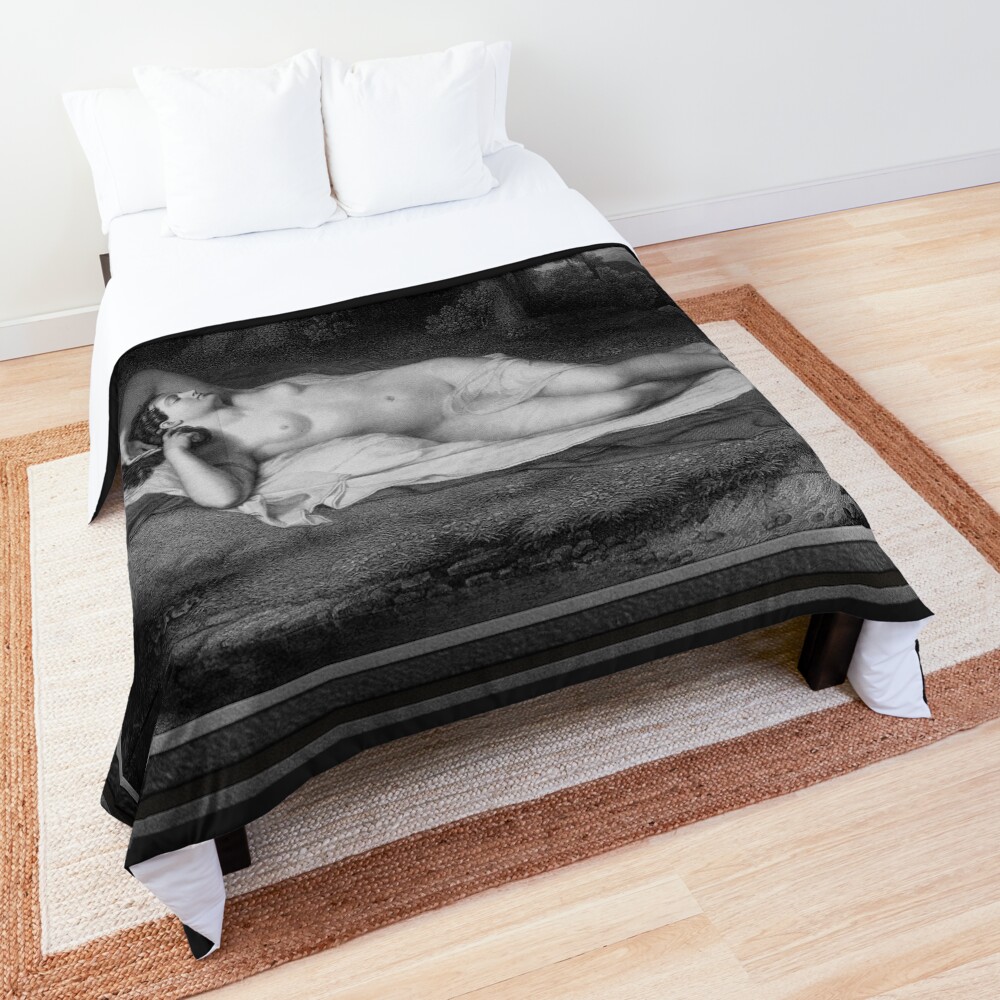
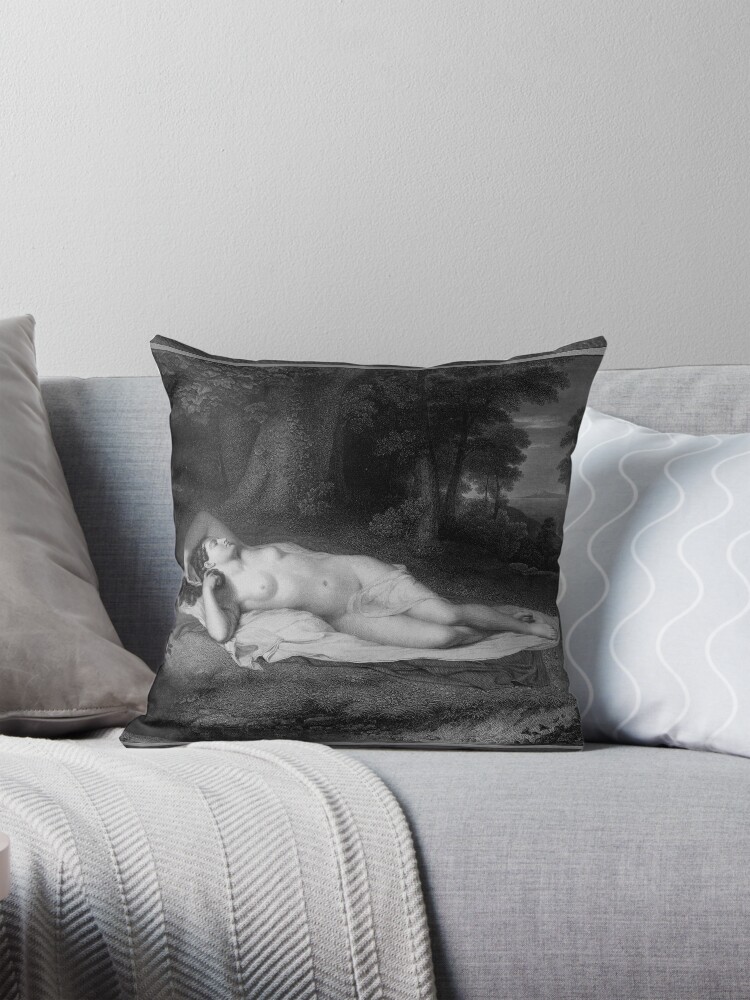
Ariadne Engraving depicts Ariadne laying down in the forest, auf einem Bündel Kleidungsstücke, das teilweise nackt an einem Bach liegt, mit ihrem linken Arm über ihrem Kopf und ihrer rechten Hand, die ihr Haar greift, das auf ihrem Nacken ruht.
In the background of the Ariadne Engraving past the trees and the hill she is resting on, we can see a boat on the bank of a lake, and in the far distance we can see what appears to be a large island.
This Ariadne Engraving is a retouched digital art old masters reproduction of a public domain image.
Info unten von Wikipedia.org
Durand wurde in Maplewood geboren und starb schließlich in Maplewood, New Jersey (dann Jefferson Village genannt). Er war das achte von elf Kindern. Durands Vater war Uhrmacher und Silberschmied.
Durand machte eine Lehre bei einem Graveur von 1812 zu 1817 und ging später eine Partnerschaft mit dem Eigentümer des Unternehmens ein, Charles Cushing Wright (1796–1854), der ihn bat, das New Yorker Büro des Unternehmens zu leiten.
Er gravierte die Unabhängigkeitserklärung für John Trumbull während 1823, was Durands Ruf als einer der besten Graveure des Landes begründete.
Durand half bei der Organisation der New York Drawing Association während 1825, aus der die National Academy of Design werden sollte; er würde der Organisation als Präsident dienen von 1845 zu 1861.
Ashers Gravuren auf Banknoten wurden als Porträts für Amerikas erste Briefmarken verwendet, das 1847 Serie. Zusammen mit seinem Bruder Cyrus gravierte er auch einige der Nachfolge 1851 Themen.
Sein Hauptinteresse wechselte vom Kupferstich zum Ölgemälde über 1830 mit der Ermutigung seines Gönners, Luman Reed. Während 1837, er begleitete seinen Freund Thomas Cole auf einer Skizzierexpedition zum Schroon Lake in den Adirondacks Mountains und begann sich bald darauf auf die Landschaftsmalerei zu konzentrieren.
Er verbrachte den Sommer damit, in den Catskills zu skizzieren, Adirondack, und die White Mountains von New Hampshire, Hunderte von Zeichnungen und Ölskizzen anfertigen, die später in fertige Akademiestücke eingearbeitet wurden, die dazu beitrugen, die Hudson River School zu definieren.
Durand ist vor allem für seine detaillierten Baumdarstellungen in Erinnerung geblieben, Felsen, und Laub. Er war ein Befürworter dafür, mit so viel Realismus wie möglich direkt aus der Natur zu zeichnen. Durand hat geschrieben, “Lassen [der Künstler] akzeptiere gewissenhaft was auch immer [Natur] präsentiert ihn, bis er, in einem grad, sind mit ihrer Unendlichkeit vertraut geworden ... lass ihn niemals ihre Heiligkeit entweihen durch eine absichtliche Abweichung von der Wahrheit.”
Wie andere Künstler der Hudson River School, Durand glaubte auch, dass die Natur eine unbeschreibliche Manifestation Gottes ist. Dieses Gefühl und seine allgemeinen Meinungen zur Kunst drückte er in seinem Essay aus “Briefe zur Landschaftsmalerei” in Der Wachsmalstift, eine New Yorker Kunstzeitschrift aus der Mitte des 19. Jahrhunderts. Schrieb Durand, “[T.]ie wahres Gebiet der Landschaftskunst ist die Darstellung des Werkes Gottes in der sichtbaren Schöpfung…”
Durand ist bekannt für seine 1849 Malen von Kindred Spirits, das seinen Kollegen Thomas Cole und den Dichter William Cullen Bryant in einer Landschaft der Catskills Mountains zeigt. Dies wurde als Hommage an Coles Tod während des Todes von Cole gemalt 1848, und als Geschenk an Bryant.